School of Geography, University of Leeds, Leeds, UK.
Department of Ecology and Genetics, Evolutionary Biology Centre, Uppsala University, Uppsala, Sweden.
Nature. 2023 May;617(7959):111-117. doi: 10.1038/s41586-023-05971-3. Epub 2023 Apr 26.
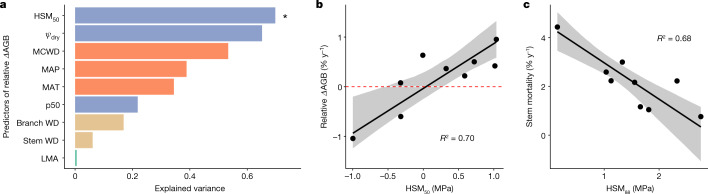
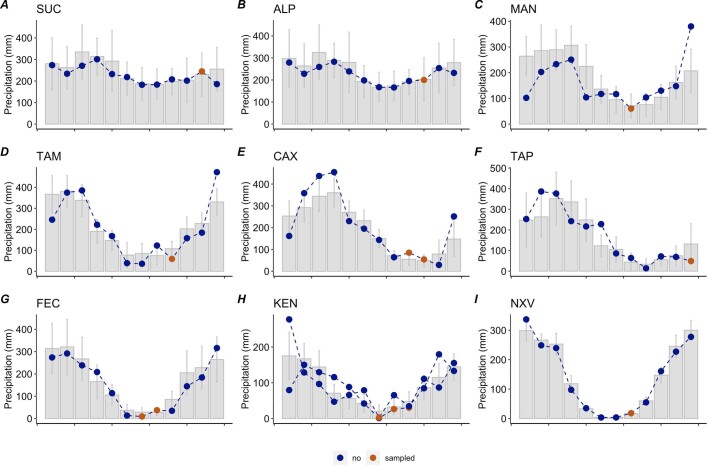
Tropical forests face increasing climate risk, yet our ability to predict their response to climate change is limited by poor understanding of their resistance to water stress. Although xylem embolism resistance thresholds (for example, [Formula: see text]) and hydraulic safety margins (for example, HSM) are important predictors of drought-induced mortality risk, little is known about how these vary across Earth's largest tropical forest. Here, we present a pan-Amazon, fully standardized hydraulic traits dataset and use it to assess regional variation in drought sensitivity and hydraulic trait ability to predict species distributions and long-term forest biomass accumulation. Parameters [Formula: see text] and HSM vary markedly across the Amazon and are related to average long-term rainfall characteristics. Both [Formula: see text] and HSM influence the biogeographical distribution of Amazon tree species. However, HSM was the only significant predictor of observed decadal-scale changes in forest biomass. Old-growth forests with wide HSM are gaining more biomass than are low HSM forests. We propose that this may be associated with a growth-mortality trade-off whereby trees in forests consisting of fast-growing species take greater hydraulic risks and face greater mortality risk. Moreover, in regions of more pronounced climatic change, we find evidence that forests are losing biomass, suggesting that species in these regions may be operating beyond their hydraulic limits. Continued climate change is likely to further reduce HSM in the Amazon, with strong implications for the Amazon carbon sink.
热带雨林面临着日益增加的气候风险,但我们预测其对气候变化的反应的能力受到对其对水分胁迫的抵抗力的理解不足的限制。尽管木质部栓塞阻力阈值(例如,[公式:见文本])和水力安全裕度(例如,HSM)是预测干旱引起的死亡率风险的重要指标,但对于这些指标如何在地球上最大的热带雨林中变化,我们知之甚少。在这里,我们提出了一个泛亚马逊,完全标准化的水力性状数据集,并使用它来评估干旱敏感性和水力性状预测物种分布和长期森林生物量积累的能力的区域变化。参数[公式:见文本]和 HSM 在整个亚马逊地区差异明显,与平均长期降雨特征有关。[公式:见文本]和 HSM 都影响亚马逊树种的生物地理分布。然而,HSM 是唯一能显著预测亚马逊森林生物量数十年尺度变化的因素。具有宽 HSM 的原始森林比低 HSM 森林获得更多的生物量。我们提出,这可能与生长-死亡率权衡有关,即由快速生长的物种组成的森林中的树木承担更大的水力风险,并面临更大的死亡率风险。此外,在气候变化更为明显的地区,我们发现证据表明森林正在失去生物量,这表明这些地区的物种可能已经超过了它们的水力极限。亚马逊地区的 HSM 可能会因持续的气候变化而进一步降低,这对亚马逊碳汇有重大影响。