Massahiro Yassue Rafael, Galli Giovanni, James Chen Chun-Peng, Fritsche-Neto Roberto, Morota Gota
Department of Genetics, 'Luiz de Queiroz' College of Agriculture University of São Paulo São Paulo Brazil.
School of Animal Sciences Virginia Polytechnic Institute and State University Blacksburg Virginia USA.
Plant Direct. 2023 Apr 24;7(4):e492. doi: 10.1002/pld3.492. eCollection 2023 Apr.
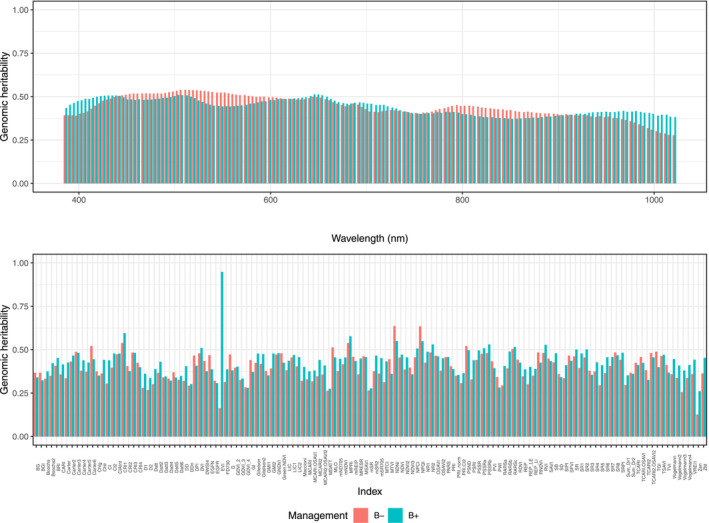
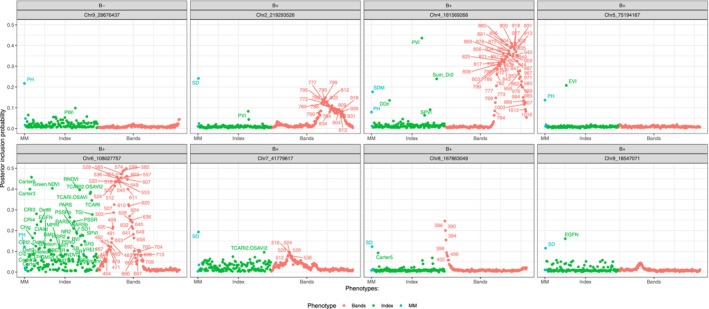
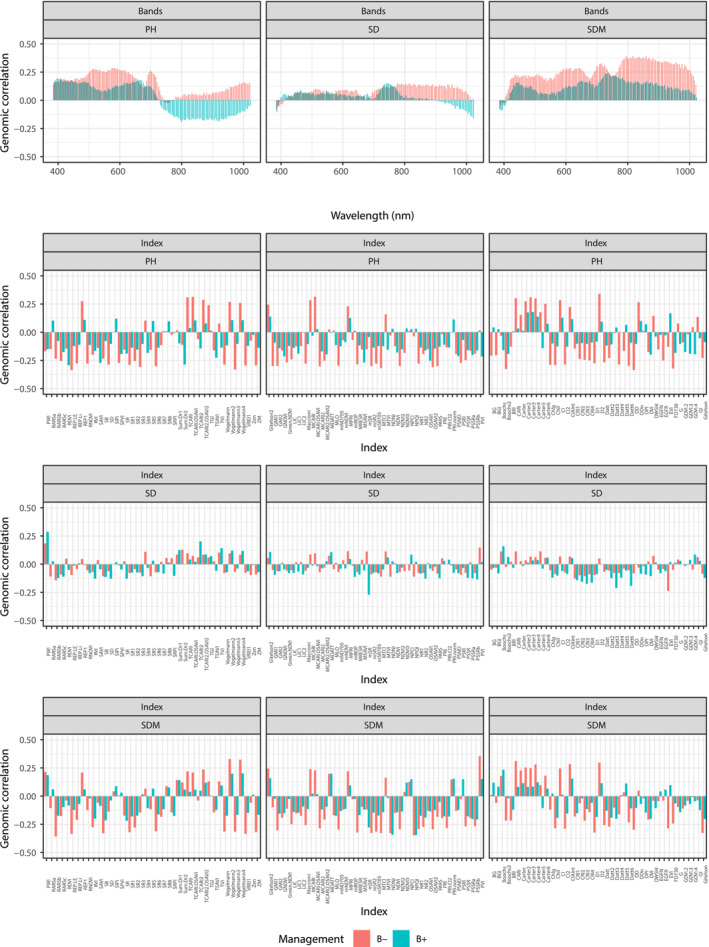
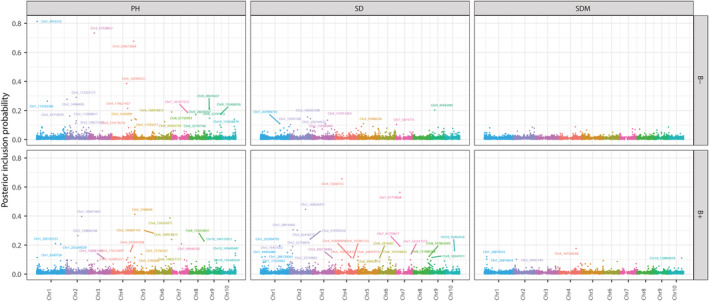
Plant growth-promoting bacteria (PGPB) may be of use for increasing crop yield and plant resilience to biotic and abiotic stressors. Using hyperspectral reflectance data to assess growth-related traits may shed light on the underlying genetics as such data can help assess biochemical and physiological traits. This study aimed to integrate hyperspectral reflectance data with genome-wide association analyses to examine maize growth-related traits under PGPB inoculation. A total of 360 inbred maize lines with 13,826 single nucleotide polymorphisms (SNPs) were evaluated with and without PGPB inoculation; 150 hyperspectral wavelength reflectances at 386-1021 nm and 131 hyperspectral indices were used in the analysis. Plant height, stalk diameter, and shoot dry mass were measured manually. Overall, hyperspectral signatures produced similar or higher genomic heritability estimates than those of manually measured phenotypes, and they were genetically correlated with manually measured phenotypes. Furthermore, several hyperspectral reflectance values and spectral indices were identified by genome-wide association analysis as potential markers for growth-related traits under PGPB inoculation. Eight SNPs were detected, which were commonly associated with manually measured and hyperspectral phenotypes. Different genomic regions were found for plant growth and hyperspectral phenotypes between with and without PGPB inoculation. Moreover, the hyperspectral phenotypes were associated with genes previously reported as candidates for nitrogen uptake efficiency, tolerance to abiotic stressors, and kernel size. In addition, a Shiny web application was developed to explore multiphenotype genome-wide association results interactively. Taken together, our results demonstrate the usefulness of hyperspectral-based phenotyping for studying maize growth-related traits in response to PGPB inoculation.
植物促生细菌(PGPB)可能有助于提高作物产量以及增强植物对生物和非生物胁迫的抵御能力。利用高光谱反射数据评估与生长相关的性状可能有助于揭示潜在的遗传学机制,因为此类数据有助于评估生化和生理性状。本研究旨在将高光谱反射数据与全基因组关联分析相结合,以研究接种PGPB条件下玉米的生长相关性状。对360个具有13826个单核苷酸多态性(SNP)的玉米自交系在接种和未接种PGPB的情况下进行了评估;分析中使用了386 - 1021 nm处的150个高光谱波长反射率和131个高光谱指数。人工测量了株高、茎直径和地上部干质量。总体而言,高光谱特征产生的基因组遗传力估计值与人工测量的表型相似或更高,并且它们与人工测量的表型存在遗传相关性。此外,通过全基因组关联分析确定了几个高光谱反射率值和光谱指数,作为接种PGPB条件下与生长相关性状的潜在标记。检测到8个SNP,它们通常与人工测量的表型和高光谱表型相关。在接种和未接种PGPB的情况下,发现了与植物生长和高光谱表型相关的不同基因组区域。此外,高光谱表型与先前报道的氮吸收效率、对非生物胁迫的耐受性和籽粒大小的候选基因相关。此外,还开发了一个Shiny网络应用程序,以交互式方式探索多表型全基因组关联结果。综上所述,我们的结果证明了基于高光谱的表型分析在研究接种PGPB后玉米生长相关性状方面的有用性。