Medical Mycology Unit, Department of Microbiology, Vallabhbhai Patel Chest Institute, University of Delhi, Delhi, India.
Department of Zoology, Ramjas College, University of Delhi, Delhi, India.
mBio. 2023 Jun 27;14(3):e0063623. doi: 10.1128/mbio.00636-23. Epub 2023 Apr 27.
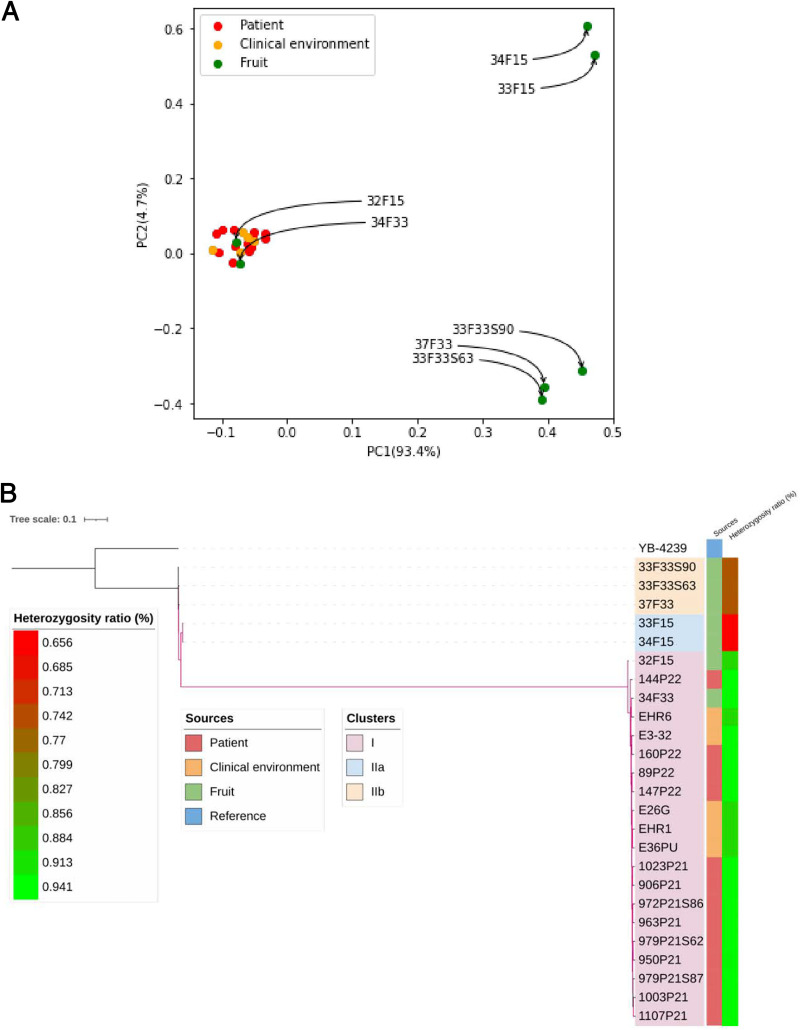
Lodderomyces elongisporus is a recently emerging yeast pathogen predominantly reported in adult patients who had immunosuppression and/or intravenous access devices. Here, we report a fungemia outbreak caused by in a neonatal intensive care unit (NICU) in Delhi, India, from September 2021 to February 2022. All 10 neonates had low birthweight, and nine of the patients survived after amphotericin B treatment. Whole-genome sequence analyses of the patient isolates as well as those from other sources in India grouped them into two clusters: one cluster consists of isolates exclusively from stored apples and the other cluster includes isolates from patients, clinical environments, and stored apples. All outbreak strains from patients were closely related to each other and showed highly similar heterozygosity patterns across all 11 major scaffolds. While overall very similar, strains from the inanimate environment of the same neonatal intensive care unit showed loss of heterozygosity at scaffold 2 (NW_001813676) compared to the patient strains. Interestingly, evidence for recombination was found in all samples. All clinical strains were susceptible to 10 tested antifungal drugs, and comparisons with strains with high fluconazole MICs derived from the surface of stored apples revealed significant genome divergence between the clinical and apple surface strains, including 119 nonsynonymous single nucleotide polymorphisms (SNPs) in 24 triazole resistance-related genes previously found in other spp. Together, our results indicate significant diversity, recombination, and persistence in the hospital setting and a high rate of evolution in this emerging yeast pathogen. was initially considered a teleomorph of Candida parapsilosis. However, DNA sequence analyses revealed it as a distinctive species. Invasive infections due to have been reported globally. We report an outbreak of fungemia due to in a NICU affecting 10 preterm, low-birthweight neonates during a period of 6 months. The outbreak investigation identified two environmental sites, the railing and the temperature panel of the neonate open care warmer, harboring . Whole-genome sequencing confirmed that the neonate isolates were closely related to each other whereas strains from the inanimate clinical environment were related to clinical strains but showed a marked loss of heterozygosity. Further, strains recovered previously from the surface of stored apples showed high fluconazole MICs and alterations in triazole resistance-related genes. Genome-wide SNP comparisons revealed recombination as an important source for genomic diversity during adaptation of to different environments.
长孢拟内孢霉是一种最近出现的酵母病原体,主要报道于存在免疫抑制和/或静脉通路装置的成年患者。在这里,我们报告了印度德里新生儿重症监护病房(NICU)发生的由引起的真菌血症爆发,时间为 2021 年 9 月至 2022 年 2 月。所有 10 名新生儿均为低出生体重儿,9 名患者在接受两性霉素 B 治疗后存活。对患者分离株以及来自印度其他来源的分离株进行全基因组序列分析,将它们分为两个聚类:一个聚类由仅来自储存苹果的分离株组成,另一个聚类包括来自患者、临床环境和储存苹果的分离株。所有来自患者的暴发株彼此之间非常密切相关,并且在所有 11 个主要支架上显示出高度相似的杂合性模式。虽然总体非常相似,但来自同一新生儿重症监护病房的非生物环境的菌株在支架 2(NW_001813676)处显示出与患者菌株相比的杂合性丢失。有趣的是,在所有样本中都发现了重组的证据。所有临床菌株对 10 种测试的抗真菌药物均敏感,并且与来自储存苹果表面的高氟康唑 MIC 菌株的比较表明,临床菌株和苹果表面菌株之间存在显著的基因组差异,包括在其他 spp 中发现的 24 个三唑耐药相关基因中的 119 个非同义单核苷酸多态性(SNP)。总之,我们的研究结果表明,在医院环境中存在显著的多样性、重组和持久性,并且这种新兴酵母病原体的进化速度很快。最初被认为是近平滑假丝酵母的有性型。然而,DNA 序列分析表明它是一个独特的种。由于引起的侵袭性感染已在全球范围内报道。我们报告了一起由引起的 NICU 真菌血症暴发,影响了 6 个月期间的 10 名早产、低出生体重的新生儿。暴发调查确定了两个环境部位,即新生儿开放式保暖器的栏杆和温度面板,均携带。全基因组测序证实,新生儿分离株彼此之间密切相关,而来自非生物临床环境的菌株与临床菌株有关,但显示出明显的杂合性丢失。此外,先前从储存苹果表面回收的菌株表现出高氟康唑 MIC 和三唑耐药相关基因的改变。全基因组 SNP 比较显示,重组是适应不同环境时基因组多样性的重要来源。