Li Wenfu, Zhang Shuai, Lin Hao, Zhang Keke, Zhang Xiaolong, Chen Jingting, Xu Fangfang, Liu Chuanxin
School of Mental Health, Jining Medical University, Jining 272067, China.
College of Chinese and Western Medicine, Jining Medical University, Jining 272067, China.
J Intell. 2023 Mar 24;11(4):58. doi: 10.3390/jintelligence11040058.
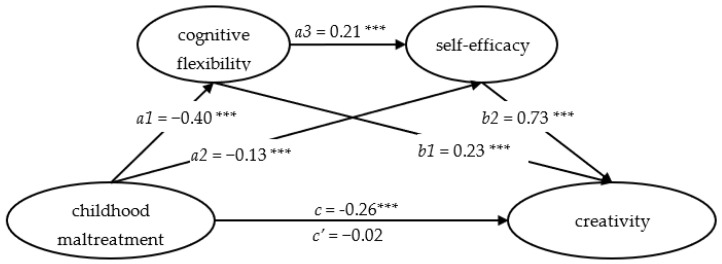
Creativity plays a very crucial impact on our cultural life and has also been important to the improvement of human civilization. Numerous studies have indicated that family circumstance plays an important role in the development of individual creativity. However, little is known about the mediating mechanisms underlying the association between childhood maltreatment and creativity. This study intended to explore the serial multiple mediation model in which undergraduates' cognitive flexibility and self-efficacy were proposed to mediate the potential influence of childhood maltreatment on their creativity. Participants were 1069 undergraduates (573 males and 496 females, mean age was 20.57 ± 1.24 years ranging from 17 to 24) from a university in Shandong Province, China. Participants were required to complete an internet survey including the Short Form of Childhood Trauma Questionnaire (CTQ-SF), General Self-Efficacy Scale (GSES), Cognitive Flexibility Inventory (CFI), and Williams Creativity Aptitude Test (WCAT). Serial multiple mediation analysis and the bootstrap method were used to investigate the mediation effects of cognitive flexibility and self-efficacy. The results showed that childhood maltreatment indirectly influenced undergraduates' creativity through three indirect paths: childhood maltreatment→cognitive flexibility→creativity, childhood maltreatment→self-efficacy→creativity, and childhood maltreatment→cognitive flexibility→self-efficacy→creativity. The ratios of the total indirect effects and branch-indirect effects to the total effects were 92.73%, 34.61%, 35.68%, and 22.44%, respectively. These results indicated that cognitive flexibility and self-efficacy could completely mediate the potential impact of childhood maltreatment on individuals creativity.
创造力对我们的文化生活有着至关重要的影响,对人类文明的进步也很重要。大量研究表明,家庭环境在个体创造力的发展中起着重要作用。然而,对于童年期受虐与创造力之间关联的中介机制却知之甚少。本研究旨在探讨一个系列多重中介模型,其中大学生的认知灵活性和自我效能被认为可以中介童年期受虐对其创造力的潜在影响。参与者是来自中国山东省一所大学的1069名本科生(573名男性和496名女性,平均年龄为20.57±1.24岁,年龄范围在17至24岁之间)。参与者被要求完成一项网络调查,包括童年创伤问卷简表(CTQ-SF)、一般自我效能量表(GSES)、认知灵活性量表(CFI)和威廉姆斯创造力能力测验(WCAT)。采用系列多重中介分析和自抽样法来研究认知灵活性和自我效能的中介作用。结果表明,童年期受虐通过三条间接路径间接影响大学生的创造力:童年期受虐→认知灵活性→创造力,童年期受虐→自我效能→创造力,以及童年期受虐→认知灵活性→自我效能→创造力。总间接效应和分支间接效应与总效应的比例分别为92.73%、34.61%、35.68%和22.44%。这些结果表明,认知灵活性和自我效能可以完全中介童年期受虐对个体创造力的潜在影响。