Santos Sarah S, Ramaldes Luana A L, Dualib Patricia M, Gabbay Monica A L, Sá João R, Dib Sergio A
Department of Medicine, Endocrinology Division, Diabetes & Endocrinology Center, Escola Paulista de Medicina, Universidade Federal de Sao Paulo, Caixa Postal 20266/CEP: 04022-001, Sao Paulo, Brazil.
Diabetol Metab Syndr. 2023 Apr 28;15(1):85. doi: 10.1186/s13098-023-01054-5.
Recurrent DKA (rDKA) remains an acute type 1 diabetes complication even in post-insulin era. This study aimed to analyze the predictors and effects of rDKA on the mortality of patients with type 1 diabetes.
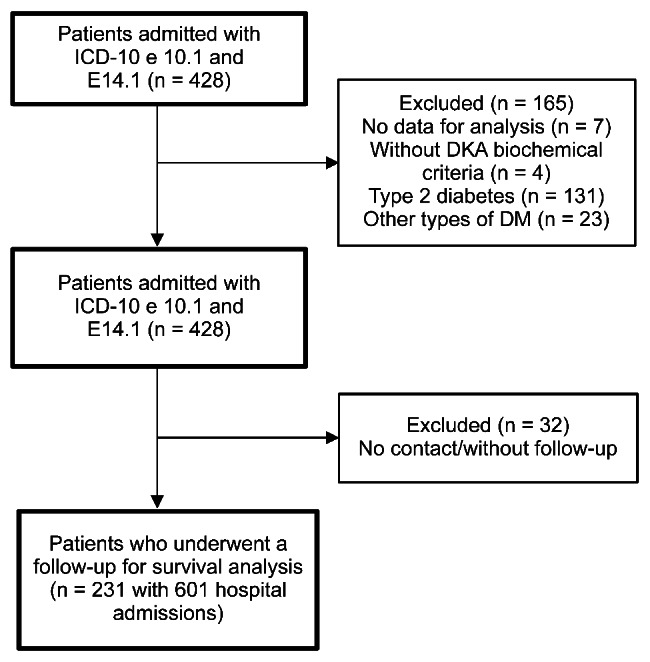
Patients hospitalized (n = 231) wih diabetic ketoacidosis (between 2007 and 2018) were included. Laboratorial and clinical variables were collected. Mortality curves were compared in four groups: diabetic ketoacidosis as a new-onset type 1 diabetes (group A), single diabetic ketoacidosis episode after diagnosis of type 1 diabetes (group B), 2-5 diabetic ketoacidosis events (group C), and > 5 diabetic ketoacidosis events during follow-up period (group D).
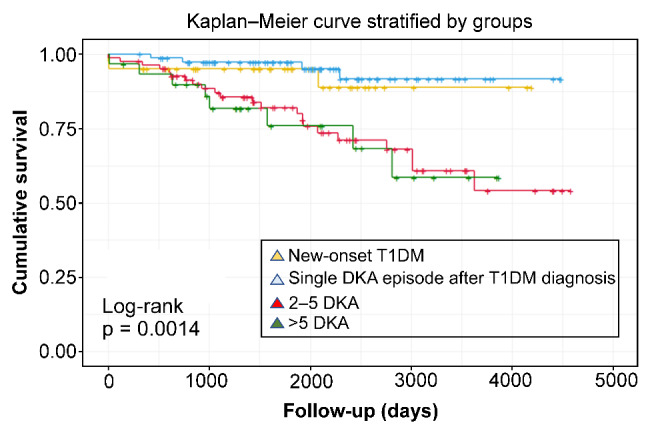
During the follow-up period (approximately 1823 days), the mortality rate was 16.02% (37/231). The median age at death was 38.7 years. In the survival curve analysis, at 1926 days (5 years), the probabilities of death were indicated by ratios of 7.78%, 4.58%, 24.40%, and 26.63% in groups A, B, C, and D, respectively. One diabetic ketoacidosis episode compared with ≥ 2 events had a relative risk of 4.49 (p = 0.004) of death and > 5 events had 5.81 (p = 0.04). Neuropathy (RR 10.04; p < 0.001), retinopathy (relative risk 7.94; p < 0.01), nephropathy (RR 7.10; p < 0.001), mood disorders (RR 3.57; p = 0.002), antidepressant use (RR 3.09; p = 0.004), and statin use (RR 2.81; p = 0.0024) increased the risk of death.
Patients with type 1 diabetes with > 2 diabetic ketoacidosis episodes have four times greater risk of death in 5 years. Microangiopathies, mood disorders, and use of antidepressants and statins were important risk factors for short-term mortality.
即使在胰岛素时代,复发性糖尿病酮症酸中毒(rDKA)仍是1型糖尿病的一种急性并发症。本研究旨在分析rDKA的预测因素及其对1型糖尿病患者死亡率的影响。
纳入2007年至2018年期间因糖尿病酮症酸中毒住院的患者(n = 231例)。收集实验室和临床变量。比较四组的死亡率曲线:糖尿病酮症酸中毒作为1型糖尿病新发(A组)、1型糖尿病诊断后单次糖尿病酮症酸中毒发作(B组)、2 - 5次糖尿病酮症酸中毒事件(C组)以及随访期间>5次糖尿病酮症酸中毒事件(D组)。
在随访期(约1823天)内,死亡率为16.02%(37/231)。死亡的中位年龄为38.7岁。在生存曲线分析中,在1926天(5年)时,A、B、C、D组的死亡概率分别为7.78%、4.58%、24.40%和26.63%。与≥2次事件相比,单次糖尿病酮症酸中毒发作的死亡相对风险为4.49(p = 0.004),>5次事件的死亡相对风险为5.81(p = 0.04)。神经病变(RR 10.04;p < 0.001)、视网膜病变(相对风险7.94;p < 0.01)、肾病(RR 7.10;p < 0.001)、情绪障碍(RR 3.57;p = 0.002)、使用抗抑郁药(RR 3.09;p = 0.004)和使用他汀类药物(RR 2.81;p = 0.0024)增加了死亡风险。
1型糖尿病患者发生>2次糖尿病酮症酸中毒发作,5年内死亡风险增加四倍。微血管病变、情绪障碍以及使用抗抑郁药和他汀类药物是短期死亡的重要危险因素。