Scarpa Fabio, Azzena Ilenia, Locci Chiara, Casu Marco, Fiori Pier Luigi, Ciccozzi Alessandra, Angeletti Silvia, Imperia Elena, Giovanetti Marta, Maruotti Antonello, Borsetti Alessandra, Cauda Roberto, Cassone Antonio, Via Allegra, Pascarella Stefano, Sanna Daria, Ciccozzi Massimo
Department of Biomedical Sciences, University of Sassari, 07100 Sassari, Italy.
Department of Veterinary Medicine, University of Sassari, 07100 Sassari, Italy.
Microorganisms. 2023 Mar 31;11(4):912. doi: 10.3390/microorganisms11040912.
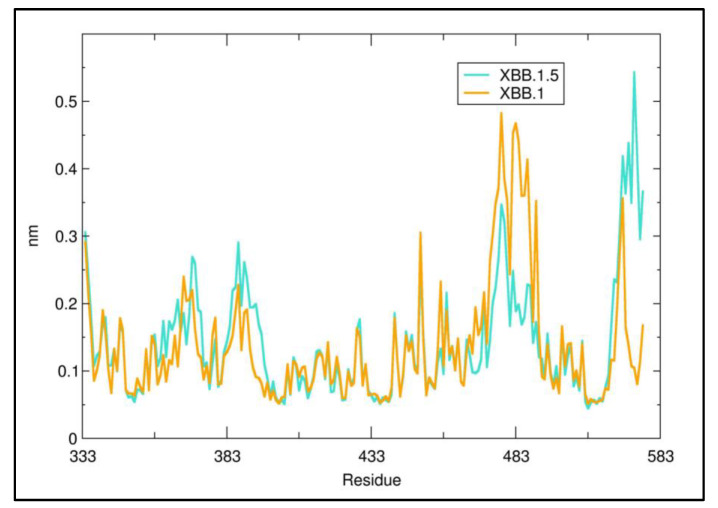
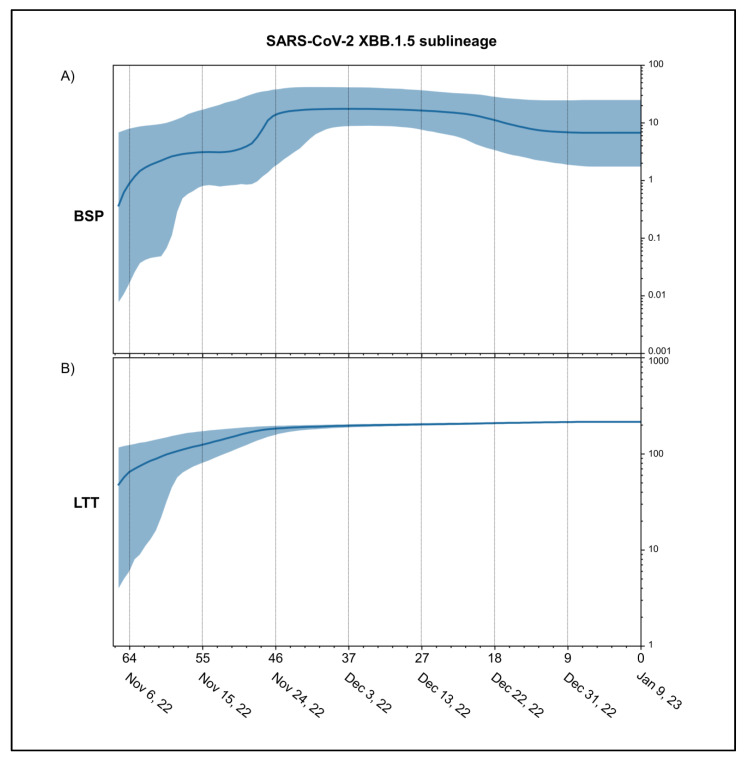
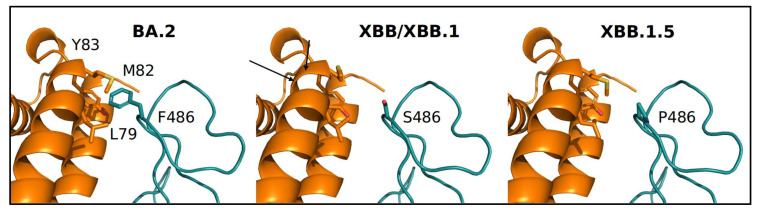
Since the beginning of the pandemic, the generation of new variants periodically recurs. The XBB.1.5 SARS-CoV-2 variant is one of the most recent. This research was aimed at verifying the potential hazard of this new subvariant. To achieve this objective, we performed a genome-based integrative approach, integrating results from genetic variability/phylodynamics with structural and immunoinformatic analyses to obtain as comprehensive a viewpoint as possible. The Bayesian Skyline Plot (BSP) shows that the viral population size reached the plateau phase on 24 November 2022, and the number of lineages peaked at the same time. The evolutionary rate is relatively low, amounting to 6.9 × 10 subs/sites/years. The NTD domain is identical for XBB.1 and XBB.1.5 whereas their RBDs only differ for the mutations at position 486, where the Phe (in the original Wuhan) is replaced by a Ser in XBB and XBB.1, and by a Pro in XBB.1.5. The variant XBB.1.5 seems to spread more slowly than sub-variants that have caused concerns in 2022. The multidisciplinary molecular in-depth analyses on XBB.1.5 performed here does not provide evidence for a particularly high risk of viral expansion. Results indicate that XBB.1.5 does not possess features to become a new, global, public health threat. As of now, in its current molecular make-up, XBB.1.5 does not represent the most dangerous variant.
自疫情开始以来,新变种的产生周期性地反复出现。XBB.1.5新冠病毒变种是最新的变种之一。本研究旨在验证这种新亚变种的潜在危害。为实现这一目标,我们采用了基于基因组的综合方法,将遗传变异性/系统发育动力学结果与结构和免疫信息学分析结果相结合,以尽可能获得全面的观点。贝叶斯天际线图(BSP)显示,病毒种群数量在2022年11月24日达到平稳期,谱系数量同时达到峰值。进化速率相对较低,为6.9×10⁻⁴个替换/位点/年。XBB.1和XBB.1.5的NTD结构域相同,而它们的RBD仅在486位的突变上有所不同,在该位置,苯丙氨酸(原始武汉株)在XBB和XBB.1中被丝氨酸取代,在XBB.1.5中被脯氨酸取代。XBB.1.5变种的传播速度似乎比2022年引起关注的亚变种更慢。此处对XBB.1.5进行的多学科分子深入分析并未提供病毒扩张特别高风险的证据。结果表明,XBB.1.5不具备成为新的全球公共卫生威胁的特征。截至目前,就其当前的分子构成而言,XBB.1.5并不代表最危险的变种。