Taylor Bryn C, Sheikh Andalibi Mohammadsobhan, Wandro Stephen, Weldon Kelly C, Sepich-Poore Gregory D, Carpenter Carolina S, Fraraccio Serena, Franklin Donald, Iudicello Jennifer E, Letendre Scott, Gianella Sara, Grant Igor, Ellis Ronald J, Heaton Robert K, Knight Rob, Swafford Austin D
Biomedical Sciences Graduate Program, University of California San Diego, San Diego, CA 92093, USA.
Departments of Neurosciences and Psychiatry, HIV Neurobehavioral Research Center, University of California, San Diego, CA 92093, USA.
Microorganisms. 2023 Apr 14;11(4):1022. doi: 10.3390/microorganisms11041022.
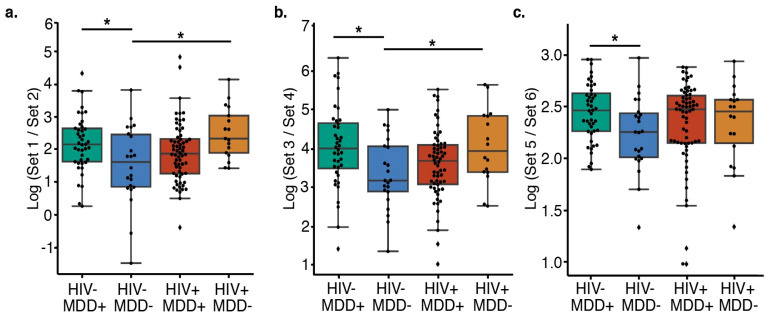
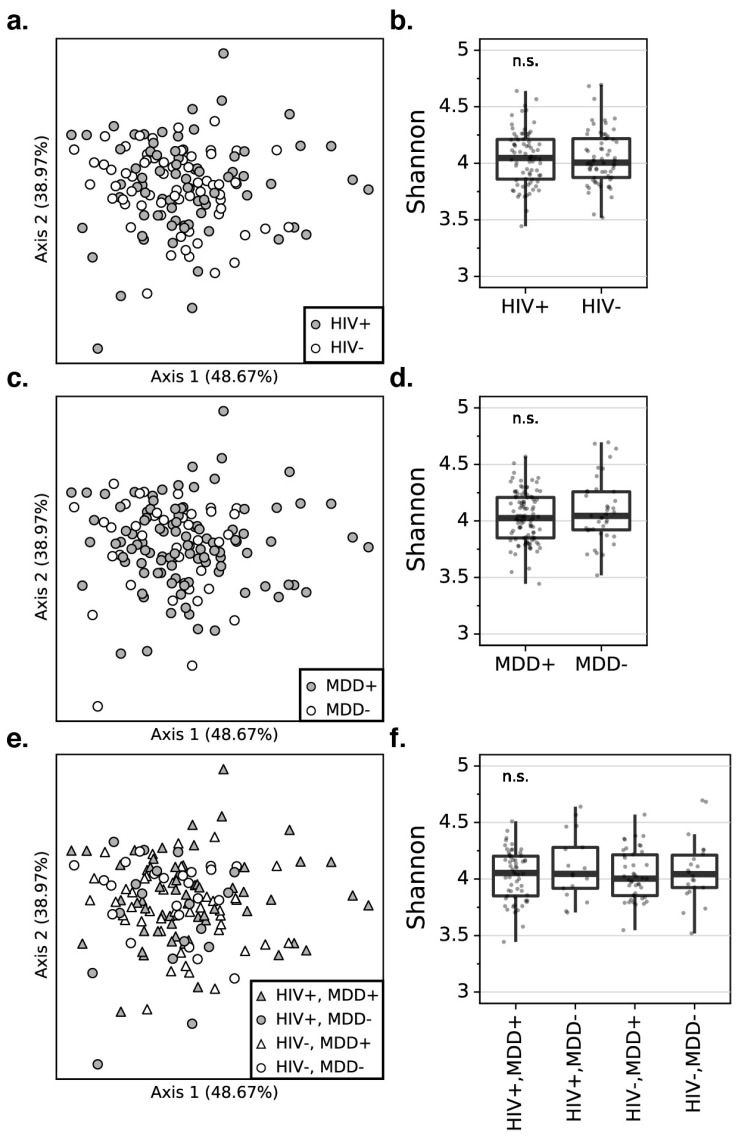
Inter-individual differences in the gut microbiome are linked to alterations in inflammation and blood-brain barrier permeability, which may increase the risk of depression in people with HIV (PWH). The microbiome profile of blood, which is considered by many to be typically sterile, remains largely unexplored. We aimed to characterize the blood plasma microbiome composition and assess its association with major depressive disorder (MDD) in PWH and people without HIV (PWoH). In this cross-sectional, observational cohort, we used shallow-shotgun metagenomic sequencing to characterize the plasma microbiome of 151 participants (84 PWH and 67 PWoH), all of whom underwent a comprehensive neuropsychiatric assessment. The microbial composition did not differ between PWH and PWoH or between participants with MDD and those without it. Using the songbird model, we computed the log ratio of the highest and lowest 30% of the ranked classes associated with HIV and MDD. We found that HIV infection and lifetime MDD were enriched in a set of differentially abundant inflammatory classes, such as Flavobacteria and Nitrospira. Our results suggest that the circulating plasma microbiome may increase the risk of MDD related to dysbiosis-induced inflammation in PWH. If confirmed, these findings may indicate new biological mechanisms that could be targeted to improve treatment of MDD in PWH.
肠道微生物群的个体差异与炎症和血脑屏障通透性的改变有关,这可能会增加艾滋病毒感染者(PWH)患抑郁症的风险。许多人认为血液的微生物群特征通常是无菌的,但在很大程度上仍未得到充分研究。我们旨在描述血浆微生物群的组成,并评估其与PWH和未感染艾滋病毒者(PWoH)的重度抑郁症(MDD)之间的关联。在这个横断面观察队列中,我们使用浅鸟枪法宏基因组测序来描述151名参与者(84名PWH和67名PWoH)的血浆微生物群,所有参与者都接受了全面的神经精神评估。PWH和PWoH之间以及患有MDD和未患MDD的参与者之间的微生物组成没有差异。使用鸣禽模型,我们计算了与艾滋病毒和MDD相关的排名类别中最高和最低30%的对数比率。我们发现,艾滋病毒感染和终生MDD在一组差异丰富的炎症类别中富集,如黄杆菌和硝化螺旋菌。我们的结果表明,循环血浆微生物群可能会增加PWH中与生态失调引起的炎症相关的MDD风险。如果得到证实,这些发现可能表明新的生物学机制,可作为改善PWH中MDD治疗的靶点。