Department of Epidemiology, Faculty of Public Health in Bytom, Medical University of Silesia in Katowice, 41-902 Bytom, Poland.
Student Scientific Society, Department of Epidemiology, Faculty of Public Health in Bytom, Medical University of Silesia in Katowice, 41-902 Bytom, Poland.
Nutrients. 2023 Apr 17;15(8):1928. doi: 10.3390/nu15081928.
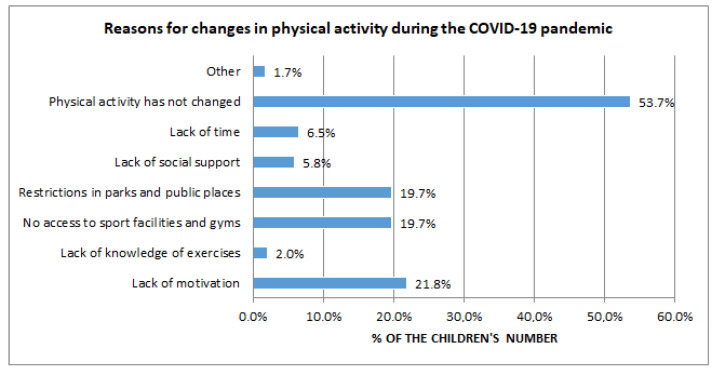
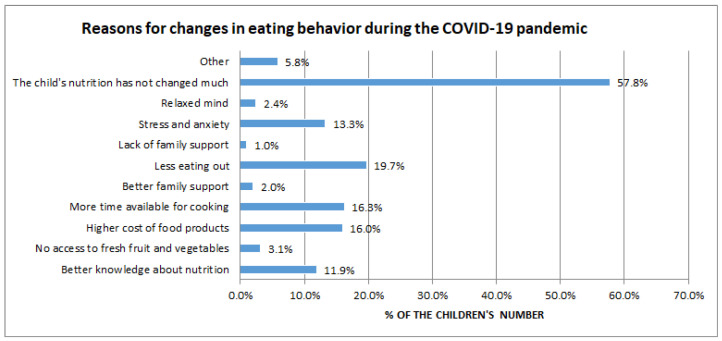
The harmful consequences of the COVID-19 pandemic on children are its impact on eating habits, physical activity, sleep, and mood disorders. In the future, this may result in a higher prevalence of obesity and diet-related diseases. Therefore, this study aimed to assess the impact of the COVID-19 pandemic on children's eating behavior and lifestyle. The study was conducted using a proprietary questionnaire on dietary and lifestyle habits before and during the pandemic, and the reasons for changes due to the pandemic. The study involved 294 parents of children in grades 1-8 in elementary schools in two regions of Poland. The survey showed that during the pandemic, the percentage of children eating five regular meals daily, including fruits and vegetables, and engaging in daily physical activity decreased. However, the percentage of children spending more than 4 h a day in front of a screen increased ( < 0.05). The main reasons for changes in eating habits and physical activity were less eating out, lack of motivation, obstruction, and lack of access to sports facilities ( < 0.05). The pandemic had a significant impact on reduced levels of physical activity and increased time spent in front of a screen. In summary, among the reasons for changes in children's dietary and lifestyle habits, factors related to the pandemic itself, i.e., social restrictions, restrictions, closure of schools and other facilities, and fear of coronavirus infection, had the greatest impact.
COVID-19 大流行对儿童的有害后果是其对饮食习惯、身体活动、睡眠和情绪障碍的影响。未来,这可能会导致肥胖症和与饮食相关的疾病更为普遍。因此,本研究旨在评估 COVID-19 大流行对儿童饮食行为和生活方式的影响。本研究使用了一份专有的问卷,调查了大流行前后儿童的饮食和生活习惯,以及因大流行而导致习惯改变的原因。研究涉及波兰两个地区小学 1-8 年级的 294 名儿童的家长。调查显示,在大流行期间,每天吃五顿常规餐(包括水果和蔬菜)并进行日常身体活动的儿童比例下降。然而,每天在屏幕前花费超过 4 小时的儿童比例增加(<0.05)。饮食习惯和身体活动变化的主要原因是外出就餐减少、缺乏动力、阻碍和缺乏体育设施(<0.05)。大流行对身体活动水平的降低和在屏幕前花费时间的增加产生了重大影响。总之,在儿童饮食和生活方式习惯变化的原因中,与大流行本身相关的因素,即社会限制、限制、学校和其他设施关闭以及对冠状病毒感染的恐惧,影响最大。