Department of Civil Engineering, The University of Texas at Arlington, Arlington, TX 76019, USA.
School of Architecture, Kyungpook National University, Daegu 37224, Republic of Korea.
Sensors (Basel). 2023 Apr 13;23(8):3947. doi: 10.3390/s23083947.
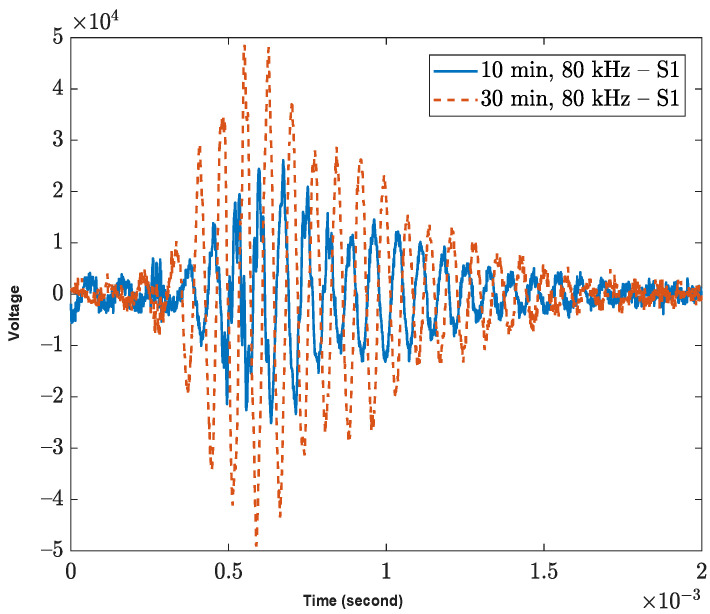
This paper aims to investigate wave dispersion behavior in the quasi-solid state of concrete to better understand microstructure hydration interactions. The quasi-solid state refers to the consistency of the mixture between the initial liquid-solid stage and the hardened stage, where the concrete has not yet fully solidified but still exhibits viscous behavior. The study seeks to enable a more accurate evaluation of the optimal time for the quasi-liquid product of concrete using both contact and noncontact sensors, as current set time measurement approaches based on group velocity may not provide a comprehensive understanding of the hydration phenomenon. To achieve this goal, the wave dispersion behavior of P-wave and surface wave with transducers and sensors is studied. The dispersion behavior with different concrete mixtures and the phase velocity comparison of dispersion behavior are investigated. The analytical solutions are used to validate the measured data. The laboratory test specimen with w/c = 0.5 was subjected to an impulse in a frequency range of 40 kHz to 150 kHz. The results demonstrate that the P-wave results exhibit well-fitted waveform trends with analytical solutions, showing a maximum phase velocity when the impulse frequency is at 50 kHz. The surface wave phase velocity shows distinct patterns at different scanning times, which is attributed to the effect of the microstructure on the wave dispersion behavior. This investigation delivers profound knowledge of hydration and quality control in the quasi-solid state of concrete with wave dispersion behavior, providing a new approach for determining the optimal time of the quasi-liquid product. The criteria and methods developed in this paper can be applied to optimal timing for additive manufacturing of concrete material for 3D printers by utilizing sensors.
本文旨在研究混凝土准固态中的波色散行为,以更好地了解微观结构水化相互作用。准固态是指初始固液阶段和硬化阶段之间的混合物的稠度,此时混凝土尚未完全凝固,但仍表现出粘性行为。该研究旨在利用接触和非接触传感器更准确地评估混凝土准液态产品的最佳时间,因为目前基于群速度的设定时间测量方法可能无法全面了解水化现象。为了实现这一目标,研究了换能器和传感器的 P 波和表面波的波色散行为。研究了不同混凝土混合物的色散行为以及色散行为的相速度比较。使用解析解验证测量数据。w/c = 0.5 的实验室试件在 40 kHz 至 150 kHz 的频率范围内受到脉冲激励。结果表明,P 波结果与解析解呈现出良好拟合的波形趋势,在脉冲频率为 50 kHz 时表现出最大相速度。表面波相速度在不同扫描时间呈现出明显的模式,这归因于微观结构对波色散行为的影响。这项研究提供了关于混凝土准固态中水化和质量控制的深入知识,为确定准液态产品的最佳时间提供了一种新方法。本文提出的标准和方法可以应用于通过传感器对混凝土材料进行 3D 打印的最佳定时的添加剂制造。