Hogan Dan, Gupta Anuradha
Gavi, The Vaccine Alliance, 1218 Le Grand-Saconnex, Switzerland.
Sabin Vaccine Institute, Washington, DC 20037, USA.
Vaccines (Basel). 2023 Mar 31;11(4):781. doi: 10.3390/vaccines11040781.
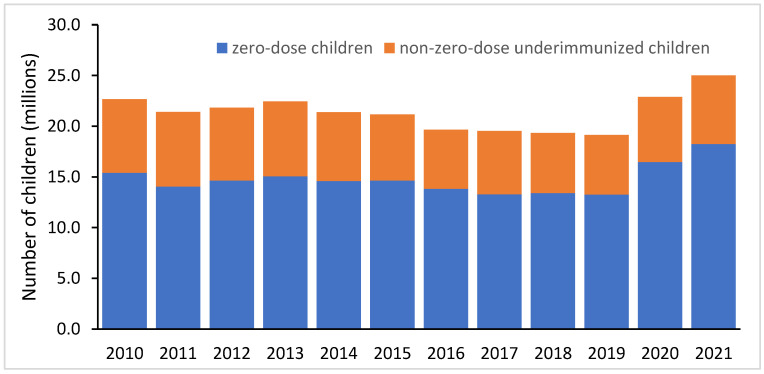
Immunization has one of the highest coverage levels of any health intervention, yet there remain zero-dose children, defined as those who do not receive any routine immunizations. There were 18.2 million zero-dose children in 2021, and as they accounted for over 70% of all underimmunized children, reaching zero-dose children will be essential to meeting ambitious immunization coverage targets by 2030. While certain geographic locations, such as urban slum, remote rural, and conflict-affected settings, may place a child at higher risk of being zero-dose, zero-dose children are found in many places, and understanding the social, political, and economic barriers they face will be key to designing sustainable programs to reach them. This includes gender-related barriers to immunization and, in some countries, barriers related to ethnicity and religion, as well as the unique challenges associated with reaching nomadic, displaced, or migrant populations. Zero-dose children and their families face multiple deprivations related to wealth, education, water and sanitation, nutrition, and access to other health services, and they account for one-third of all child deaths in low- and middle-income countries. Reaching zero-dose children and missed communities is therefore critical to achieving the Sustainable Development Goals commitment to "leave no one behind".
免疫接种是所有卫生干预措施中覆盖率最高的措施之一,但仍存在零剂次儿童,即那些未接受任何常规免疫接种的儿童。2021年有1820万零剂次儿童,由于他们占所有未充分免疫儿童的70%以上,因此接触到零剂次儿童对于在2030年前实现宏伟的免疫接种覆盖率目标至关重要。虽然某些地理位置,如城市贫民窟、偏远农村和受冲突影响地区,可能会使儿童面临更高的零剂次风险,但在许多地方都能发现零剂次儿童,了解他们面临的社会、政治和经济障碍将是设计可持续项目以接触到他们的关键。这包括与免疫接种相关的性别障碍,以及在一些国家与种族和宗教相关的障碍,还有接触游牧、流离失所或移民人口所面临的独特挑战。零剂次儿童及其家庭在财富、教育、水和卫生设施、营养以及获得其他卫生服务方面面临多重匮乏,他们占低收入和中等收入国家所有儿童死亡人数的三分之一。因此,接触到零剂次儿童和未覆盖社区对于实现“不让任何一个人掉队”的可持续发展目标承诺至关重要。