Department of Thoracic Medical Oncology, Fudan University Shanghai Cancer Center, Shanghai, 200032, China.
Department of Oncology, Shanghai Medical College, Fudan University, No. 270, Dong'an Road, Shanghai, 20032, China.
J Cancer Res Clin Oncol. 2023 Sep;149(11):8663-8671. doi: 10.1007/s00432-023-04806-y. Epub 2023 Apr 28.
Thoracic SMARCA4-deficient undifferentiated tumor (SD-UT) is a highly aggressive disease that is nosologically related to but distinct from SMARCA4-deficient non-small cell lung cancer (SD-NSCLC). No standard treatment guidelines were established for SD-UT. This research explored the efficacy of different treatments in SD-UT, and the prognostic, clinicopathologic and genomic difference between SD-UT and SD-NSCLC.
Information of 25 SD-UT and 22 SD-NSCLC patients diagnosed and treated in Fudan University Shanghai Cancer Center from January, 2017 to September, 2022 was analyzed.
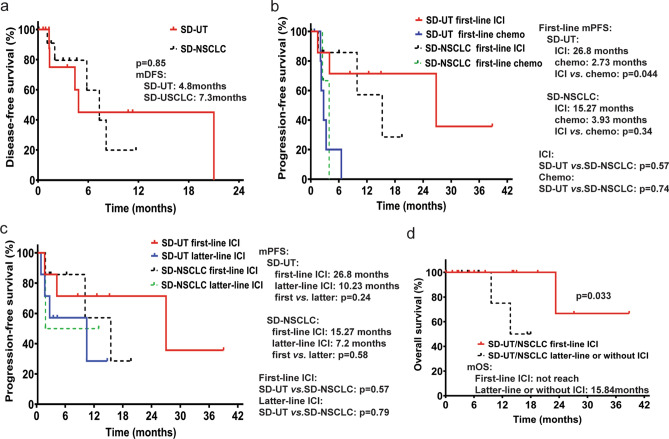
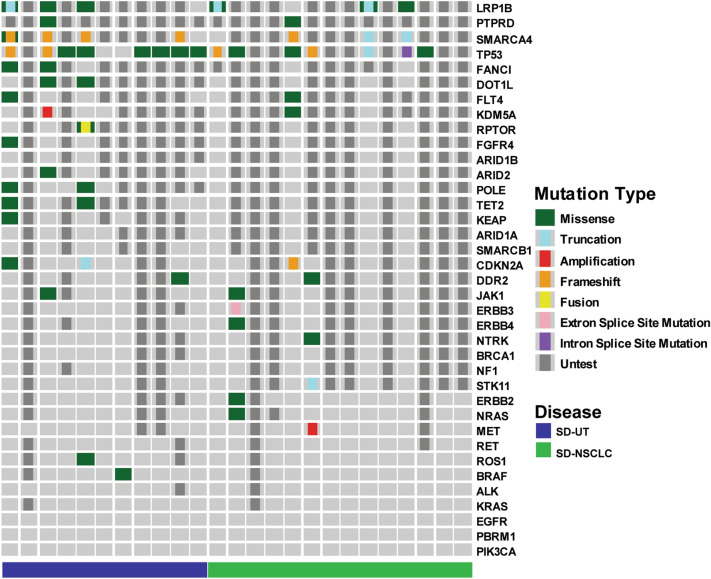
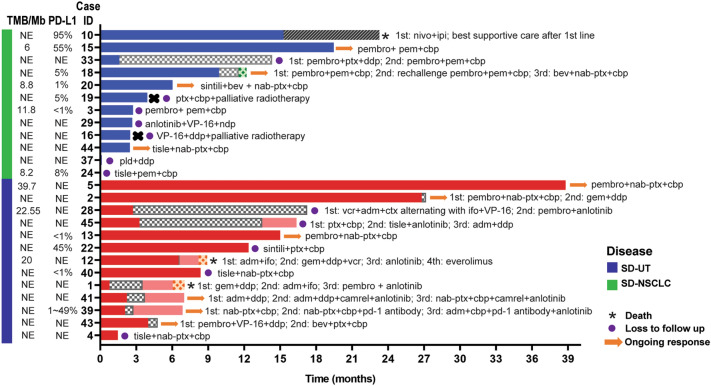
SD-UT was similar to SD-NSCLC in characteristics of onset age, male prevalence, heavy smoking history and metastatic pattern. SD-UT showed a rapid relapse pattern after radical therapy. For Stage IV SD-UT patients, immune checkpoint inhibitor (ICI) plus chemotherapy significantly improved median progression-free survival (PFS) compared to traditional chemotherapy as first-line treatment (26.8 vs. 2.73 months, p = 0.0437), while objective response rates of two arms were comparable (71.4% vs. 66.7%). No significant survival differences were observed between SD-UT and SD-NSCLC under similar treatment settings. SD-UT or SD-NSCLC patients receiving ICI in the first line had significantly prolonged OS than those with ICI in the latter lines or without ICI treatment throughout clinical courses. Genetic study found frequent SMARCA4, TP53 and LRP1B mutations in SD-UT.
To the best of our knowledge, this is the largest series to date to compare the efficacy of ICI-based treatment to chemotherapy and document frequent mutations of LRP1B in SD-UT. ICI plus chemotherapy is an effective strategy for Stage IV SD-UT.
胸段 SMARCA4 缺陷未分化肿瘤(SD-UT)是一种高度侵袭性疾病,其在病理学上与 SMARCA4 缺陷非小细胞肺癌(SD-NSCLC)相关,但又与之不同。目前尚未为 SD-UT 制定标准的治疗指南。本研究旨在探讨不同治疗方法在 SD-UT 中的疗效,并比较 SD-UT 和 SD-NSCLC 之间的预后、临床病理和基因组差异。
回顾性分析 2017 年 1 月至 2022 年 9 月在复旦大学附属肿瘤医院诊断和治疗的 25 例 SD-UT 和 22 例 SD-NSCLC 患者的资料。
SD-UT 在发病年龄、男性患病率、大量吸烟史和转移模式方面与 SD-NSCLC 相似。根治性治疗后 SD-UT 复发迅速。对于 IV 期 SD-UT 患者,与传统化疗作为一线治疗相比,免疫检查点抑制剂(ICI)联合化疗显著改善了中位无进展生存期(PFS)(26.8 与 2.73 个月,p=0.0437),但两组的客观缓解率相当(71.4%与 66.7%)。在相似的治疗方案下,SD-UT 和 SD-NSCLC 的生存差异无统计学意义。SD-UT 或 SD-NSCLC 患者一线接受 ICI 治疗的总生存期(OS)明显长于后续线接受 ICI 或全程未接受 ICI 治疗的患者。遗传学研究发现,SD-UT 中频繁出现 SMARCA4、TP53 和 LRP1B 突变。
据我们所知,这是迄今为止比较 ICI 为基础的治疗与化疗疗效并记录 SD-UT 中频繁发生的 LRP1B 突变的最大系列研究。ICI 联合化疗是治疗 IV 期 SD-UT 的有效策略。