Corda Pedro O, Moreira Jéssica, Howl John, Oliveira Pedro F, Fardilha Margarida, Silva Joana Vieira
Institute of Biomedicine (iBiMED), Department of Medical Sciences, University of Aveiro, Aveiro, Portugal.
Research Institute in Healthcare Science, University of Wolverhampton, Wolverhampton, UK.
World J Mens Health. 2024 Jan;42(1):71-91. doi: 10.5534/wjmh.220262. Epub 2023 Apr 20.
The advent of proteomics provides new opportunities to investigate the molecular mechanisms underlying male infertility. The selection of relevant targets based on a single analysis is not always feasible, due to the growing number of proteomic studies with conflicting results. Thus, this study aimed to systematically review investigations comparing the sperm proteome of normozoospermic and infertile men to define a panel of proteins with the potential to be used to evaluate sperm quality.
A literature search was conducted on PubMed, Web of Science, and Scopus databases following the PRISMA guidelines. To identify proteins systematically reported, first the studies were divided by condition into four groups (asthenozoospermia, low motility, unexplained infertility, and infertility related to risk factors) and then, all studies were analysed simultaneously (poor sperm quality). To gain molecular insights regarding identified proteins, additional searches were performed within the Human Protein Atlas, Mouse Genome Informatics, UniProt, and PubMed databases.
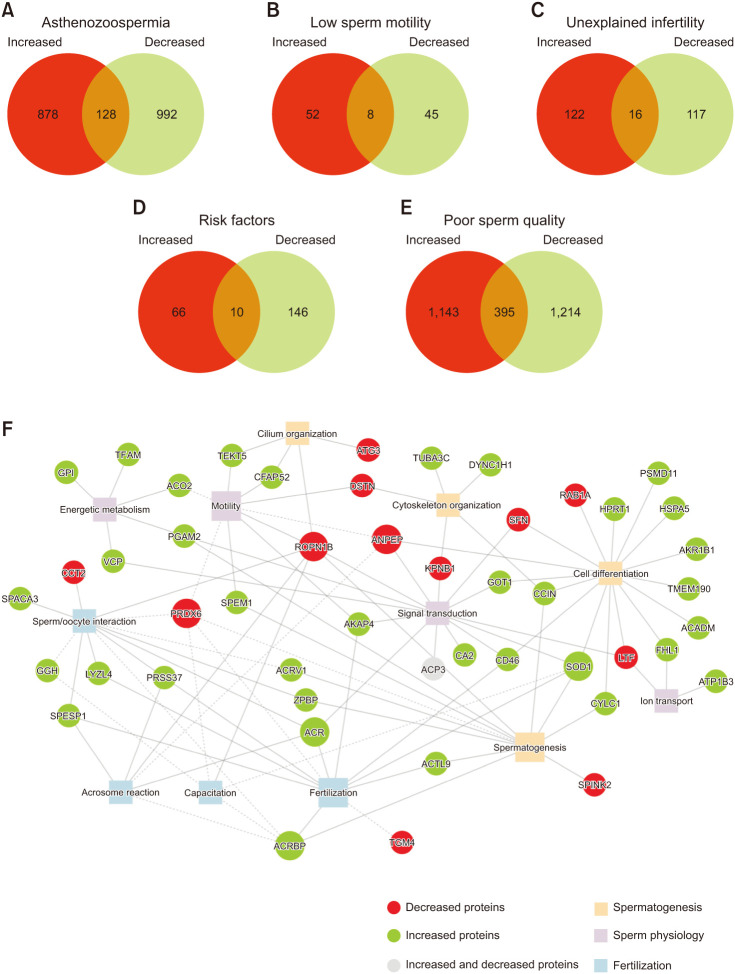
Thirty-two studies were included and divided into 4 sub-analysis groups. A total of 2752 proteins were collected, of which 38, 1, 3 and 2 were indicated as potential markers for asthenozoospermia, low motility, unexplained infertility and infertility related to risk factors, respectively, and 58 for poor sperm quality. Among the identified proteins, ACR, ACRBP, ACRV1, ACTL9, AKAP4, ATG3, CCT2, CFAP276, CFAP52, FAM209A, GGH, HPRT1, LYZL4, PRDX6, PRSS37, REEP6, ROPN1B, SPACA3, SOD1, SPEM1, SPESP1, SPINK2, TEKT5, and ZPBP were highlighted due to their roles in male reproductive tissues, association with infertility phenotypes or participation in specific biological functions in spermatozoa.
Sperm proteomics allows the identification of protein markers with the potential to overcome limitations in male infertility diagnosis and to understand changes in sperm function at the molecular level. This study provides a reliable list of systematically reported proteins that could be potential targets for further basic and clinical studies.
蛋白质组学的出现为研究男性不育的分子机制提供了新的机会。由于蛋白质组学研究数量不断增加且结果相互矛盾,仅基于单一分析来选择相关靶点并不总是可行的。因此,本研究旨在系统回顾比较正常精子症男性和不育男性精子蛋白质组的研究,以确定一组有潜力用于评估精子质量的蛋白质。
按照PRISMA指南在PubMed、科学网和Scopus数据库中进行文献检索。为了系统地识别所报道的蛋白质,首先将研究按情况分为四组(弱精子症、低活力、不明原因不育和与危险因素相关的不育),然后对所有研究进行综合分析(精子质量差)。为了深入了解已识别蛋白质的分子情况,在人类蛋白质图谱、小鼠基因组信息学、UniProt和PubMed数据库中进行了额外的检索。
纳入32项研究并分为4个亚分析组。共收集到2752种蛋白质,其中分别有38种、1种、3种和2种被指明为弱精子症、低活力、不明原因不育和与危险因素相关的不育的潜在标志物,58种为精子质量差的潜在标志物。在所识别的蛋白质中,ACR、ACRBP、ACRV1、ACTL9、AKAP4、ATG3、CCT2、CFAP276、CFAP52、FAM209A、GGH、HPRT1、LYZL4、PRDX6、PRSS37、REEP6、ROPN1B、SPACA3、SOD1、SPEM1、SPESP1、SPINK2、TEKT5和ZPBP因其在男性生殖组织中的作用、与不育表型的关联或参与精子的特定生物学功能而受到关注。
精子蛋白质组学能够识别有潜力克服男性不育诊断局限性并在分子水平上理解精子功能变化的蛋白质标志物。本研究提供了一份系统报道的可靠蛋白质清单,这些蛋白质可能是进一步基础和临床研究的潜在靶点。