Beg Mohd Amin, Ismail Abrar Osama, Alaiya Ayodele, Khan Firdous Ahmad, Hamoda Taha Abo-Almagd Abdel-Meguid, Sheikh Ishfaq Ahmad, Sharma Priyanka, Baothman Omar Mohammed, Alkhzaim Ali Hasan, Shinwari Zakia, Abuzinadah Rinad Fahad, Mohammed Arif, Assiri Abdullah Mohammed, Abuzenadah Adel Mohammad, Memili Erdogan, Feugang Jean Magloire
King Fahd Medical Research Center, King Abdulaziz University, Jeddah 21589, Saudi Arabia.
Biomedical Sciences, Clinical Embryology and Reproductive Biology, College of Medicine, Alfaisal University, Riyadh 11533, Saudi Arabia.
Int J Mol Sci. 2025 Jun 25;26(13):6099. doi: 10.3390/ijms26136099.
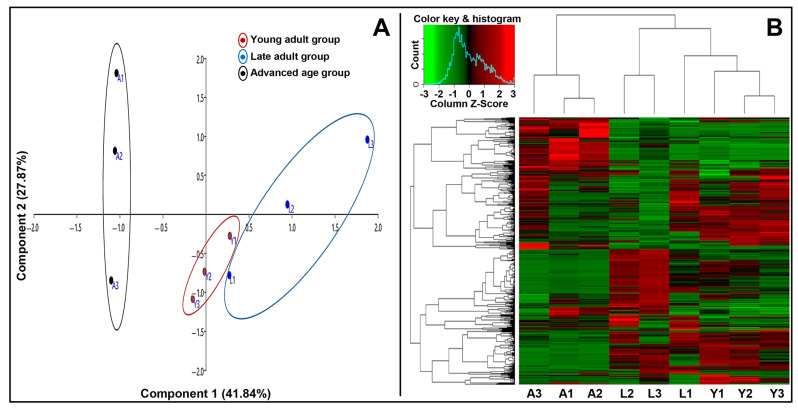
Advancing age in men significantly contributes to declining sperm fertility. Information on age-related proteomic changes in spermatozoa is limited. This study involved normal fertile Arab men in three age groups: young adult (21-30 years; = 6), late adult (31-40 years; = 7), and advanced age (40-51 years; = 5). Gradient-purified spermatozoa were analyzed using LC-MS/MS and proteomic data were processed using Progenesis QI (QIfp) v3.0 and UniProt/SwissProt. Significantly enriched annotations and clustering of proteins in the proteomic datasets were identified (2-fold change; < 0.05). A total of 588 proteins were identified, with 93% shared across the three groups. Unique proteins were MYLK4 for the young adult group, PRSS57 for the late adult group, and HMGB4, KRT4, LPGAT1, OXCT2, and MGRN1 for the advanced age group. Furthermore, 261 (44%) proteins were differentially expressed ( < 0.05) across the three groups. Functional enrichment analysis suggested an aging-related significant increase in pathways associated with neurodegenerative diseases and protein folding, alongside decreases in glycolysis/gluconeogenesis, flagellated sperm motility, acetylation, phosphoprotein modifications, oxidation processes, and Ubl conjugation. Cluster analysis highlighted significantly upregulated proteins in young adults (e.g., H2BC1, LAP3, SQLE, LTF, PDIA4, DYNLT2) and late adults (e.g., ATP5F1B, ODF2, TUBA3C, ENO1, SPO11, TEX45, TEKT3), whereas most proteins in the advanced age group exhibited downregulation (e.g., SPESP1, RAB10, SEPTIN4, RAB15, PTPN7, USP5, ANXA1, PRDX1). In conclusion, this study revealed aging-associated proteomic changes in spermatozoa that impact critical processes, including spermatogenesis, motility, metabolism, and fertilization, potentially contributing to fertility decline. These changes provide a molecular framework for developing therapies to preserve sperm proteostasis and enhance fertility in older men.
男性年龄增长会显著导致精子生育能力下降。关于精子中与年龄相关的蛋白质组变化的信息有限。本研究纳入了三个年龄组的正常生育能力的阿拉伯男性:青年成年人(21 - 30岁;n = 6)、中年成年人(31 - 40岁;n = 7)和老年(40 - 51岁;n = 5)。使用液相色谱 - 串联质谱法(LC - MS/MS)分析梯度纯化的精子,并使用Progenesis QI(QIfp)v3.0和UniProt/SwissProt处理蛋白质组数据。鉴定了蛋白质组数据集中蛋白质的显著富集注释和聚类(2倍变化;P < 0.05)。总共鉴定出588种蛋白质,其中93%在三组中共享。青年成年人组的独特蛋白质是MYLK4,中年成年人组是PRSS57,老年组是HMGB4、KRT4、LPGAT1、OXCT2和MGRN1。此外,261种(44%)蛋白质在三组中差异表达(P < 0.05)。功能富集分析表明,与神经退行性疾病和蛋白质折叠相关的通路在衰老过程中显著增加,同时糖酵解/糖异生、有鞭毛精子运动、乙酰化、磷酸化蛋白修饰、氧化过程和泛素样蛋白缀合减少。聚类分析突出了青年成年人(如H2BC1、LAP3、SQLE、LTF、PDIA4、DYNLT2)和中年成年人(如ATP5F1B、ODF2、TUBA3C、ENO1、SPO11、TEX45、TEKT3)中显著上调的蛋白质,而老年组中的大多数蛋白质表现出下调(如SPESP1、RAB10、SEPTIN4、RAB15、PTPN7、USP5、ANXA1、PRDX1)。总之,本研究揭示了精子中与衰老相关的蛋白质组变化,这些变化影响包括精子发生、运动、代谢和受精在内的关键过程,可能导致生育能力下降。这些变化为开发维持精子蛋白质稳态和提高老年男性生育能力的治疗方法提供了分子框架。