Department of Animal Sciences, Faculty of Biological Sciences, Quaid-i-Azam University Islamabad, Islamabad, Pakistan.
Department of Reproductive Health Sciences, Salma and Kafeel Medical Centre, Islamabad, Pakistan.
Front Endocrinol (Lausanne). 2023 Apr 14;14:1092603. doi: 10.3389/fendo.2023.1092603. eCollection 2023.
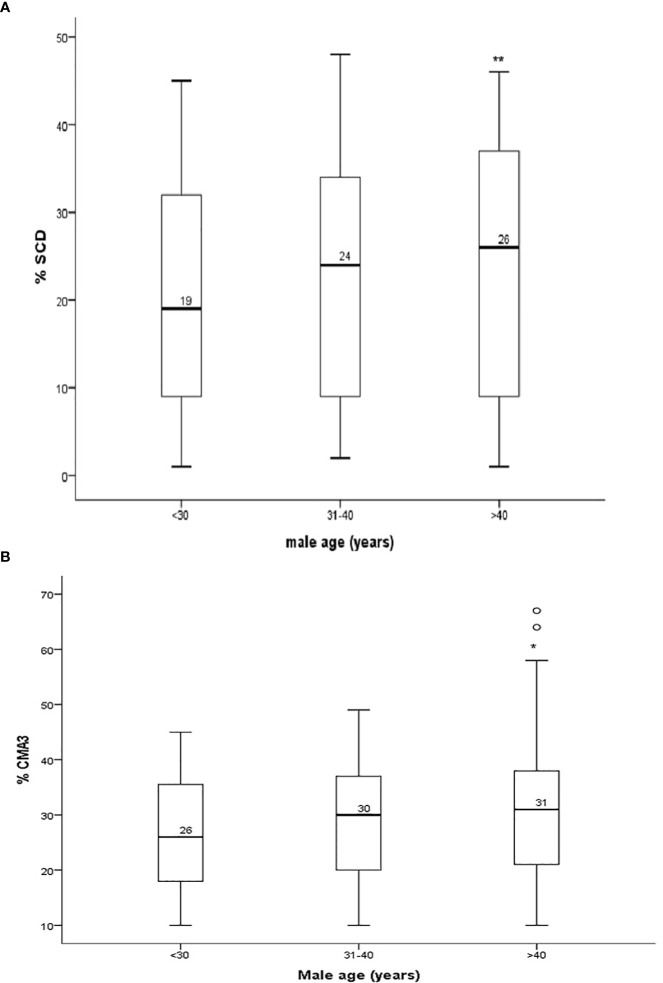
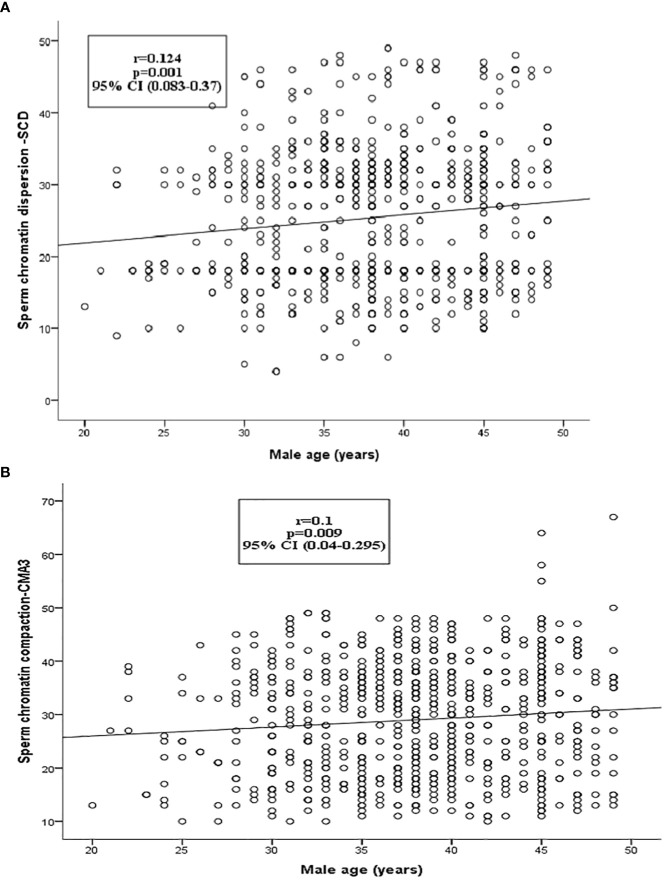
In this study, the semen parameters, sperm chromatin integrity, antioxidant enzyme levels, and reproductive hormone levels of subfertile male subjects from Pakistan were assessed in relation to their age. Data on the demographic characteristics of the 750 study participants, including their general health, body mass index (BMI), and reproductive status, were collected from subfertile men from Pakistan. Semen and blood were collected to determine standard semen parameters, sperm chromatin dispersion (Halosperm-SCD), sperm chromatin integrity using toluidine blue (TB) staining, sperm chromatin maturity using chromomycin A3 (CMA3+) staining, and reproductive hormone (FSH, LH, prolactin and testosterone levels). The patients were divided into three groups according to their age: Group 1 included male subjects aged 30 years or less ( = 90), Group 2 included male subjects between the ages of 31 and 40 years ( = 330), and Group 3 included male subjects over 40 years of age ( = 330). Conventional semen parameters, reactive oxygen species (ROS), superoxide dismutase (SOD), guaiacol peroxidase (GPX), catalase (CAT), and lipid peroxidation (MDA) did not statistically ( > 0.05) differ with increasing male age or between different age groups. When compared to younger men (<30 years), sperm SCD (23.2 ± 0.88%) was significantly ( = 0.01) lower as compared to male patients aged >40 years (26.6 ± 0.6%). The concentration of LH, FSH, and testosterone levels were comparable between the groups ( > 0.05), while a significant ( = 0.04) increase in sperm chromatin immaturity CMA3+ (30 ± 0.71%) was observed in the old age group (>40 years) compared to the <30-year group (26.6 ± 1.03%). A positive association was observed between advanced male age and sperm chromatin dispersion (SCD) ( = 0.124, = 0.001) and decondensation (CMA3+) ( = 0.1, = 0.009). Despite potential limitations, this study has been carried out with extensive information on the potential risk of male age on sperm integrity. The present study demonstrated the impact of male age on male reproductive health, as these patients had a higher percentage of sperm chromatin damage (SCD) in their semen. Sperm DNA damage assessment will help in the evaluation and diagnosis of the underlying cause of poor fertility and can help clinicians in selecting the right treatment options. Male age is one of the factors that have an impact on the decline in male fertility. As a result, it is preferable for patients receiving assisted reproductive technology to be younger.
在这项研究中,评估了来自巴基斯坦的不育男性受试者的精液参数、精子染色质完整性、抗氧化酶水平和生殖激素水平与其年龄的关系。研究人员从巴基斯坦的不育男性中收集了 750 名研究参与者的人口统计学特征数据,包括他们的一般健康状况、体重指数(BMI)和生殖状况。采集精液和血液以确定标准精液参数、精子染色质分散(Halosperm-SCD)、使用甲苯胺蓝(TB)染色的精子染色质完整性、使用色霉素 A3(CMA3+)染色的精子染色质成熟度以及生殖激素(FSH、LH、催乳素和睾酮水平)。根据年龄将患者分为三组:第 1 组包括 30 岁或以下的男性受试者(=90),第 2 组包括 31 至 40 岁之间的男性受试者(=330),第 3 组包括 40 岁以上的男性受试者(=330)。随着男性年龄的增加或在不同年龄组之间,常规精液参数、活性氧(ROS)、超氧化物歧化酶(SOD)、愈创木酚过氧化物酶(GPX)、过氧化氢酶(CAT)和脂质过氧化(MDA)没有统计学意义(>0.05)差异。与年轻男性(<30 岁)相比,精子 SCD(23.2±0.88%)显著降低(=0.01),而年龄>40 岁的男性患者 SCD(26.6±0.6%)显著升高。各组之间 LH、FSH 和睾酮水平无差异(>0.05),而年龄较大组(>40 岁)精子染色质不成熟 CMA3+(30±0.71%)显著升高(=0.04)与<30 岁组(26.6±1.03%)相比。随着男性年龄的增加,精子染色质分散(SCD)(=0.124,=0.001)和去凝聚(CMA3+)(=0.1,=0.009)呈正相关。尽管存在潜在的局限性,但本研究对男性年龄对精子完整性的潜在风险进行了广泛的信息评估。本研究表明,男性年龄对男性生殖健康有影响,因为这些患者的精液中精子染色质损伤(SCD)的百分比更高。精子 DNA 损伤评估有助于评估和诊断不良生育力的潜在原因,并有助于临床医生选择正确的治疗方案。男性年龄是影响男性生育力下降的因素之一。因此,接受辅助生殖技术的患者最好年轻一些。