School of Medicine, Department of Medicine, Division of Hematology/Oncology, University of Pittsburgh, Pittsburgh, PA, USA.
UPMC Hillman Cancer Center, 5114 Centre Ave, Pittsburgh, PA, 15232, USA.
Cancer Causes Control. 2023 Jul;34(7):595-609. doi: 10.1007/s10552-023-01696-w. Epub 2023 May 2.
Disparities in cancer care persist between patients living in rural versus urban areas. The COVID-19 pandemic may have impacted concerns related to care and personal health differently in rural cancer patients. Using survey data collected from cancer patients in western Pennsylvania, we examined pandemic-related distress, concerns related to cancer care, impact on personal health, and the extent to which these differed by urban-rural residence.
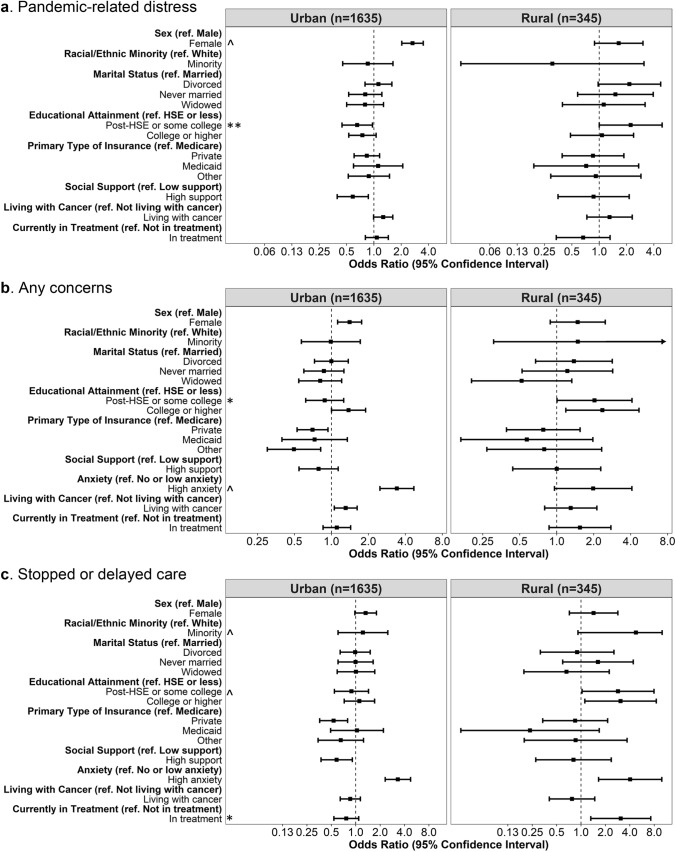
Patients filled out an initial survey in August-December 2020; a second survey was completed in March 2021. The following patient concerns related to the pandemic were evaluated: threat of COVID-19 to their health, pandemic-related distress, perceptions of cancer care, and vaccine hesitancy. Multivariable logistic regression models were used to examine relationships between these outcomes and urban-rural residence as well as patient-related factors, including anxiety symptoms and social support.
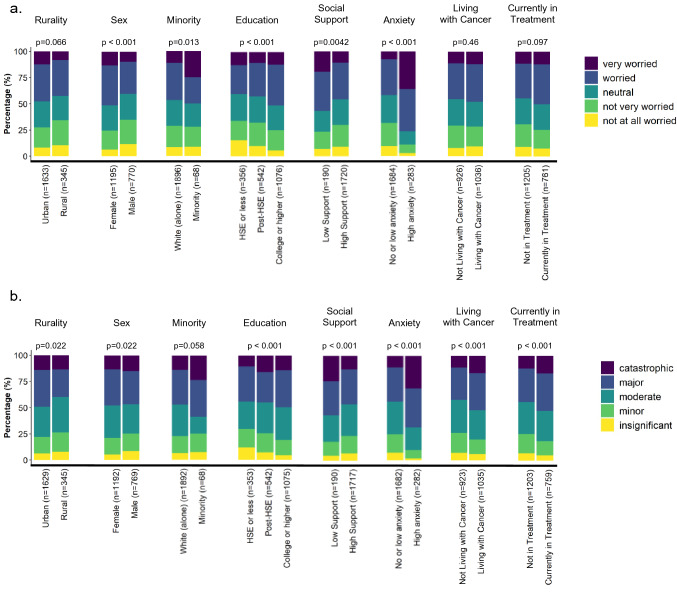
The study sample included 1,980 patients, 17% resided in rural areas. COVID-19 represented a major or catastrophic threat to personal health for 39.7% of rural and 49.0% of urban patients (p = 0.0017). Patients with high general anxiety were 10-times more likely to experience pandemic-related distress (p < 0.001). In the follow-up survey (n = 983), vaccine hesitancy was twice as prevalent among rural patients compared to urban (p = 0.012).
The extent to which perceptions of the threat of COVD-19 to personal health and vaccine hesitancy exacerbates rural-urban disparities in cancer care and prognosis warrants further study. Cancer patients may be vulnerable to heightened anxiety and distress triggered by the pandemic.
城乡癌症患者的医疗服务存在差异。COVID-19 大流行可能对农村癌症患者的医疗保健和个人健康问题产生不同的影响。本研究利用来自宾夕法尼亚州西部癌症患者的调查数据,研究了与大流行相关的痛苦、与癌症护理相关的担忧、对个人健康的影响,以及这些担忧在城乡居住者之间的差异。
患者在 2020 年 8 月至 12 月期间填写了初始调查;2021 年 3 月完成了第二次调查。评估了与大流行相关的以下患者关注问题:COVID-19 对他们健康的威胁、与大流行相关的痛苦、对癌症护理的看法以及疫苗犹豫。使用多变量逻辑回归模型检查这些结果与城乡居住以及患者相关因素(包括焦虑症状和社会支持)之间的关系。
研究样本包括 1980 名患者,其中 17%居住在农村地区。39.7%的农村患者和 49.0%的城市患者认为 COVID-19 对个人健康构成重大或灾难性威胁(p=0.0017)。一般焦虑程度高的患者经历与大流行相关的痛苦的可能性是一般焦虑程度低的患者的 10 倍(p<0.001)。在后续调查(n=983)中,农村患者的疫苗犹豫程度是城市患者的两倍(p=0.012)。
对 COVID-19 对个人健康的威胁和疫苗犹豫程度的看法加剧了癌症护理和预后的城乡差异,这值得进一步研究。癌症患者可能容易受到大流行引发的焦虑和痛苦的影响。