Health Campus The Hague/Department of Public Health and Primary Care, Leiden University Medical Center, The Hague, The Netherlands
Health, Medical and Neuropsychology unit, Department of Psychology, Leiden University, Leiden, Netherlands.
BMJ Open. 2023 May 2;13(5):e066183. doi: 10.1136/bmjopen-2022-066183.
The present study aimed to early identify patients with persistent somatic symptoms (PSS) in primary care by exploring routine care data-based approaches.
DESIGN/SETTING: A cohort study based on routine primary care data from 76 general practices in the Netherlands was executed for predictive modelling.
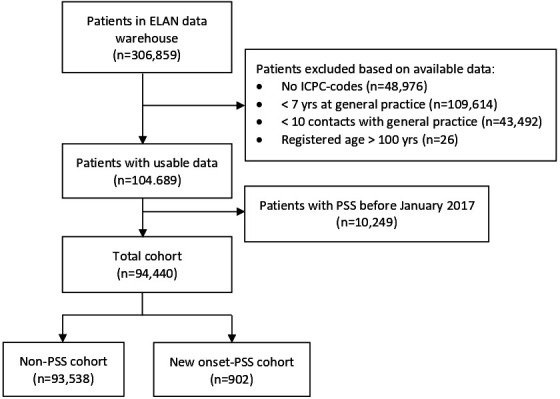
Inclusion of 94 440 adult patients was based on: at least 7-year general practice enrolment, having more than one symptom/disease registration and >10 consultations.
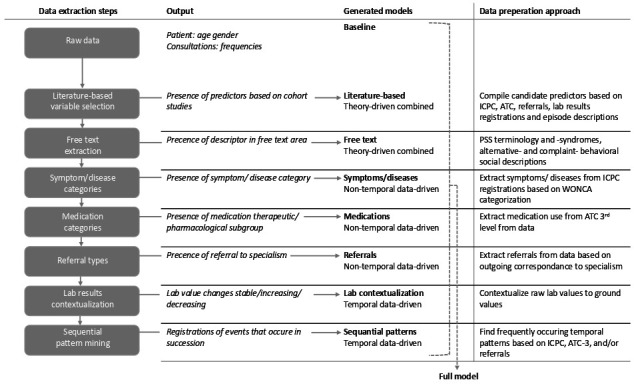
Cases were selected based on the first PSS registration in 2017-2018. Candidate predictors were selected 2-5 years prior to PSS and categorised into data-driven approaches: symptoms/diseases, medications, referrals, sequential patterns and changing lab results; and theory-driven approaches: constructed factors based on literature and terminology in free text. Of these, 12 candidate predictor categories were formed and used to develop prediction models by cross-validated least absolute shrinkage and selection operator regression on 80% of the dataset. Derived models were internally validated on the remaining 20% of the dataset.
All models had comparable predictive values (area under the receiver operating characteristic curves=0.70 to 0.72). Predictors are related to genital complaints, specific symptoms (eg, digestive, fatigue and mood), healthcare utilisation, and number of complaints. Most fruitful predictor categories are literature-based and medications. Predictors often had overlapping constructs, such as digestive symptoms (symptom/disease codes) and drugs for anti-constipation (medication codes), indicating that registration is inconsistent between general practitioners (GPs).
The findings indicate low to moderate diagnostic accuracy for early identification of PSS based on routine primary care data. Nonetheless, simple clinical decision rules based on structured symptom/disease or medication codes could possibly be an efficient way to support GPs in identifying patients at risk of PSS. A full data-based prediction currently appears to be hampered by inconsistent and missing registrations. Future research on predictive modelling of PSS using routine care data should focus on data enrichment or free-text mining to overcome inconsistent registrations and improve predictive accuracy.
本研究旨在通过探索基于常规医疗数据的方法,早期识别初级保健中持续性躯体症状(PSS)患者。
设计/设置:本研究基于荷兰 76 家普通诊所的常规初级保健数据进行了队列研究,以进行预测建模。
纳入了 94440 名成年患者,纳入标准为:至少有 7 年的普通诊所登记记录、有超过一种症状/疾病登记和>10 次就诊。
根据 2017-2018 年首次出现 PSS 登记情况选择病例。候选预测因子在出现 PSS 前 2-5 年选择,并分为数据驱动方法:症状/疾病、药物、转诊、序列模式和变化的实验室结果;以及理论驱动方法:基于文献和自由文本中的术语构建的因素。其中,形成了 12 种候选预测因子类别,并使用交叉验证最小绝对收缩和选择算子回归方法在数据集的 80%上开发预测模型。剩余的 20%数据集用于模型的内部验证。
所有模型的预测值都具有可比性(接收者操作特征曲线下面积=0.70 至 0.72)。预测因子与生殖器投诉、特定症状(如消化、疲劳和情绪)、医疗保健利用和投诉数量有关。最有成效的预测因子类别是基于文献和药物。预测因子通常具有重叠的结构,例如消化症状(症状/疾病代码)和抗便秘药物(药物代码),这表明全科医生之间的登记不一致。
基于常规初级保健数据,本研究结果表明早期识别 PSS 的诊断准确性较低,处于中等水平。尽管如此,基于结构化症状/疾病或药物代码的简单临床决策规则可能是一种有效的方法,有助于全科医生识别有患 PSS 风险的患者。目前,基于全数据的预测似乎因登记不一致和缺失而受到阻碍。未来使用常规护理数据进行 PSS 预测模型的研究应集中在数据丰富或自由文本挖掘上,以克服不一致的登记并提高预测准确性。