Biomedical Sciences Graduate Program, University of California, San Diego, La Jolla, CA 92093, USA; Department of Cellular and Molecular Medicine, University of California, San Diego, La Jolla, CA 92093, USA; Ludwig Institute for Cancer Research, La Jolla, CA 92093, USA.
Department of Cellular and Molecular Medicine, University of California, San Diego, La Jolla, CA 92093, USA; Ludwig Institute for Cancer Research, La Jolla, CA 92093, USA.
Curr Biol. 2023 Jun 5;33(11):2291-2299.e10. doi: 10.1016/j.cub.2023.04.021. Epub 2023 May 2.
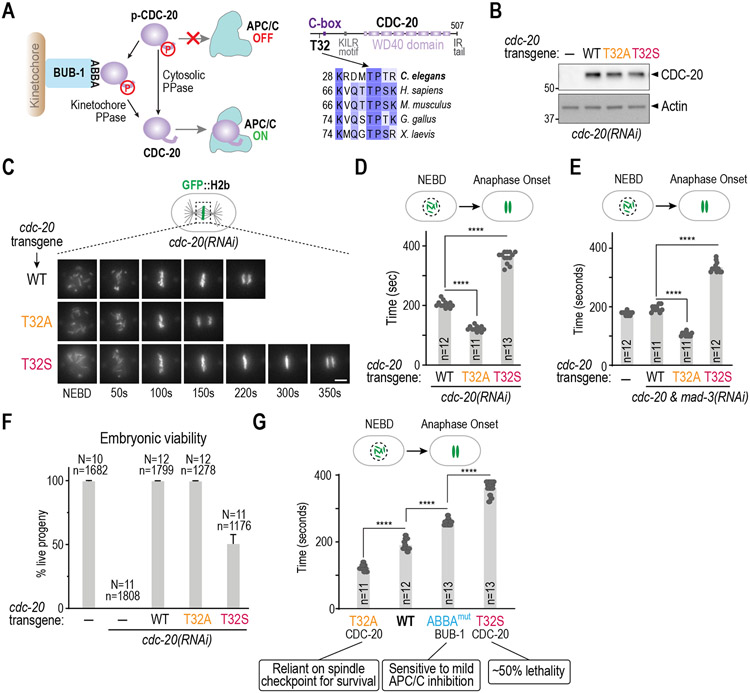
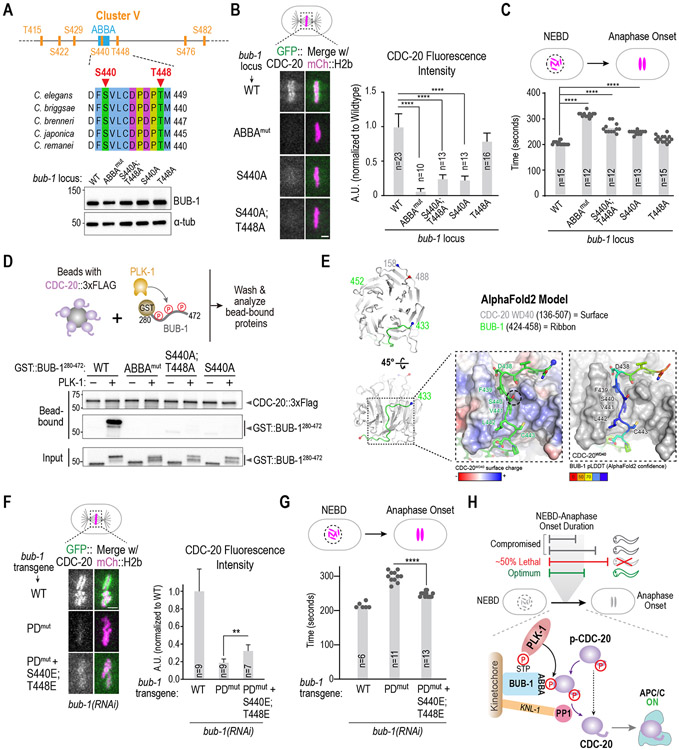
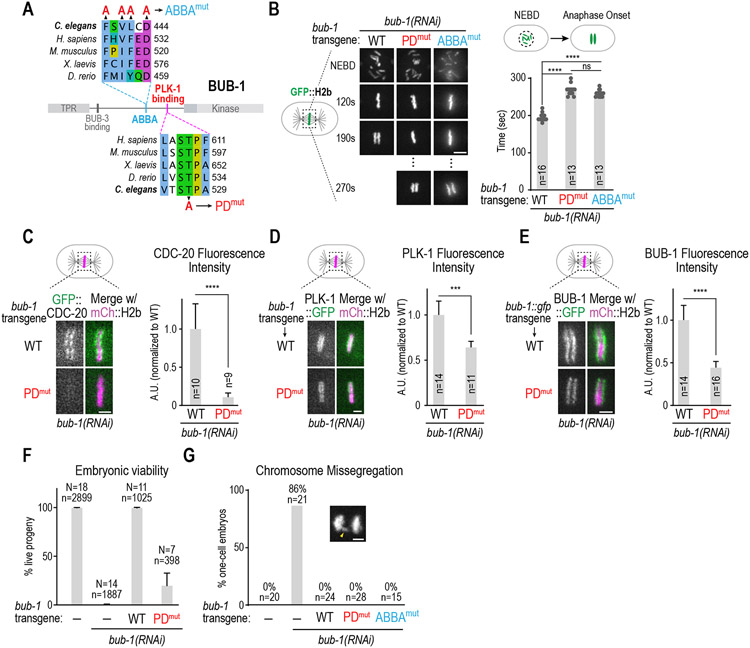
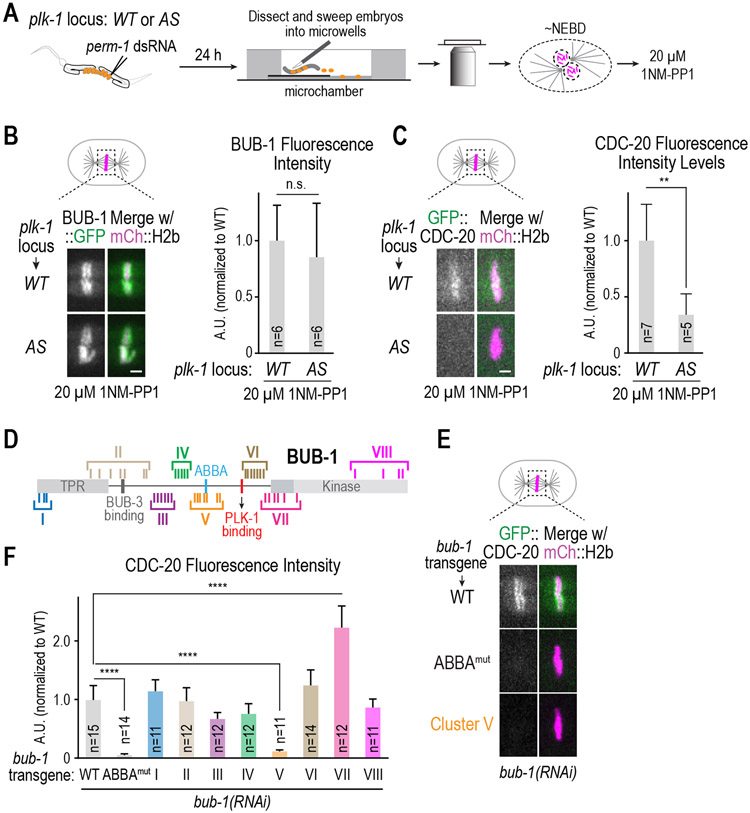
During mitosis, chromosomes assemble kinetochores to dynamically couple with spindle microtubules. Kinetochores also function as signaling hubs directing mitotic progression by recruiting and controlling the fate of the anaphase promoting complex/cyclosome (APC/C) activator CDC-20. Kinetochores either incorporate CDC-20 into checkpoint complexes that inhibit the APC/C or dephosphorylate CDC-20, which allows it to interact with and activate the APC/C. The importance of these two CDC-20 fates likely depends on the biological context. In human somatic cells, the major mechanism controlling mitotic progression is the spindle checkpoint. By contrast, progression through mitosis during the cell cycles of early embryos is largely checkpoint independent. Here, we first show that CDC-20 phosphoregulation controls mitotic duration in the C. elegans embryo and defines a checkpoint-independent temporal mitotic optimum for robust embryogenesis. CDC-20 phosphoregulation occurs at kinetochores and in the cytosol. At kinetochores, the flux of CDC-20 for local dephosphorylation requires an ABBA motif on BUB-1 that directly interfaces with the structured WD40 domain of CDC-20. We next show that a conserved "STP" motif in BUB-1 that docks the mitotic kinase PLK-1 is necessary for CDC-20 kinetochore recruitment and timely mitotic progression. The kinase activity of PLK-1 is required for CDC-20 to localize to kinetochores and phosphorylates the CDC-20-binding ABBA motif of BUB-1 to promote BUB-1-CDC-20 interaction and mitotic progression. Thus, the BUB-1-bound pool of PLK-1 ensures timely mitosis during embryonic cell cycles by promoting CDC-20 recruitment to the vicinity of kinetochore-localized phosphatase activity.
在有丝分裂过程中,染色体组装动粒以动态方式与纺锤体微管结合。动粒还作为信号中心,通过招募和控制后期促进复合物/环体(APC/C)激活因子 CDC-20 的命运来指导有丝分裂进程。动粒将 CDC-20 纳入检查点复合物以抑制 APC/C,或去磷酸化 CDC-20,使其能够与 APC/C 相互作用并激活 APC/C。这两种 CDC-20 命运的重要性可能取决于生物学背景。在人类体细胞中,控制有丝分裂进程的主要机制是纺锤体检查点。相比之下,早期胚胎细胞周期中的有丝分裂进程在很大程度上不受检查点的影响。在这里,我们首先表明,CDC-20 的磷酸化调节控制着秀丽隐杆线虫胚胎的有丝分裂持续时间,并定义了一个与检查点无关的时间性有丝分裂最优期,以实现稳健的胚胎发生。CDC-20 的磷酸化调节发生在动粒和细胞质中。在动粒处,CDC-20 的局部去磷酸化通量需要 BUB-1 上的 ABBA 基序,该基序直接与 CDC-20 的结构化 WD40 结构域相互作用。我们接下来表明,BUB-1 中的保守“STP”基序与有丝分裂激酶 PLK-1 对接,对于 CDC-20 动粒募集和适时有丝分裂进展是必需的。PLK-1 的激酶活性对于 CDC-20 定位到动粒并磷酸化 BUB-1 的 CDC-20 结合 ABBA 基序以促进 BUB-1-CDC-20 相互作用和有丝分裂进展是必需的。因此,BUB-1 结合的 PLK-1 池通过促进 CDC-20 募集到靠近动粒定位的磷酸酶活性附近,确保了胚胎细胞周期中的适时有丝分裂。