Zeng Georgia, Koffas Apostolos, Mak Lung-Yi, Gill Upkar S, Kennedy Patrick T F
Faculty of Medicine, St Vincent's Clinical School, University of New South Wales, Sydney, Australia.
Barts Liver Centre, Blizard Institute, Barts and The London School of Medicine and Dentistry, Queen Mary University of London, London, UK.
JHEP Rep. 2023 Mar 8;5(6):100720. doi: 10.1016/j.jhepr.2023.100720. eCollection 2023 Jun.
BACKGROUND & AIMS: Antivirals represent the mainstay of chronic hepatitis B treatment given their efficacy and tolerability, but rates of functional cure remain low during long-term therapy. Treatment discontinuation has emerged as a strategy to maintain partial cure and achieve functional cure in select patient groups. We aimed to evaluate how data from treatment discontinuation studies exploring novel viral and/or immune markers could be applied to the functional cure program.
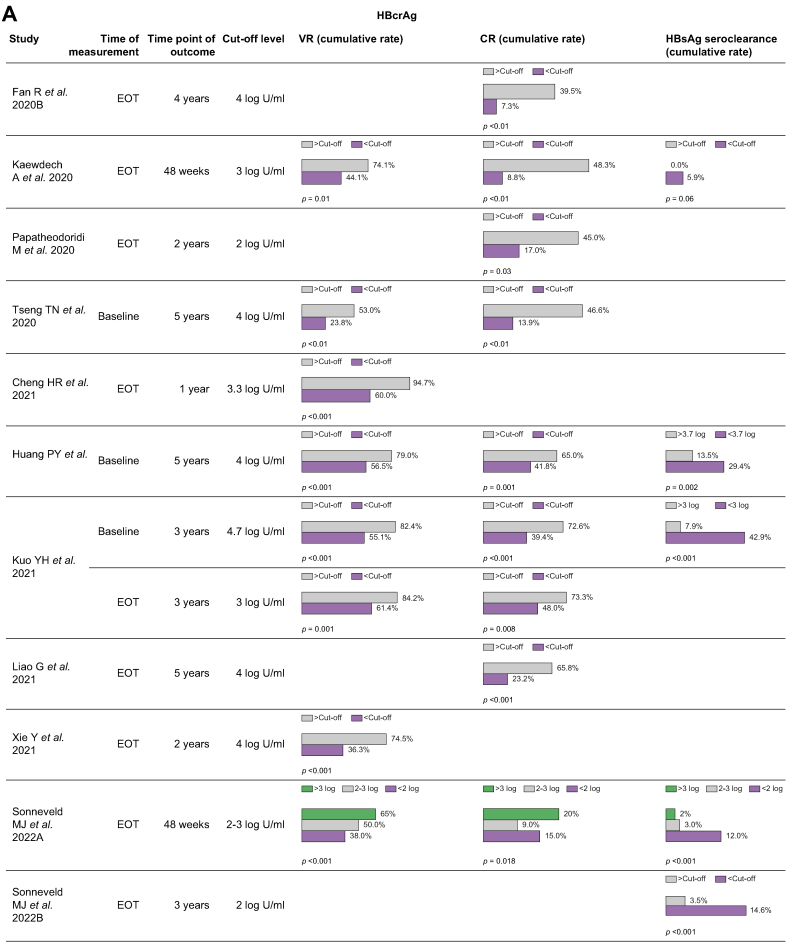
Treatment discontinuation studies evaluating novel viral and/or immune markers were identified by a systematic search of the PubMed database through to October 30, 2022. Data extraction focused on information regarding novel markers, including identified cut-off levels, timing of measurement, and associated effect on study outcomes of virological relapse, clinical relapse, and HBsAg seroclearance.
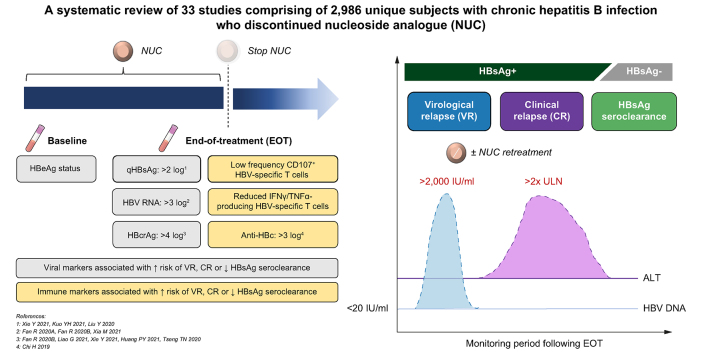
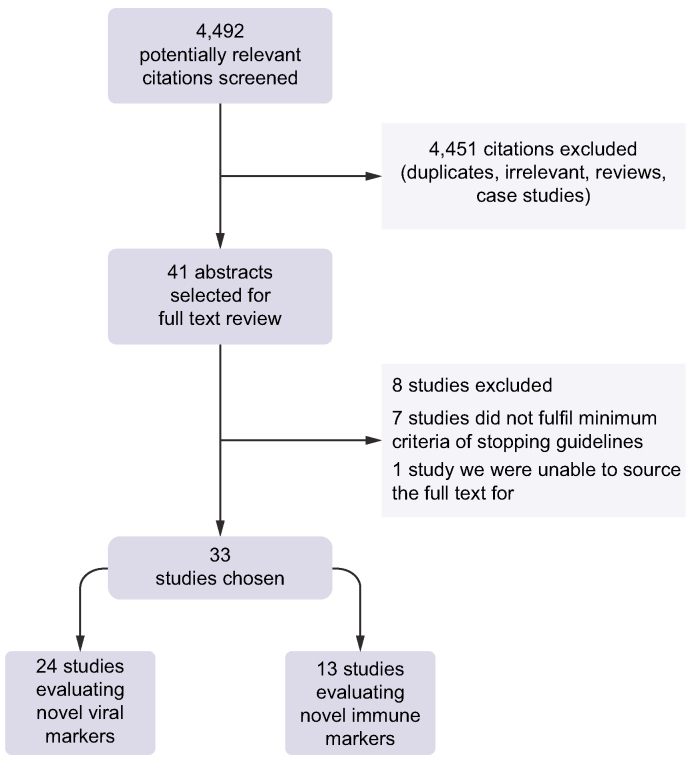
From a search of 4,492 citations, 33 studies comprising a minimum of 2,986 unique patients met the inclusion criteria. Novel viral markers, HBcrAg and HBV RNA, were demonstrated across most studies to be helpful in predicting off-therapy partial cure, with emerging evidence to support a link with functional cure. From novel immune marker studies, we observed that treatment discontinuation has the potential to trigger immune restoration, which may be associated with a transient virological relapse. To this end, these studies support the combination of virus-directing agents with immunomodulator therapies to induce two key steps underlying functional cure: viral antigen load reduction and restoration of the host immune response.
Patients with a favourable profile of novel viral and immune markers stand to benefit from a trial of antiviral treatment discontinuation alongside novel virus-directing agents with the aim of achieving functional cure without excessive risk of severe clinical relapse.
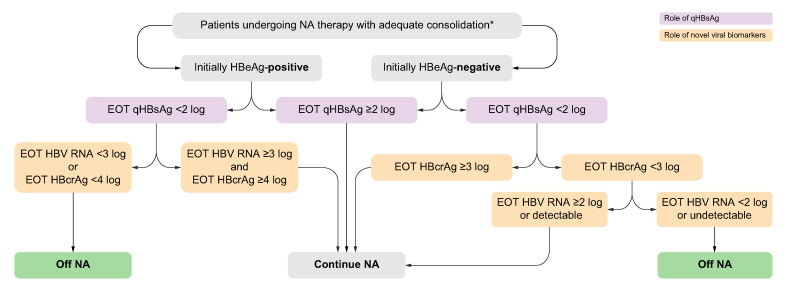
Select patients with chronic hepatitis B undergoing nucleoside analogue therapy may benefit from a trial of treatment discontinuation, aiming to maintain partial cure and/or achieve functional cure. We propose a profile of novel viral and immune markers to identify patients who are likely to achieve these goals without excessive risk of hepatic decompensation. Furthermore, treatment discontinuation may also be considered as a therapeutic strategy to trigger immune restoration, which may increase the chance of functional cure when used in conjunction with novel virus-directing agents.
鉴于抗病毒药物的疗效和耐受性,其是慢性乙型肝炎治疗的主要手段,但长期治疗期间功能性治愈的比例仍然较低。停药已成为一种在特定患者群体中维持部分治愈并实现功能性治愈的策略。我们旨在评估探索新型病毒和/或免疫标志物的停药研究数据如何应用于功能性治愈计划。
通过系统检索截至2022年10月30日的PubMed数据库,确定评估新型病毒和/或免疫标志物的停药研究。数据提取集中在有关新型标志物的信息上,包括确定的临界值水平、测量时间以及对病毒学复发、临床复发和HBsAg血清清除等研究结果的相关影响。
在检索的4492篇文献中,33项研究(至少包括2986名独特患者)符合纳入标准。大多数研究表明,新型病毒标志物HBcrAg和HBV RNA有助于预测停药后的部分治愈,并有新证据支持其与功能性治愈的关联。从新型免疫标志物研究中,我们观察到停药有可能触发免疫恢复,这可能与短暂的病毒学复发有关。为此,这些研究支持将病毒导向药物与免疫调节疗法联合使用,以诱导功能性治愈的两个关键步骤:降低病毒抗原负荷和恢复宿主免疫反应。
具有良好新型病毒和免疫标志物特征的患者可能受益于抗病毒治疗停药试验,同时使用新型病毒导向药物,以期在不过度增加严重临床复发风险的情况下实现功能性治愈。
正在接受核苷类似物治疗的部分慢性乙型肝炎患者可能受益于停药试验,旨在维持部分治愈和/或实现功能性治愈。我们提出了一种新型病毒和免疫标志物特征,以识别那些在不过度增加肝失代偿风险的情况下可能实现这些目标的患者。此外,停药也可被视为一种触发免疫恢复的治疗策略,当与新型病毒导向药物联合使用时,可能会增加功能性治愈的机会。