Jiang Mengzhu, Huang Huping, Mei Lingyun, He Chufeng, Cai Xinzhang, Jiang Lu, Wu Hong, Wang Xin, Wu Xuewen
Department of Otolaryngology Head and Neck Surgery, Xiangya Hospital, Central South University, Changsha, Hunan, China.
Province Key Laboratory of Otolaryngology Critical Diseases, Changsha, Hunan, China.
Front Neurol. 2023 Apr 17;14:1102297. doi: 10.3389/fneur.2023.1102297. eCollection 2023.
Sudden sensorineural hearing loss (SSNHL) can cause great panic in patients. Whether it is advantageous to add intravenous batroxobin in the treatment of SSNHL remains to be determined. This study aimed to compare the short-term efficacy of therapy combined with intravenous batroxobin and that without intravenous batroxobin in SSNHL patients.
This retrospective study harvested the data of SSNHL patients hospitalized in our department from January 2008 to April 2021. The hearing levels on the admitted day (before treatment) and the discharge day were considered pre-treatment hearing and post-treatment hearing, respectively. The hearing gain was the difference value of pre-treatment hearing and post-treatment hearing. We used Siegel's criteria and the Chinese Medical Association of Otolaryngology (CMAO) criteria to evaluate hearing recovery. The complete recovery rate, overall effective rate, and hearing gain at each frequency were considered outcomes. Propensity score matching (PSM) was conducted to balance the baseline characteristics between the batroxobin group and the non-batroxobin group. Sensitivity analysis was carried out in flat-type and total-deafness SSNHL patients.
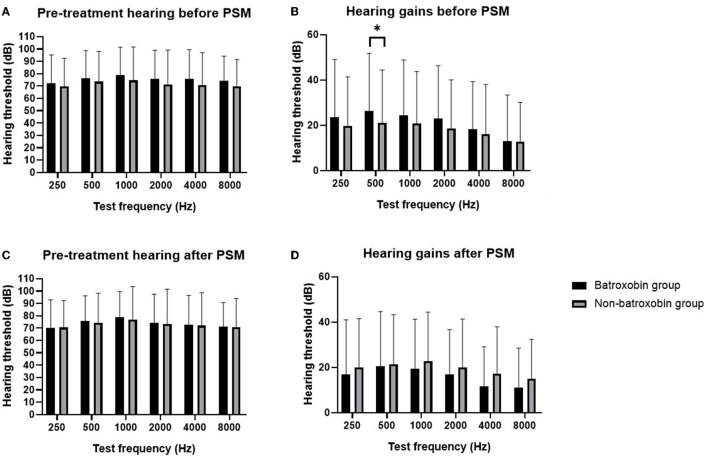
During the study period, 657 patients with SSNHL were admitted to our department. Among them, a total of 274 patients met the enrolled criteria of our study. After PSM, 162 patients (81 in each group) were included in the analysis. Once the hospitalized treatment was completed, the patients would be discharged the next day. Logistic regression analysis of the propensity score-matched cohort indicated that both the complete recovery rates [Siegel's criteria, OR: 0.734, 95% CI: 0.368-1.466, = 0.381; CMAO criteria, OR: 0.879, 95% CI: 0.435-1.777, = 0.720] and the overall effective rates [Siegel's criteria and CMAO criteria, OR: 0.741, 95% CI: 0.399-1.378, = 0.344] were not significantly different between the two treatment groups. Sensitivity analysis has shown similar results. For flat-type and total-deafness SSNHL patients, no significant difference was found in post-treatment hearing gain at each frequency between the two groups after PSM.
There was no significant difference in short-term hearing outcomes between treatment with batroxobin and treatment without batroxobin in SSNHL patients by Siegel's and CMAO criteria after PSM. Future studies for better therapy regimens of SSNHL are still needed.
突发性感音神经性听力损失(SSNHL)可使患者极度恐慌。在SSNHL治疗中加用静脉注射巴曲酶是否有益仍有待确定。本研究旨在比较静脉注射巴曲酶与未使用静脉注射巴曲酶治疗SSNHL患者的短期疗效。
本回顾性研究收集了2008年1月至2021年4月在我科住院的SSNHL患者的数据。入院当天(治疗前)和出院当天的听力水平分别视为治疗前听力和治疗后听力。听力增益为治疗前听力与治疗后听力的差值。我们采用西格尔标准和中华医学会耳鼻咽喉头颈外科学分会(CMAO)标准评估听力恢复情况。将各频率的完全恢复率、总有效率和听力增益作为观察指标。进行倾向得分匹配(PSM)以平衡巴曲酶组和非巴曲酶组之间的基线特征。对平坦型和全聋型SSNHL患者进行敏感性分析。
研究期间,657例SSNHL患者入住我科。其中,共有274例患者符合本研究的纳入标准。经过PSM,162例患者(每组81例)纳入分析。一旦完成住院治疗,患者将于次日出院。对倾向得分匹配队列进行逻辑回归分析表明,两组的完全恢复率[西格尔标准,OR:0.734,95%CI:0.368 - 1.466,P = 0.381;CMAO标准,OR:0.879,95%CI:0.435 - 1.777,P = 0.720]和总有效率[西格尔标准和CMAO标准,OR:0.741,95%CI:0.399 - 1.378,P = 0.344]差异均无统计学意义。敏感性分析显示了类似结果。对于平坦型和全聋型SSNHL患者,PSM后两组各频率治疗后听力增益差异均无统计学意义。
PSM后,根据西格尔标准和CMAO标准,SSNHL患者使用巴曲酶治疗与未使用巴曲酶治疗的短期听力结果差异无统计学意义。仍需要进一步研究以探索更好的SSNHL治疗方案。