International Development Group, RTI International, Washington, District of Columbia, USA.
The Task Force for Global Health, Decatur, Georgia, USA.
BMJ Glob Health. 2023 May;8(5). doi: 10.1136/bmjgh-2022-011193.
Delivering preventive chemotherapy through mass drug administration (MDA) is a central approach in controlling or eliminating several neglected tropical diseases (NTDs). Treatment coverage, a primary indicator of MDA performance, can be measured through routinely reported programmatic data or population-based coverage evaluation surveys. Reported coverage is often the easiest and least expensive way to estimate coverage; however, it is prone to inaccuracies due to errors in data compilation and imprecise denominators, and in some cases measures treatments offered as opposed to treatments swallowed.
Analyses presented here aimed to understand (1) how often coverage calculated using routinely reported data and survey data would lead programme managers to make the same programmatic decisions; (2) the magnitude and direction of the difference between these two estimates, and (3) whether there is meaningful variation by region, age group or country.
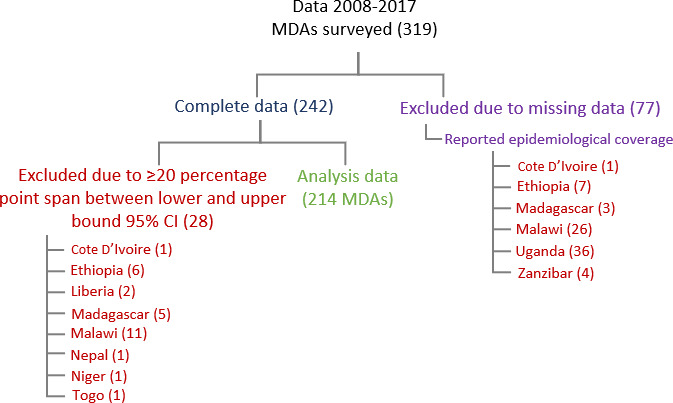
We analysed and compared reported and surveyed treatment coverage data from 214 MDAs implemented between 2008 and 2017 in 15 countries in Africa, Asia and the Caribbean. Routinely reported treatment coverage was compiled using data reported by national NTD programmes to donors, either directly or via NTD implementing partners, following the implementation of a district-level MDA campaign; coverage was calculated by dividing the number of individuals treated by a population value, which is typically based on national census projections and occasionally community registers. Surveyed treatment coverage came from post-MDA community-based coverage evaluation surveys, which were conducted as per standardised WHO recommended methodology.
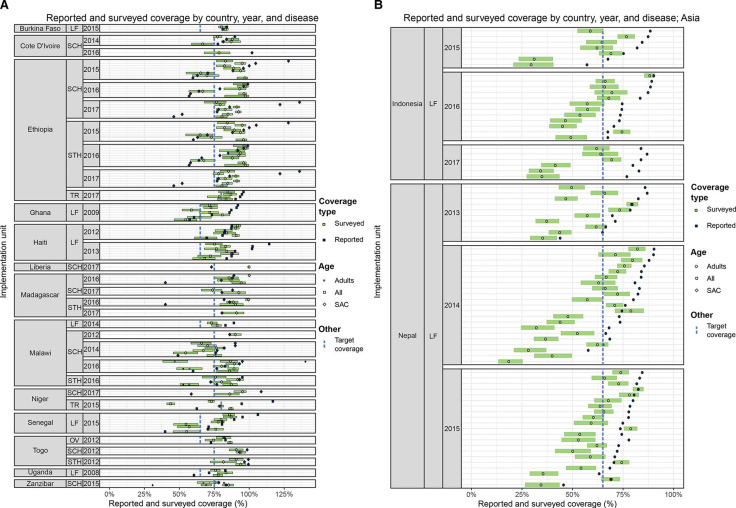
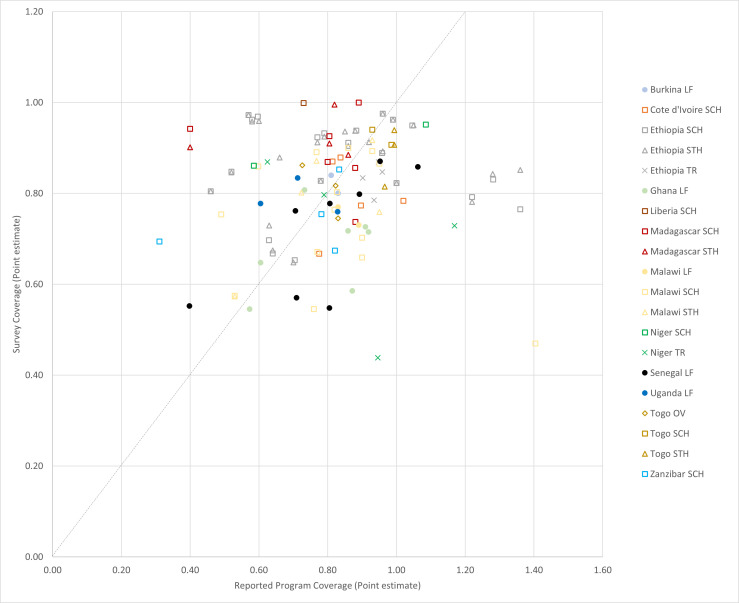
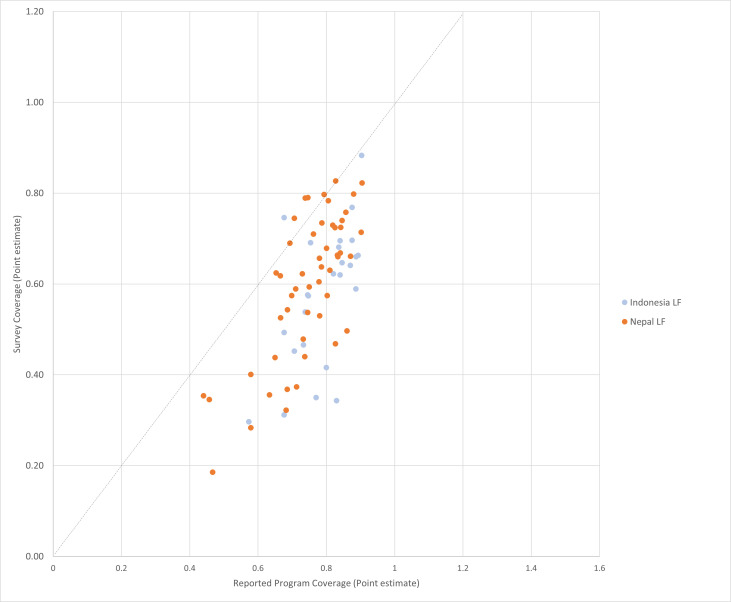
Coverage estimates using routine reporting and surveys gave the same result in terms of whether the minimum coverage threshold was reached in 72% of the MDAs surveyed in the Africa region and in 52% in the Asia region. The reported coverage value was within ±10 percentage points of the surveyed coverage value in 58/124 of the surveyed MDAs in the Africa region and 19/77 in the Asia region. Concordance between routinely reported and surveyed coverage estimates was 64% for the total population and 72% for school-age children. The study data showed variation across countries in the number of surveys conducted as well as the frequency with which there was concordance between the two coverage estimates.
Programme managers must grapple with making decisions based on imperfect information, balancing needs for accuracy with cost and available capacity. The study shows that for many of the MDAs surveyed, based on the concordance with respect to reaching the minimum coverage thresholds, the routinely reported data were accurate enough to make programmatic decisions. Where coverage surveys do show a need to improve accuracy of routinely reported results, NTD programme managers should use various tools and approaches to strengthen data quality in order to use data for decision-making to achieve NTD control and elimination goals.
通过大规模药物治疗(MDA)提供预防性化疗是控制或消除几种被忽视的热带病(NTD)的核心方法。治疗覆盖率是 MDA 绩效的主要指标,可以通过常规报告的方案数据或基于人群的覆盖率评估调查来衡量。报告的覆盖率通常是估算覆盖率最容易和最便宜的方法;然而,由于数据编制错误和不精确的分母,以及在某些情况下,测量提供的治疗方法而不是服用的治疗方法,报告的覆盖率容易出现不准确。
本文分析的目的是了解:(1)使用常规报告数据和调查数据计算的覆盖率在多大程度上会导致方案管理者做出相同的方案决策;(2)这两个估计值之间的差异幅度和方向;(3)是否存在因地区、年龄组或国家而有意义的差异。
我们分析和比较了 2008 年至 2017 年期间在非洲、亚洲和加勒比地区的 15 个国家实施的 214 项 MDA 中的常规报告和调查治疗覆盖率数据。常规报告的治疗覆盖率是使用国家 NTD 方案向捐助者报告的数据计算的,这些数据是在实施地区级 MDA 运动后直接或通过 NTD 实施伙伴报告的;覆盖率是通过将接受治疗的人数除以人口值来计算的,人口值通常基于国家人口普查预测,偶尔也基于社区登记。调查治疗覆盖率来自 MDA 后的基于社区的覆盖率评估调查,这些调查是按照世界卫生组织推荐的标准方法进行的。
在非洲地区 72%和亚洲地区 52%的接受调查的 MDA 中,使用常规报告和调查的覆盖率估计值在是否达到最低覆盖率阈值方面给出了相同的结果。在非洲地区的 124 个接受调查的 MDA 中有 58 个和亚洲地区的 77 个,报告的覆盖率值在±10%以内。在总人口中,常规报告和调查覆盖率估计值的一致性为 64%,在校龄儿童中为 72%。研究数据显示,各国在进行调查的次数以及两种覆盖率估计值之间的一致性方面存在差异。
方案管理者必须根据不完美的信息做出决策,在准确性、成本和可用能力之间取得平衡。该研究表明,对于许多接受调查的 MDA 来说,根据达到最低覆盖率阈值的一致性,常规报告的数据足以做出方案决策。在覆盖率调查确实表明需要提高常规报告结果的准确性的情况下,NTD 方案管理者应使用各种工具和方法来加强数据质量,以便利用数据做出决策,实现 NTD 控制和消除目标。