Department of Psychology, Yale University, 2 Hillhouse Ave, New Haven, CT, 06511, USA.
Interdepartmental Neuroscience Program, Yale University, New Haven, CT, USA.
Brain Imaging Behav. 2023 Oct;17(5):461-470. doi: 10.1007/s11682-023-00773-7. Epub 2023 May 5.
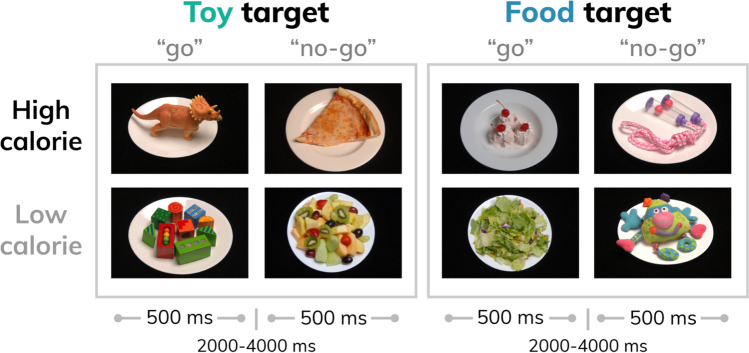
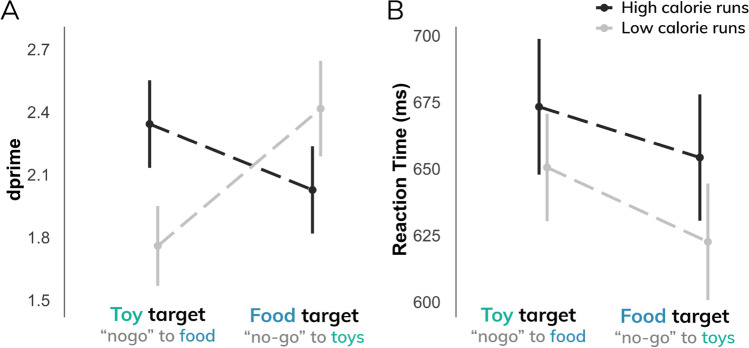
Pediatric obesity is a major public health concern. Genetic susceptibility and increased availability of energy-dense food are known risk factors for obesity. However, the extent to which these factors jointly bias behavior and neural circuitry towards increased adiposity in children remains unclear. While undergoing fMRI, 108 children (ages 5-11y) performed a food-specific go/no-go task. Participants were instructed to either respond ("go") or inhibit responding ("no-go") to images of food or toys. Half of the runs depicted high-calorie foods (e.g., pizza) whereas the other half depicted low-calorie foods (e.g., salad). Children were also genotyped for a DNA polymorphism associated with energy intake and obesity (FTO rs9939609) to examine the influence of obesity risk on behavioral and brain responses to food. Participants demonstrated differences in behavioral sensitivity to high- and low-calorie food images depending on task demands. Participants were slower but more accurate at detecting high- (relative to low-) calorie foods when responding to a neutral stimulus (i.e., toys) and worse at detecting toys when responding to high-calorie foods. Inhibition failures were accompanied by salience network activity (anterior insula, dorsal anterior cingulate cortex), which was driven by false alarms to food images. Children at a greater genetic risk for obesity (dose-dependent model of the FTO genotype) demonstrated pronounced brain and behavioral relationships such that genetic risk was associated with heightened sensitivity to high-calorie food images and increased anterior insula activity. These findings suggest that high-calorie foods may be particularly salient to children at risk for developing eating habits that promote obesity.
儿科肥胖是一个主要的公共卫生关注点。遗传易感性和高热量食物的可获得性是肥胖的已知危险因素。然而,这些因素在多大程度上共同影响儿童的行为和神经回路,导致肥胖程度增加,目前尚不清楚。在进行 fMRI 检查时,108 名儿童(5-11 岁)进行了一项特定于食物的 Go/No-Go 任务。参与者被指示对食物或玩具的图像做出反应(“Go”)或抑制反应(“No-Go”)。一半的运行描绘了高热量食物(例如披萨),而另一半则描绘了低热量食物(例如沙拉)。儿童还接受了与能量摄入和肥胖相关的 DNA 多态性(FTO rs9939609)的基因分型,以检查肥胖风险对食物的行为和大脑反应的影响。参与者在行为上对高卡路里和低卡路里食物图像的敏感性存在差异,这取决于任务要求。当对中性刺激(即玩具)做出反应时,参与者对高(相对低)卡路里食物的检测速度较慢,但准确性较高,而当对高卡路里食物做出反应时,对玩具的检测能力较差。抑制失败伴随着突显网络活动(前岛叶、背侧前扣带皮层),这是由对食物图像的假警报驱动的。肥胖风险较高的儿童(FTO 基因型的剂量依赖模型)表现出明显的大脑和行为关系,即遗传风险与对高热量食物图像的敏感性增加和前岛叶活动增加有关。这些发现表明,高热量食物可能对易患促进肥胖的饮食习惯的儿童特别明显。