Divisions of Population Sciences and Hematologic Malignancies, Dana-Farber Cancer Institute, Boston, MA.
The Emmes Company, LLC, Rockville, MD.
Blood Adv. 2023 Jul 25;7(14):3506-3515. doi: 10.1182/bloodadvances.2022009000.
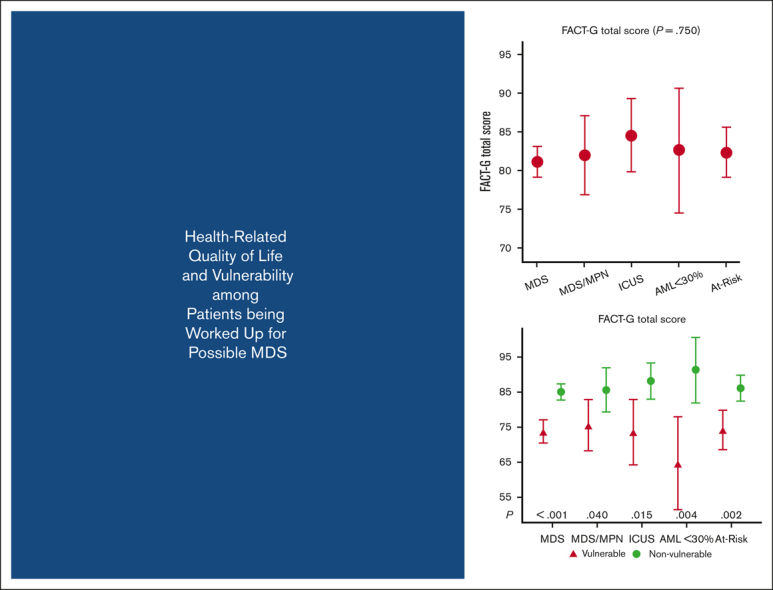
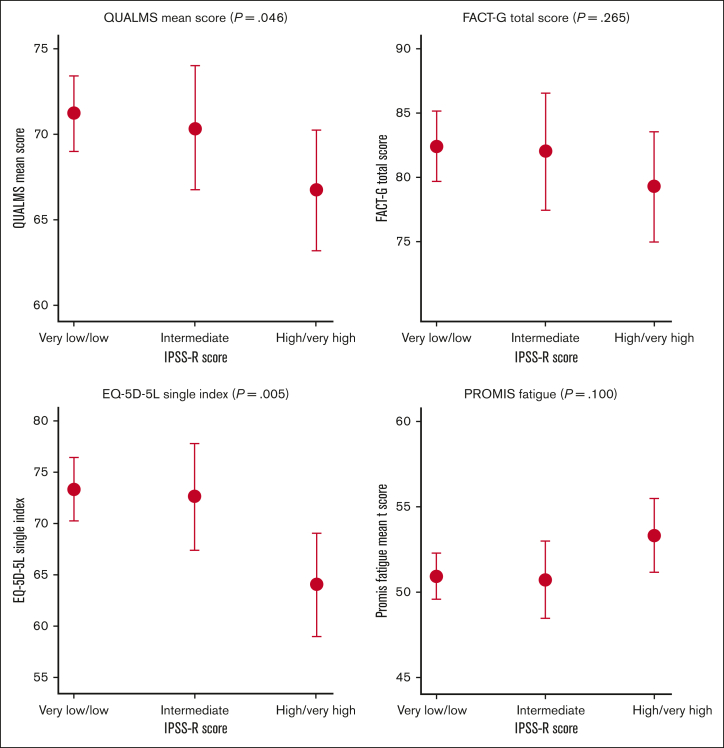
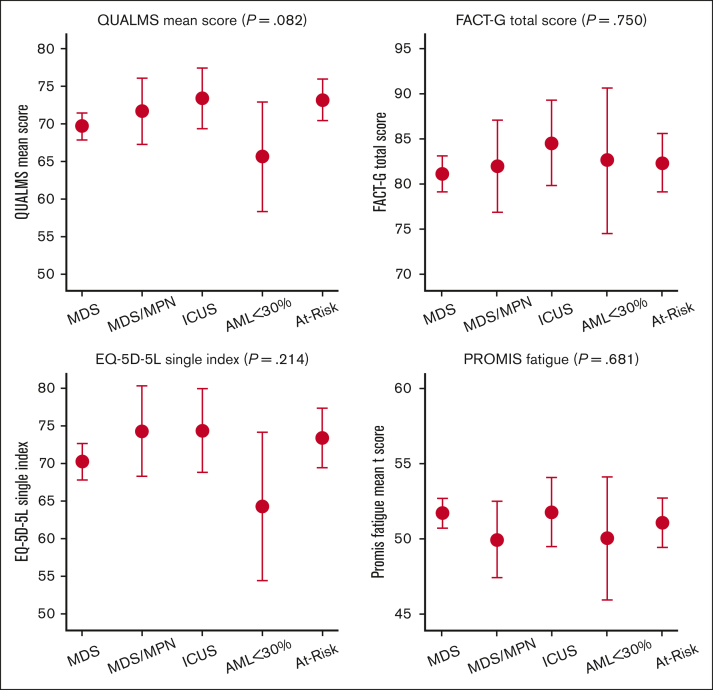
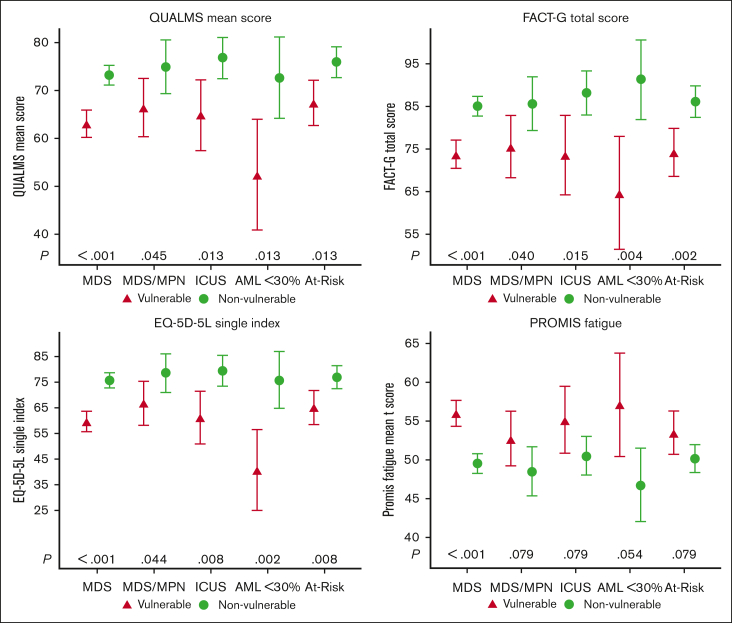
Health-related quality of life (HRQoL) and vulnerability are variably affected in patients with myelodysplastic syndromes (MDS) and other cytopenic states; however, the heterogeneity of these diseases has limited our understanding of these domains. The National Heart, Lung, and Blood Institute-sponsored MDS Natural History Study is a prospective cohort enrolling patients undergoing workup for suspected MDS in the setting of cytopenias. Untreated patients undergo bone marrow assessment with central histopathology review for assignment as MDS, MDS/myeloproliferative neoplasm (MPN), idiopathic cytopenia of undetermined significance (ICUS), acute myeloid leukemia (AML) with <30% blasts, or "At-Risk." HRQoL data are collected at enrollment, including the MDS-specific Quality of Life in Myelodysplasia Scale (QUALMS). Vulnerability is assessed with the Vulnerable Elders Survey. Baseline HRQoL scores from 449 patients with MDS, MDS/MPN, AML <30%, ICUS or At-Risk were similar among diagnoses. In MDS, HRQoL was worse for vulnerable participants (eg, mean Patent-Reported Outcomes Management Information Systems [PROMIS] Fatigue of 56.0 vs 49.5; P < .001) and those with worse prognosis (eg, mean Euroqol-5 Dimension-5 Level [EQ-5D-5L] of 73.4, 72.7, and 64.1 for low, intermediate, and high-risk disease; P = .005). Among vulnerable MDS participants, most had difficulty with prolonged physical activity (88%), such as walking a quarter mile (74%). These data suggest that cytopenias leading to MDS evaluation are associated with similar HRQoL, regardless of eventual diagnosis, but with worse HRQoL among the vulnerable. Among those with MDS, lower-risk disease was associated with better HRQoL, but the relationship was lost among the vulnerable, showing for the first time that vulnerability trumps disease risk in affecting HRQoL. This study is registered at www.clinicaltrials.gov as NCT02775383.
健康相关生活质量(HRQoL)和脆弱性在骨髓增生异常综合征(MDS)和其他血细胞减少症患者中受到不同程度的影响;然而,这些疾病的异质性限制了我们对这些领域的理解。美国国立心肺血液研究所(National Heart, Lung, and Blood Institute)赞助的 MDS 自然史研究是一项前瞻性队列研究,招募了在血细胞减少症背景下接受疑似 MDS 检查的患者。未经治疗的患者接受骨髓评估,中央组织病理学检查结果用于诊断 MDS、MDS/骨髓增生性肿瘤(MPN)、特发性血细胞减少症不明意义(ICUS)、急性髓系白血病(AML)伴<30%的原始细胞或“高危”。在入组时收集 HRQoL 数据,包括 MDS 特异性生活质量量表(QUALMS)。脆弱性用脆弱老年人调查进行评估。449 例 MDS、MDS/MPN、AML<30%、ICUS 或高危患者的基线 HRQoL 评分在诊断之间相似。在 MDS 中,脆弱参与者的 HRQoL 更差(例如,专利报告结果管理信息系统[PROMIS]疲劳得分 56.0 与 49.5;P<.001)和预后较差的参与者(例如,EuroQol-5 维度-5 级[EQ-5D-5L]得分低、中、高危疾病分别为 73.4、72.7 和 64.1;P=.005)。在脆弱的 MDS 参与者中,大多数人难以进行长时间的体力活动(88%),例如行走四分之一英里(74%)。这些数据表明,导致 MDS 评估的血细胞减少症与 HRQoL 相似,无论最终诊断如何,但脆弱者的 HRQoL 更差。在 MDS 患者中,低危疾病与更好的 HRQoL 相关,但这种关系在脆弱者中丧失,这是首次表明脆弱性在影响 HRQoL 方面胜过疾病风险。这项研究在 www.clinicaltrials.gov 上注册为 NCT02775383。