Gilbert Stephanie, Irvine Rachel, D'or Melissa, Adam Marc T P, Collins Clare E, Marriott Rhonda, Rollo Megan, Walker Roz, Rae Kym
Faculty of Humanities and Social Sciences, University of Queensland, Brisbane, Australia.
Aboriginal and Torres Strait Islander Studies Unit, University of Queensland, Brisbane, Australia.
JMIR Res Protoc. 2023 Jul 6;12:e45983. doi: 10.2196/45983.
Nutrition in pregnancy is pivotal to optimizing infant growth and maternal well-being. The factors affecting Indigenous people's food and nutrition intake are complex with a history of colonization impacting the disproportionate effect of social determinants to this day. Literature regarding the dietary intake or dietary priorities of Indigenous women in Australia is scarce, with supportive, culturally appropriate resources developed for and with this group rare. Research suggests mobile health (mHealth) tools are effective in supporting health knowledge of Indigenous people and positive health behavior changes when designed and developed with the expertise of Indigenous communities.
This study seeks to build the body of knowledge related to nutrition needs and priorities for Indigenous women in Australia during pregnancy. Further, this project team and its participants will co-design an mHealth digital tool to support these nutrition needs.
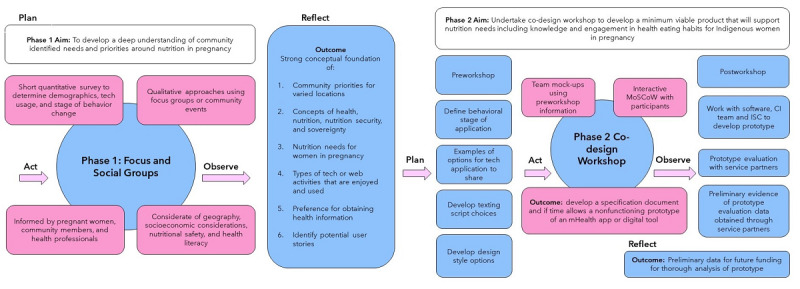
The Mums and Bubs Deadly Diets study recruits Indigenous women and health care professionals who support Indigenous women during pregnancy into 2 phases. Phase 1 (predesign) uses a mixed methods convergent design using a biographical questionnaire and social or focus groups to inform phase 2 (generative). Phase 2 will use a participatory action research process during co-design workshops to iteratively develop the digital tool; the exact actions within a workshop will evolve according to the participant group decisions.
To date, this project has undertaken phase 1 focus groups at all Queensland sites, with New South Wales and Western Australia to begin in early to mid-2023. We have recruited 12 participants from Galangoor Duwalami, 18 participants from Carbal in Toowoomba, and 18 participants from Carbal in Warwick. We are expecting similar numbers of recruits in Western Australia and New South Wales. Participants have been both community members and health care professionals.
This study is an iterative and adaptive research program that endeavors to develop real-world, impactful resources to support the nutrition needs and priorities of pregnant Indigenous women in Australia. This comprehensive project requires a combination of methods and methodologies to ensure Indigenous voices are heard at each stage and in all aspects of research output. The development of an mHealth resource for this cohort will provide a necessary bridge where there is often a gap in access to nutrition resources for women in pregnancy in Indigenous communities.
INTERNATIONAL REGISTERED REPORT IDENTIFIER (IRRID): DERR1-10.2196/45983.
孕期营养对于优化婴儿生长和孕产妇健康至关重要。影响原住民食物和营养摄入的因素复杂,殖民历史至今仍对社会决定因素产生不均衡影响。关于澳大利亚原住民妇女饮食摄入或饮食优先事项的文献稀缺,为该群体开发并与之合作的支持性、符合文化习俗的资源也很罕见。研究表明,移动健康(mHealth)工具在由原住民社区专业人员设计和开发时,能有效支持原住民的健康知识和积极的健康行为改变。
本研究旨在积累与澳大利亚原住民妇女孕期营养需求和优先事项相关的知识体系。此外,该项目团队及其参与者将共同设计一个移动健康数字工具,以满足这些营养需求。
“妈妈和宝宝致命饮食”研究招募原住民妇女以及在孕期为原住民妇女提供支持的医疗保健专业人员,分为两个阶段。第一阶段(预设计)采用混合方法收敛设计,使用传记问卷和社会或焦点小组来为第二阶段(生成阶段)提供信息。第二阶段将在共同设计研讨会上采用参与式行动研究过程,迭代开发数字工具;研讨会上的确切行动将根据参与者群体的决定而演变。
迄今为止,该项目已在昆士兰州所有地点开展了第一阶段焦点小组研究,新南威尔士州和西澳大利亚州将于2023年上半年开始。我们已从加兰古尔·杜瓦拉米招募了12名参与者,从图文巴的卡尔巴尔招募了18名参与者,从沃里克的卡尔巴尔招募了18名参与者。我们预计西澳大利亚州和新南威尔士州的招募人数与此类似。参与者既有社区成员,也有医疗保健专业人员。
本研究是一个迭代和适应性研究项目,致力于开发切实可行、有影响力的资源,以支持澳大利亚原住民孕妇的营养需求和优先事项。这个综合性项目需要多种方法和方法论相结合,以确保在研究产出的每个阶段和各个方面都能听到原住民的声音。为这一群体开发移动健康资源将搭建一座必要的桥梁,因为原住民社区孕妇在获取营养资源方面往往存在差距。
国际注册报告标识符(IRRID):DERR1-10.2196/45983。