
岐黄针疗法治疗抽动障碍的机制:一项临床试验方案
Mechanism of Qihuang needle therapy in the management of tic disorders: a clinical trial protocol.
作者信息
Tang Yuyuan, Wu Jun'e, Xu Zhirui, Fan Baochao, Li Xiangli, Jin Bingxu, Tang Chunzhi
机构信息
Clinical Research and Big Data Laboratory, South China Research Center for Acupuncture and Moxibustion, Medical College of Acu-Moxi and Rehabilitation, Guangzhou University of Chinese Medicine, Guangzhou, China.
Department of Reproductive Health, The Fourth Clinical Medical College of Guangzhou University of Chinese Medicine, Shenzhen, China.
出版信息
Front Neurol. 2023 Apr 20;14:1036453. doi: 10.3389/fneur.2023.1036453. eCollection 2023.
BACKGROUND
Qihuang needle therapy is a newly developed acupuncture therapy to treat tic disorders in clinical practice. However, the mechanism to reduce tic severity remains unknown. Changes in intestinal flora and circulation metabolites are perhaps the potential pathogenesis of tic disorders. As a result, we present a protocol for a controlled clinical trial using multi-omics analysis to probe the mechanism of the Qihuang needle in managing tic disorders.
METHODS
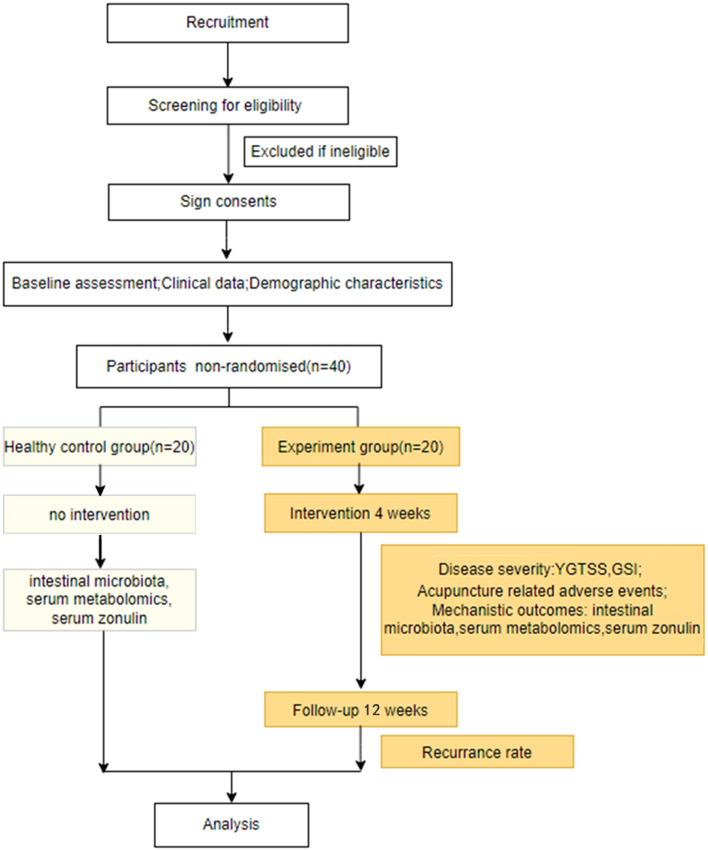
This is a matched-pairs design, controlled, clinical trial for patients with tic disorders. Participants will be allocated to either an experimental group or a healthy control group. The main acupoints are Baihui (GV20), Yintang (EX-HN3), and Jueyinshu (BL14). The experimental group will receive Qihuang needle therapy for a month, while the control group will receive no interventions.
EXPECTED OUTCOMES
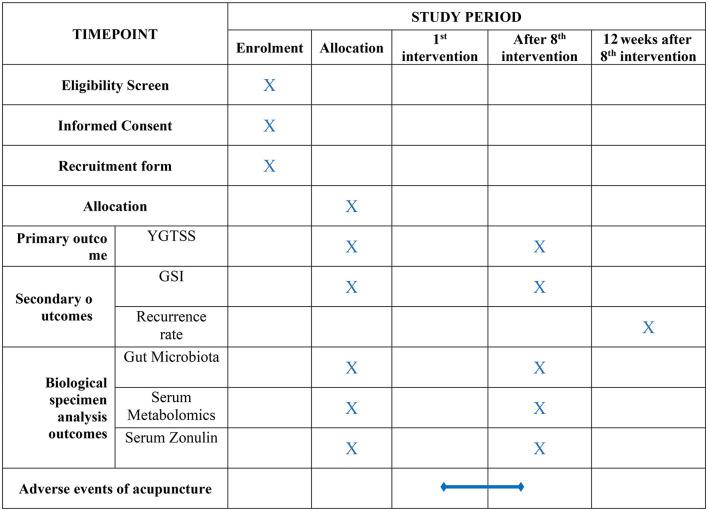
The change in the severity of the tic disorder is set as the main outcome. Secondary outcomes include gastrointestinal severity index and recurrence rate, which will be calculated after a 12-week follow-up. Gut microbiota, measured by 16S rRNA gene sequencing; serum metabolomics, assessed LC/MS; and serum zonulin, assessed by enzyme-linked immunosorbent assay (ELISA), will be used as biological specimen analysis outcomes. The present study will investigate the possible interactions between intestinal flora and serum metabolites and the improvement of clinical profiles, which may elucidate the mechanism of Qihuang needle therapy for tic disorders.
TRIAL REGISTRATION
This trial is registered at the Chinese Clinical Trial Registry (http://www.chictr.org.cn/). Registration number: ChiCTR2200057723, Date: 2022-04-14.
背景
岐黄针疗法是一种新研发的针灸疗法,用于临床治疗抽动障碍。然而,其减轻抽动严重程度的机制尚不清楚。肠道菌群和循环代谢产物的变化可能是抽动障碍的潜在发病机制。因此,我们提出一项对照临床试验方案,采用多组学分析来探究岐黄针治疗抽动障碍的机制。
方法
这是一项针对抽动障碍患者的配对设计、对照临床试验。参与者将被分配到实验组或健康对照组。主要穴位为百会(GV20)、印堂(EX-HN3)和厥阴俞(BL14)。实验组将接受为期一个月的岐黄针治疗,而对照组不接受任何干预。
预期结果
将抽动障碍严重程度的变化设定为主要结果。次要结果包括胃肠道严重程度指数和复发率,将在12周随访后计算。通过16S rRNA基因测序测量肠道微生物群;通过液相色谱/质谱联用(LC/MS)评估血清代谢组学;通过酶联免疫吸附测定(ELISA)评估血清连蛋白,将其作为生物样本分析结果。本研究将调查肠道菌群与血清代谢产物之间可能的相互作用以及临床症状的改善情况,这可能阐明岐黄针疗法治疗抽动障碍的机制。
试验注册
本试验已在中国临床试验注册中心(http://www.chictr.org.cn/)注册。注册号:ChiCTR2200057723,日期:2022年4月14日。


 Zotero 插件