Department of Clinical Laboratory, State Key Laboratory of Molecular Oncology, National Cancer Center/National Clinical Research Center for Cancer/Cancer Hospital, Chinese Academy of Medical Sciences and Peking Union Medical College, Beijing 100021, China.
Dept of Clinical Research, Precogify Pharmaceutical Co, Ltd, Beijing, China.
Gut. 2022 Jul;71(7):1315-1325. doi: 10.1136/gutjnl-2020-323476. Epub 2021 Aug 30.
To profile gut microbiome-associated metabolites in serum and investigate whether these metabolites could distinguish individuals with colorectal cancer (CRC) or adenoma from normal healthy individuals.
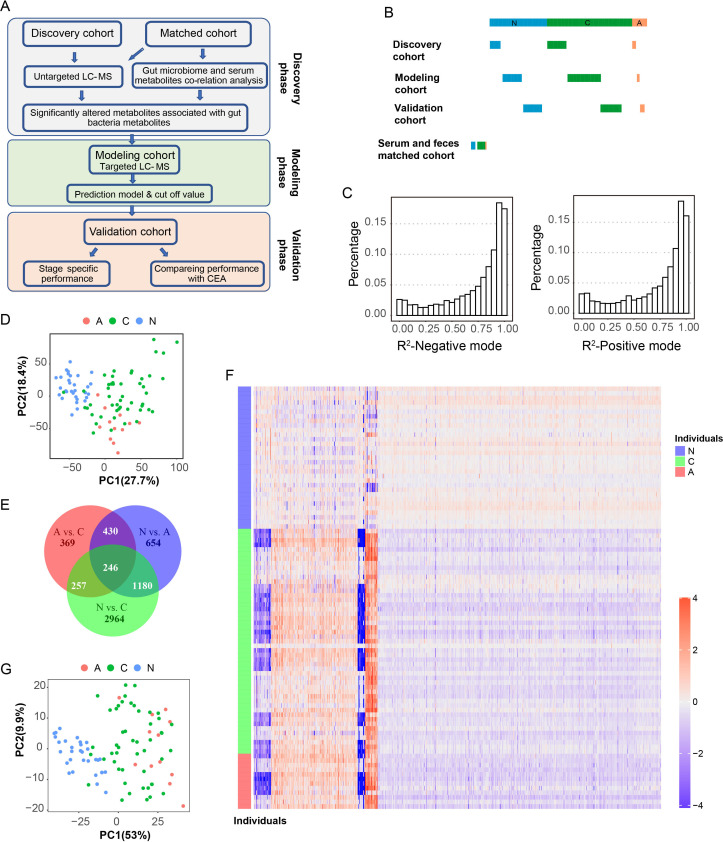
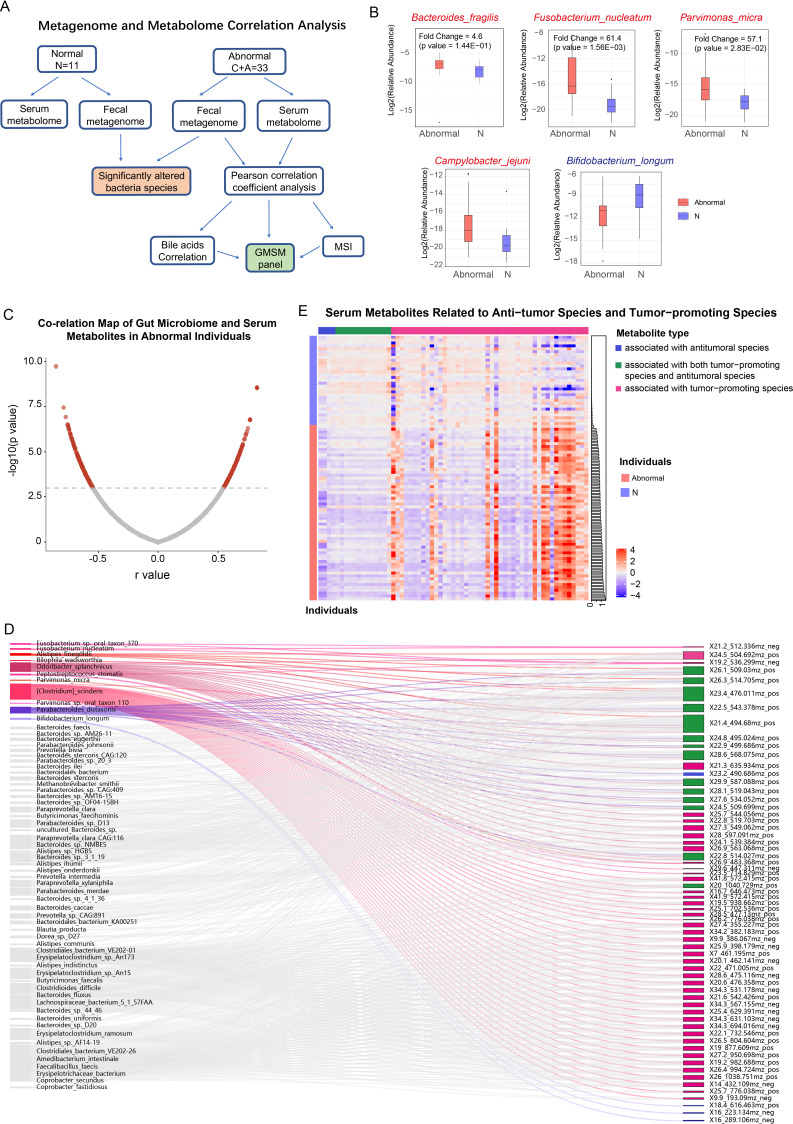
Integrated analysis of untargeted serum metabolomics by liquid chromatography-mass spectrometry and metagenome sequencing of paired faecal samples was applied to identify gut microbiome-associated metabolites with significantly altered abundance in patients with CRC and adenoma. The ability of these metabolites to discriminate between CRC and colorectal adenoma was tested by targeted metabolomic analysis. A model based on gut microbiome-associated metabolites was established and evaluated in an independent validation cohort.
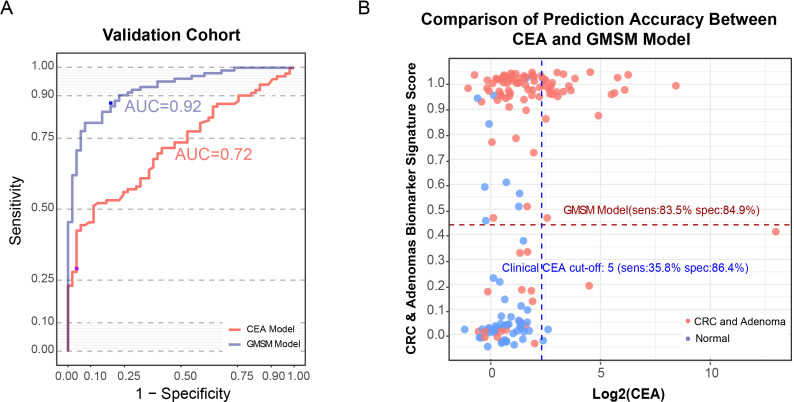
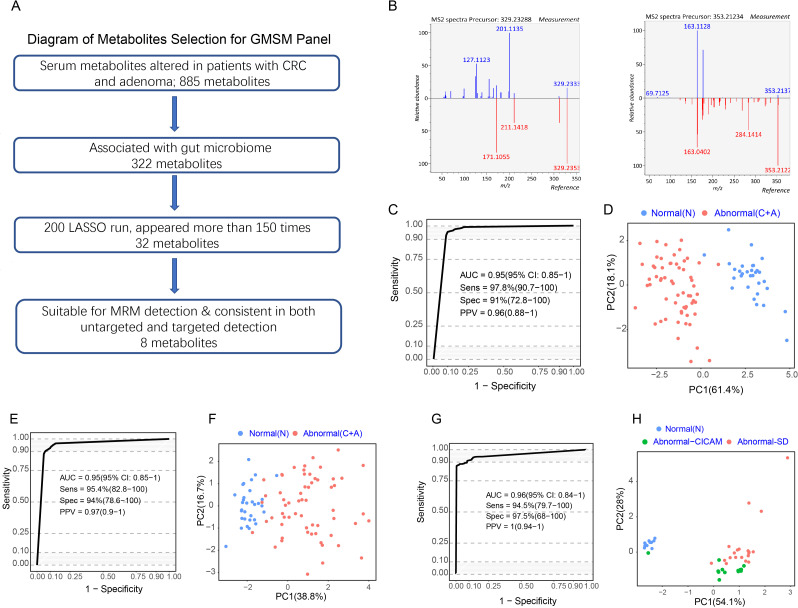
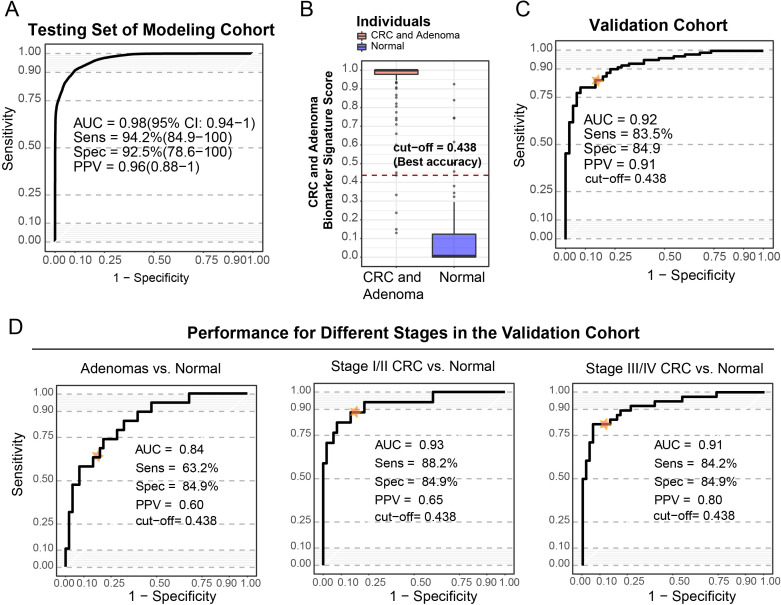
In total, 885 serum metabolites were significantly altered in both CRC and adenoma, including eight gut microbiome-associated serum metabolites (GMSM panel) that were reproducibly detected by both targeted and untargeted metabolomics analysis and accurately discriminated CRC and adenoma from normal samples. A GMSM panel-based model to predict CRC and colorectal adenoma yielded an area under the curve (AUC) of 0.98 (95% CI 0.94 to 1.00) in the modelling cohort and an AUC of 0.92 (83.5% sensitivity, 84.9% specificity) in the validation cohort. The GMSM model was significantly superior to the clinical marker carcinoembryonic antigen among samples within the validation cohort (AUC 0.92 vs 0.72) and also showed promising diagnostic accuracy for adenomas (AUC=0.84) and early-stage CRC (AUC=0.93).
Gut microbiome reprogramming in patients with CRC is associated with alterations of the serum metabolome, and GMSMs have potential applications for CRC and adenoma detection.
分析血清中与肠道微生物组相关的代谢物,并研究这些代谢物是否能区分结直肠癌(CRC)或腺瘤患者与健康个体。
通过液相色谱-质谱联用技术对非靶向血清代谢组学进行综合分析,并对配对粪便样本进行宏基因组测序,以确定CRC 和腺瘤患者中丰度发生明显变化的与肠道微生物组相关的代谢物。通过靶向代谢组学分析测试这些代谢物区分 CRC 和结直肠腺瘤的能力。基于肠道微生物组相关代谢物建立并在独立验证队列中评估模型。
总共发现 885 种血清代谢物在 CRC 和腺瘤中均发生明显改变,包括 8 种可通过靶向和非靶向代谢组学分析重复检测的与肠道微生物组相关的血清代谢物(GMSM 面板),可准确区分 CRC 和腺瘤与正常样本。基于 GMSM 面板的模型预测 CRC 和结直肠腺瘤,在建模队列中的曲线下面积(AUC)为 0.98(95%CI 0.94 至 1.00),在验证队列中的 AUC 为 0.92(83.5%灵敏度,84.9%特异性)。在验证队列中,与临床标志物癌胚抗原相比,GMSM 模型在样本中具有显著优势(AUC 0.92 比 0.72),并且对腺瘤(AUC=0.84)和早期 CRC(AUC=0.93)也具有有前景的诊断准确性。
CRC 患者肠道微生物组的重编程与血清代谢组的改变有关,GMSM 具有用于 CRC 和腺瘤检测的潜力。