Bui Truong An, Rosenfelt Cory Scott, Whitlock Kerri Hope, Leclercq Mickael, Weber Savannah, Droit Arnaud, Wiebe Sandra A, Pei Jacqueline, Bolduc Francois V
Department of Pediatrics, University of Alberta, Edmonton, AB, Canada.
Computational Biology Laboratory, Centre de Recherche du CHU de Québec, Université Laval Research Centre, Québec City, QC, Canada.
JMIR Pediatr Parent. 2023 May 8;6:e39720. doi: 10.2196/39720.
Neurodevelopmental disorders (NDD) cause individuals to have difficulty in learning facts, procedures, or social skills. NDD has been linked to several genes, and several animal models have been used to identify potential therapeutic candidates based on specific learning paradigms for long-term and associative memory. In individuals with NDD, however, such testing has not been used so far, resulting in a gap in translating preclinical results to clinical practice.
We aim to assess if individuals with NDD could be tested for paired association learning and long-term memory deficit, as shown in previous animal models.
We developed an image-based paired association task, which can be performed at different time points using remote web-based testing, and evaluated its feasibility in children with typical development (TD), as well as NDD. We included 2 tasks: object recognition as a simpler task and paired association. Learning was tested immediately after training and also the next day for long-term memory.
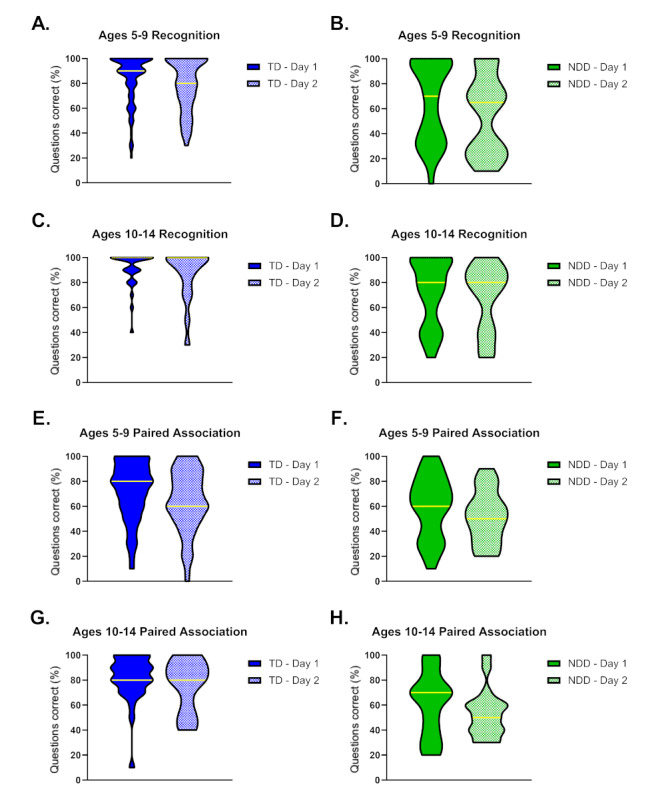
We found that children aged 5-14 years with TD (n=128) and with NDD of different types (n=57) could complete testing using the Memory Game. Children with NDD showed deficits in both recognition and paired association tasks on the first day of learning, in both 5-9-year old (P<.001 and P=.01, respectively) and 10-14-year old groups (P=.001 and P<.001, respectively). The reaction times to stimuli showed no significant difference between individuals with TD or NDD. Children with NDD exhibited a faster 24-hour memory decay for the recognition task than those with TD in the 5-9-year old group. This trend is reversed for the paired association task. Interestingly, we found that children with NDD had their retention for recognition improved and matched with typically developing individuals by 10-14 years of age. The NDD group also showed improved retention deficits in the paired association task at 10-14 years of age compared to the TD group.
We showed that web-based learning testing using simple picture association is feasible for children with TD, as well as with NDD. We showed how web-based testing allows us to train children to learn the association between pictures, as shown in immediate test results and those completed 1 day after. This is important as many models for learning deficits in NDD target both short- and long-term memory for therapeutic intervention. We also demonstrated that despite potential confounding factors, such as self-reported diagnosis bias, technical issues, and varied participation, the Memory Game shows significant differences between typically developing children and those with NDD. Future experiments will leverage this potential of web-based testing for larger cohorts and cross-validation with other clinical or preclinical cognitive tasks.

神经发育障碍(NDD)使个体在学习事实、程序或社交技能方面存在困难。NDD与多个基因有关,并且已经使用了几种动物模型,基于长期和联想记忆的特定学习范式来识别潜在的治疗候选物。然而,到目前为止,尚未在NDD个体中进行此类测试,这导致了临床前结果转化为临床实践方面的差距。
我们旨在评估NDD个体是否可以像之前的动物模型那样,接受配对联想学习和长期记忆缺陷测试。
我们开发了一种基于图像的配对联想任务,该任务可以使用远程网络测试在不同时间点进行,并评估其在典型发育(TD)儿童以及NDD儿童中的可行性。我们纳入了两项任务:作为较简单任务的物体识别和配对联想。在训练后立即测试学习情况,第二天测试长期记忆。
我们发现,5至14岁的TD儿童(n = 128)和不同类型的NDD儿童(n = 57)可以使用记忆游戏完成测试。NDD儿童在学习的第一天,在识别任务和配对联想任务中均表现出缺陷,在5至9岁组(分别为P <.001和P =.01)以及10至14岁组(分别为P =.