
一种基于可解释人工智能(XAI)的双向长短期记忆(Bi-LSTM)框架的工业4.0网络入侵检测系统优化模型。
An optimized model for network intrusion detection systems in industry 4.0 using XAI based Bi-LSTM framework.
作者信息
Sivamohan S, Sridhar S S
机构信息
Department of Computing Technologies, SRM Institute of Science & Technology, Kattankulathur, India.
出版信息
Neural Comput Appl. 2023;35(15):11459-11475. doi: 10.1007/s00521-023-08319-0. Epub 2023 Mar 10.
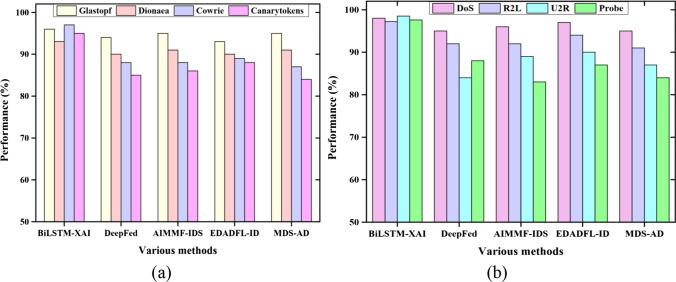
Industry 4.0 enable novel business cases, such as client-specific production, real-time monitoring of process condition and progress, independent decision making and remote maintenance, to name a few. However, they are more susceptible to a broad range of cyber threats because of limited resources and heterogeneous nature. Such risks cause financial and reputational damages for businesses, well as the theft of sensitive information. The higher level of diversity in industrial network prevents the attackers from such attacks. Therefore, to efficiently detect the intrusions, a novel intrusion detection system known as Bidirectional Long Short-Term Memory based Explainable Artificial Intelligence framework (BiLSTM-XAI) is developed. Initially, the preprocessing task using data cleaning and normalization is performed to enhance the data quality for detecting network intrusions. Subsequently, the significant features are selected from the databases using the Krill herd optimization (KHO) algorithm. The proposed BiLSTM-XAI approach provides better security and privacy inside the industry networking system by detecting intrusions very precisely. In this, we utilized SHAP and LIME explainable AI algorithms to improve interpretation of prediction results. The experimental setup is made by MATLAB 2016 software using Honeypot and NSL-KDD datasets as input. The analysis result reveals that the proposed method achieves superior performance in detecting intrusions with a classification accuracy of 98.2%.
工业4.0催生了一些新颖的商业案例,比如针对客户的定制生产、对工艺条件和进度的实时监控、自主决策以及远程维护等等。然而,由于资源有限且性质各异,它们更容易受到广泛的网络威胁。此类风险会给企业造成财务和声誉损害,以及敏感信息被盗。工业网络中更高程度的多样性可防止攻击者发动此类攻击。因此,为了有效检测入侵行为,人们开发了一种名为基于双向长短期记忆的可解释人工智能框架(BiLSTM-XAI)的新型入侵检测系统。首先,执行使用数据清理和归一化的预处理任务,以提高用于检测网络入侵的数据质量。随后,使用磷虾群优化(KHO)算法从数据库中选择显著特征。所提出的BiLSTM-XAI方法通过非常精确地检测入侵行为,在工业网络系统内部提供了更好的安全性和隐私保护。在此过程中,我们利用SHAP和LIME可解释人工智能算法来改进对预测结果的解释。实验设置是通过MATLAB 2016软件进行的,使用蜜罐和NSL-KDD数据集作为输入。分析结果表明,所提出的方法在检测入侵行为方面具有卓越性能,分类准确率达到98.2%。



 Zotero 插件