School of Public Health and Preventive Medicine, Monash University, Melbourne, Victoria, Australia.
Center for Aging and Population Health, Department of Epidemiology, University of Pittsburgh, Pittsburgh, PA, United States of America.
PLoS One. 2023 May 8;18(5):e0285530. doi: 10.1371/journal.pone.0285530. eCollection 2023.
Both grip strength and gait speed can be used as markers of muscle function, however, no previous study has examined them in the same population with respect to risk of falls.
In this prospective cohort study, utilising data from the ASPirin in Reducing Events in the Elderly (ASPREE) trial and ASPREE-Fracture substudy, we analysed the association of grip strength and gait speed and serious falls in healthy older adults. Grip strength was measured using a handheld dynamometer and gait speed from 3-metre timed walks. Serious falls were confined to those involving hospital presentation. Cox regression was used to calculate hazard ratios (HR) and 95% confidence intervals (CI) for associations with falls.
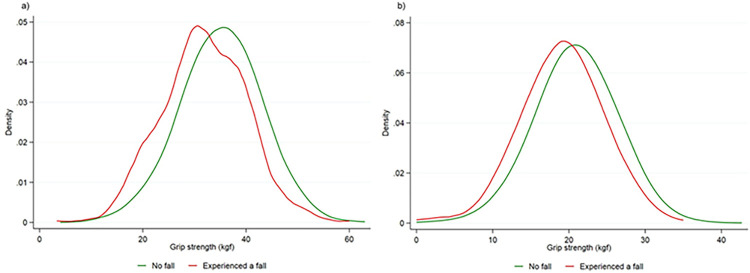
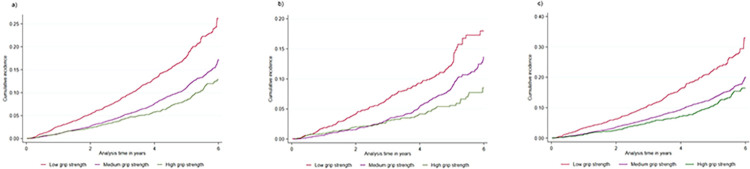
Over an average of 4.0±1.3 years, amongst 16,445 participants, 1,533 had at least one serious fall. After adjustment for age, sex, physical activity, body mass index, Short Form 12 (state of health), chronic kidney disease, polypharmacy and aspirin, each standard deviation (SD) lower grip strength was associated with 27% (HR 1.27, 95% CI 1.17-1.38) higher risk of falls. The results remained the same for males and females. There was a dose-response relationship in the association between grip strength and falls risk. The higher risk of falls was observed in males in all body mass index (BMI) categories, but only in obese females. The association between gait speed and falls risk was weaker than the association between grip strength and falls risk.
All males and only obese females with low grip strength appear to be at the greatest risk of serious falls. These findings may assist in early identification of falls.
握力和步速均可作为肌肉功能的标志物,但此前尚无研究在同一人群中同时观察它们与跌倒风险的关系。
本前瞻性队列研究利用 ASPirin in Reducing Events in the Elderly(ASPREE)试验和 ASPREE-Fracture 子研究的数据,分析了健康老年人握力和步速与严重跌倒的关系。使用手持测力计测量握力,使用 3 米计时步行测量步速。严重跌倒仅限于涉及住院的跌倒。使用 Cox 回归计算与跌倒相关的危险比(HR)和 95%置信区间(CI)。
在平均 4.0±1.3 年的随访中,在 16445 名参与者中,有 1533 人至少发生了一次严重跌倒。在校正年龄、性别、体力活动、体重指数、SF-12(健康状况)、慢性肾脏病、多种药物治疗和阿司匹林后,握力每降低一个标准差(SD)与跌倒风险增加 27%相关(HR 1.27,95%CI 1.17-1.38)。结果在男性和女性中均保持不变。握力与跌倒风险之间存在剂量反应关系。在所有体重指数(BMI)类别中,男性握力较低与跌倒风险增加有关,但仅在肥胖女性中如此。与步速和跌倒风险的关联比握力和跌倒风险的关联弱。
所有男性和仅肥胖女性握力较低者似乎有发生严重跌倒的最大风险。这些发现可能有助于早期识别跌倒。