Department of Paediatrics and Adolescent Medicine, The University of Hong Kong, Hong Kong Special Administrative Region, China.
School of Public Health, The University of Hong Kong, Hong Kong Special Administrative Region, China.
Hum Vaccin Immunother. 2023 Dec 31;19(1):2206278. doi: 10.1080/21645515.2023.2206278. Epub 2023 May 9.
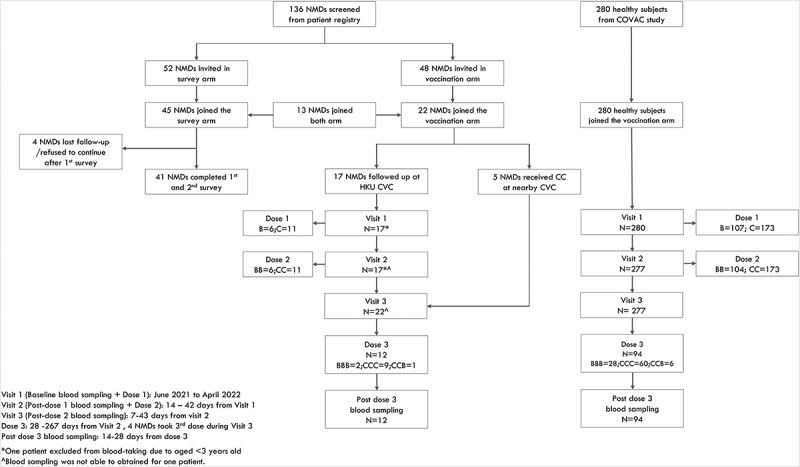
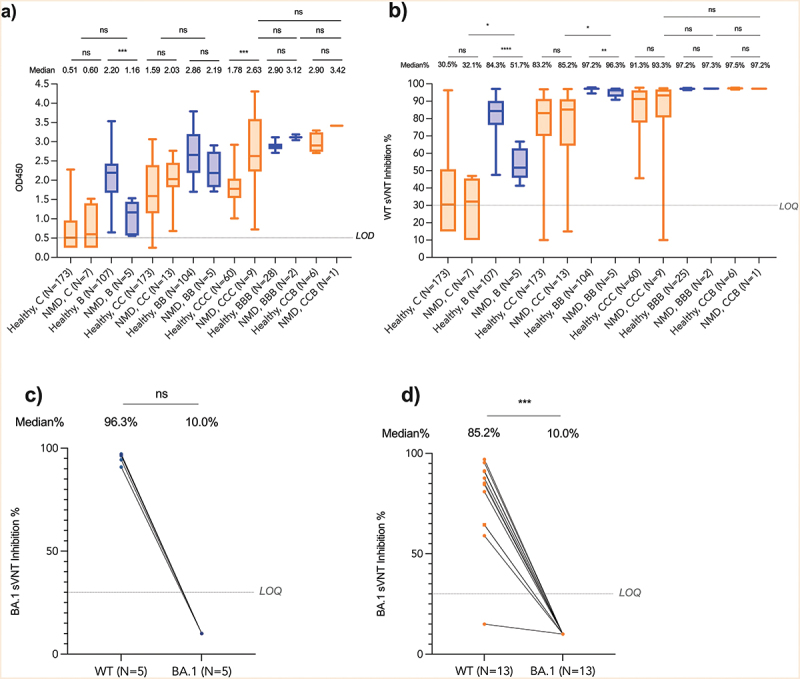
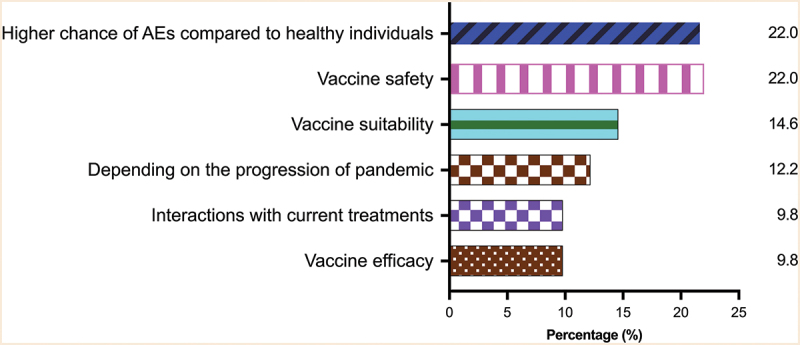
The mRNA-based BNT162b2 and inactivated whole-virus CoronaVac are two widely used COVID-19 vaccines that confer immune protection to healthy individuals. However, hesitancy toward COVID-19 vaccination appeared to be common for patients with neuromuscular diseases (NMDs) due to the paucity of data on the safety and efficacy in this high-risk patient population. Therefore, we examined the underlying factors associated with vaccine hesitancy across time for NMDs and assessed the reactogenicity and immunogenicity of these two vaccines. Patients aged 8-18 years with no cognitive delay were invited to complete surveys in January and April 2022. Patients aged 2-21 years were enrolled for COVID-19 vaccination between June 2021 and April 2022, and they recorded adverse reactions (ARs) for 7 days after vaccination. Peripheral blood was obtained before and within 49 days after vaccination to measure serological antibody responses compared to healthy children and adolescents. Forty-one patients completed vaccine hesitancy surveys for both timepoints, while 22 joined the reactogenicity and immunogenicity arm of the study. Two or more family members vaccinated against COVID-19 was positively associated with intention of vaccination (odds ratio 11.7, 95% CI 1.81-75.1, = .010). Pain at the injection site, fatigue, and myalgia were the commonest ARs. Most ARs were mild (75.5%, = 71/94). All 19 patients seroconverted against the wildtype SARS-CoV-2 after two doses of either vaccine, similar to 280 healthy counterparts. There was lower neutralization against the Omicron BA.1 variant. BNT162b2 and CoronaVac were safe and immunogenic for patients with NMDs, even in those on low-dose corticosteroids.
基于 mRNA 的 BNT162b2 和灭活全病毒科兴疫苗是两种广泛使用的 COVID-19 疫苗,可为健康个体提供免疫保护。然而,由于针对这一高风险患者人群的安全性和有效性数据有限,神经肌肉疾病(NMDs)患者对 COVID-19 疫苗的接种犹豫不决似乎很常见。因此,我们研究了随时间推移与 NMDs 相关的疫苗犹豫的潜在因素,并评估了这两种疫苗的反应原性和免疫原性。邀请年龄在 8-18 岁且无认知障碍的患者在 2022 年 1 月和 4 月完成调查。2021 年 6 月至 2022 年 4 月期间,招募年龄在 2-21 岁的患者接种 COVID-19 疫苗,并在接种后 7 天内记录不良反应(ARs)。在接种疫苗前后 49 天内采集外周血,以与健康儿童和青少年的血清抗体反应进行比较。41 名患者完成了两个时间点的疫苗犹豫调查,而 22 名患者参加了反应原性和免疫原性研究。有两个或更多家庭成员接种 COVID-19 疫苗与接种意愿呈正相关(优势比 11.7,95%置信区间 1.81-75.1, = .010)。接种部位疼痛、疲劳和肌痛是最常见的 ARs。大多数 ARs 为轻度(75.5%, = 71/94)。两种疫苗接种两剂后,所有 19 名患者均针对野生型 SARS-CoV-2 血清转化,与 280 名健康对照相似。针对奥密克戎 BA.1 变异体的中和作用较低。对于 NMDs 患者,BNT162b2 和科兴疫苗是安全且具有免疫原性的,即使是那些接受低剂量皮质类固醇治疗的患者也是如此。