• 文献检索
  • 文档翻译
  • 深度研究
  • 学术资讯
  • Suppr Zotero 插件Zotero 插件
  • 邀请有礼
  • 套餐&价格
  • 历史记录
应用&插件
Suppr Zotero 插件Zotero 插件浏览器插件Mac 客户端Windows 客户端微信小程序
定价
高级版会员购买积分包购买API积分包
服务
文献检索文档翻译深度研究API 文档MCP 服务
关于我们
关于 Suppr公司介绍联系我们用户协议隐私条款
关注我们

Suppr 超能文献

核心技术专利:CN118964589B侵权必究
粤ICP备2023148730 号-1Suppr @ 2026

文献检索

告别复杂PubMed语法,用中文像聊天一样搜索,搜遍4000万医学文献。AI智能推荐,让科研检索更轻松。

立即免费搜索

文件翻译

保留排版,准确专业,支持PDF/Word/PPT等文件格式,支持 12+语言互译。

免费翻译文档

深度研究

AI帮你快速写综述,25分钟生成高质量综述,智能提取关键信息,辅助科研写作。

立即免费体验

野生狒狒肠道微生物组中的普遍肠道微生物关系。

Universal gut microbial relationships in the gut microbiome of wild baboons.

机构信息

Program in Computational Biology and Bioinformatics, Duke University, Durham, United States.

University of Groningen and University Medical Center Groningen, Department of Gastroenterology and Hepatology, Groningen, Netherlands.

出版信息

Elife. 2023 May 9;12:e83152. doi: 10.7554/eLife.83152.

DOI:10.7554/eLife.83152
PMID:37158607
原文链接:https://pmc.ncbi.nlm.nih.gov/articles/PMC10292843/
Abstract

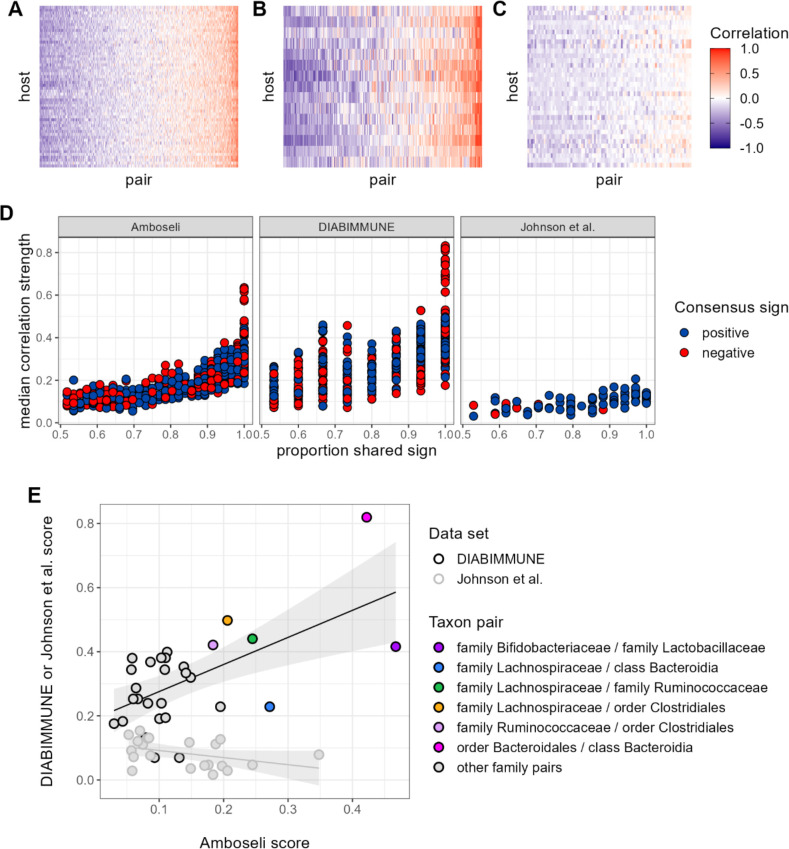
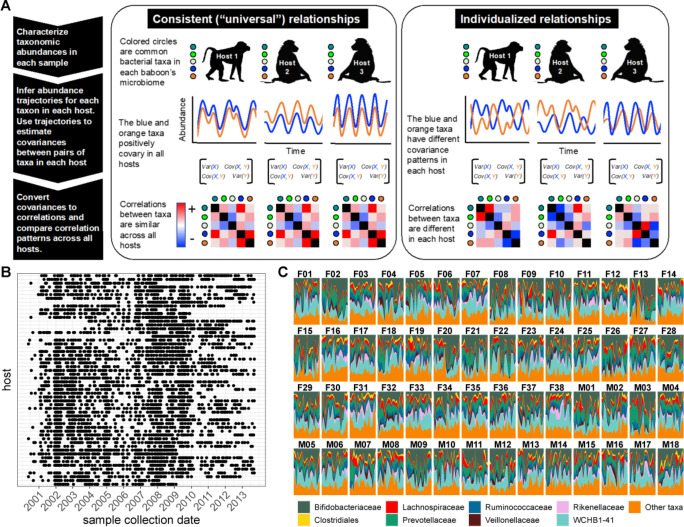
Ecological relationships between bacteria mediate the services that gut microbiomes provide to their hosts. Knowing the overall direction and strength of these relationships is essential to learn how ecology scales up to affect microbiome assembly, dynamics, and host health. However, whether bacterial relationships are generalizable across hosts or personalized to individual hosts is debated. Here, we apply a robust, multinomial logistic-normal modeling framework to extensive time series data (5534 samples from 56 baboon hosts over 13 years) to infer thousands of correlations in bacterial abundance in individual baboons and test the degree to which bacterial abundance correlations are 'universal'. We also compare these patterns to two human data sets. We find that, most bacterial correlations are weak, negative, and universal across hosts, such that shared correlation patterns dominate over host-specific correlations by almost twofold. Further, taxon pairs that had inconsistent correlation signs (either positive or negative) in different hosts always had weak correlations within hosts. From the host perspective, host pairs with the most similar bacterial correlation patterns also had similar microbiome taxonomic compositions and tended to be genetic relatives. Compared to humans, universality in baboons was similar to that in human infants, and stronger than one data set from human adults. Bacterial families that showed universal correlations in human infants were often universal in baboons. Together, our work contributes new tools for analyzing the universality of bacterial associations across hosts, with implications for microbiome personalization, community assembly, and stability, and for designing microbiome interventions to improve host health.

摘要

细菌之间的生态关系介导了肠道微生物组为其宿主提供的服务。了解这些关系的总体方向和强度对于了解生态学如何扩展以影响微生物组组装、动态和宿主健康至关重要。然而,细菌关系是否可以在宿主之间推广,或者个性化到个体宿主,这一点存在争议。在这里,我们应用了一个稳健的、多项逻辑正态建模框架,对广泛的时间序列数据(56 只狒狒宿主 13 年的 5534 个样本)进行了分析,以推断出个体狒狒中数千个细菌丰度相关性,并测试了细菌丰度相关性的普遍程度。我们还将这些模式与两个人类数据集进行了比较。我们发现,大多数细菌相关性是微弱的、负相关的,并且在宿主之间是普遍存在的,因此共享的相关模式几乎是宿主特异性相关模式的两倍。此外,在不同宿主中具有不一致相关符号(正相关或负相关)的分类群对在宿主内总是具有较弱的相关性。从宿主的角度来看,具有最相似细菌相关性模式的宿主对也具有相似的微生物组分类组成,并且往往是遗传亲属。与人类相比,狒狒的普遍性与人类婴儿相似,并且比来自人类成年人的一个数据集更强。在人类婴儿中显示出普遍相关性的细菌科通常在狒狒中也具有普遍性。总的来说,我们的工作为分析宿主间细菌关联的普遍性提供了新的工具,这对微生物组个性化、群落组装和稳定性以及设计改善宿主健康的微生物组干预措施具有重要意义。
https://cdn.ncbi.nlm.nih.gov/pmc/blobs/908c/10292843/f34b6a19925e/elife-83152-fig6.jpg
https://cdn.ncbi.nlm.nih.gov/pmc/blobs/908c/10292843/6fc0757badee/elife-83152-fig1.jpg
https://cdn.ncbi.nlm.nih.gov/pmc/blobs/908c/10292843/3cb80e89b16b/elife-83152-fig1-figsupp1.jpg
https://cdn.ncbi.nlm.nih.gov/pmc/blobs/908c/10292843/f725840040b6/elife-83152-fig1-figsupp2.jpg
https://cdn.ncbi.nlm.nih.gov/pmc/blobs/908c/10292843/20318ef5be53/elife-83152-fig1-figsupp3.jpg
https://cdn.ncbi.nlm.nih.gov/pmc/blobs/908c/10292843/f44740857a91/elife-83152-fig2.jpg
https://cdn.ncbi.nlm.nih.gov/pmc/blobs/908c/10292843/7f86f3d38e1b/elife-83152-fig2-figsupp1.jpg
https://cdn.ncbi.nlm.nih.gov/pmc/blobs/908c/10292843/9deeb28ff0c8/elife-83152-fig2-figsupp2.jpg
https://cdn.ncbi.nlm.nih.gov/pmc/blobs/908c/10292843/e53ebccef8ef/elife-83152-fig2-figsupp3.jpg
https://cdn.ncbi.nlm.nih.gov/pmc/blobs/908c/10292843/05b6e3bf24a7/elife-83152-fig2-figsupp4.jpg
https://cdn.ncbi.nlm.nih.gov/pmc/blobs/908c/10292843/823d932bd892/elife-83152-fig3.jpg
https://cdn.ncbi.nlm.nih.gov/pmc/blobs/908c/10292843/b223a5b42942/elife-83152-fig3-figsupp1.jpg
https://cdn.ncbi.nlm.nih.gov/pmc/blobs/908c/10292843/dfa425427b63/elife-83152-fig3-figsupp2.jpg
https://cdn.ncbi.nlm.nih.gov/pmc/blobs/908c/10292843/ddd1218e3dd1/elife-83152-fig4.jpg
https://cdn.ncbi.nlm.nih.gov/pmc/blobs/908c/10292843/5f5df4053f5a/elife-83152-fig4-figsupp1.jpg
https://cdn.ncbi.nlm.nih.gov/pmc/blobs/908c/10292843/12e84ee4b096/elife-83152-fig4-figsupp2.jpg
https://cdn.ncbi.nlm.nih.gov/pmc/blobs/908c/10292843/0f6f09d510ab/elife-83152-fig4-figsupp3.jpg
https://cdn.ncbi.nlm.nih.gov/pmc/blobs/908c/10292843/f0a23014817b/elife-83152-fig4-figsupp4.jpg
https://cdn.ncbi.nlm.nih.gov/pmc/blobs/908c/10292843/44f8263dd705/elife-83152-fig4-figsupp5.jpg
https://cdn.ncbi.nlm.nih.gov/pmc/blobs/908c/10292843/3c9fc597e9a0/elife-83152-fig5.jpg
https://cdn.ncbi.nlm.nih.gov/pmc/blobs/908c/10292843/4ca5bd3e5443/elife-83152-fig5-figsupp1.jpg
https://cdn.ncbi.nlm.nih.gov/pmc/blobs/908c/10292843/1a39ac5b4f6b/elife-83152-fig5-figsupp2.jpg
https://cdn.ncbi.nlm.nih.gov/pmc/blobs/908c/10292843/9136d4d55470/elife-83152-fig5-figsupp3.jpg
https://cdn.ncbi.nlm.nih.gov/pmc/blobs/908c/10292843/f34b6a19925e/elife-83152-fig6.jpg
https://cdn.ncbi.nlm.nih.gov/pmc/blobs/908c/10292843/6fc0757badee/elife-83152-fig1.jpg
https://cdn.ncbi.nlm.nih.gov/pmc/blobs/908c/10292843/3cb80e89b16b/elife-83152-fig1-figsupp1.jpg
https://cdn.ncbi.nlm.nih.gov/pmc/blobs/908c/10292843/f725840040b6/elife-83152-fig1-figsupp2.jpg
https://cdn.ncbi.nlm.nih.gov/pmc/blobs/908c/10292843/20318ef5be53/elife-83152-fig1-figsupp3.jpg
https://cdn.ncbi.nlm.nih.gov/pmc/blobs/908c/10292843/f44740857a91/elife-83152-fig2.jpg
https://cdn.ncbi.nlm.nih.gov/pmc/blobs/908c/10292843/7f86f3d38e1b/elife-83152-fig2-figsupp1.jpg
https://cdn.ncbi.nlm.nih.gov/pmc/blobs/908c/10292843/9deeb28ff0c8/elife-83152-fig2-figsupp2.jpg
https://cdn.ncbi.nlm.nih.gov/pmc/blobs/908c/10292843/e53ebccef8ef/elife-83152-fig2-figsupp3.jpg
https://cdn.ncbi.nlm.nih.gov/pmc/blobs/908c/10292843/05b6e3bf24a7/elife-83152-fig2-figsupp4.jpg
https://cdn.ncbi.nlm.nih.gov/pmc/blobs/908c/10292843/823d932bd892/elife-83152-fig3.jpg
https://cdn.ncbi.nlm.nih.gov/pmc/blobs/908c/10292843/b223a5b42942/elife-83152-fig3-figsupp1.jpg
https://cdn.ncbi.nlm.nih.gov/pmc/blobs/908c/10292843/dfa425427b63/elife-83152-fig3-figsupp2.jpg
https://cdn.ncbi.nlm.nih.gov/pmc/blobs/908c/10292843/ddd1218e3dd1/elife-83152-fig4.jpg
https://cdn.ncbi.nlm.nih.gov/pmc/blobs/908c/10292843/5f5df4053f5a/elife-83152-fig4-figsupp1.jpg
https://cdn.ncbi.nlm.nih.gov/pmc/blobs/908c/10292843/12e84ee4b096/elife-83152-fig4-figsupp2.jpg
https://cdn.ncbi.nlm.nih.gov/pmc/blobs/908c/10292843/0f6f09d510ab/elife-83152-fig4-figsupp3.jpg
https://cdn.ncbi.nlm.nih.gov/pmc/blobs/908c/10292843/f0a23014817b/elife-83152-fig4-figsupp4.jpg
https://cdn.ncbi.nlm.nih.gov/pmc/blobs/908c/10292843/44f8263dd705/elife-83152-fig4-figsupp5.jpg
https://cdn.ncbi.nlm.nih.gov/pmc/blobs/908c/10292843/3c9fc597e9a0/elife-83152-fig5.jpg
https://cdn.ncbi.nlm.nih.gov/pmc/blobs/908c/10292843/4ca5bd3e5443/elife-83152-fig5-figsupp1.jpg
https://cdn.ncbi.nlm.nih.gov/pmc/blobs/908c/10292843/1a39ac5b4f6b/elife-83152-fig5-figsupp2.jpg
https://cdn.ncbi.nlm.nih.gov/pmc/blobs/908c/10292843/9136d4d55470/elife-83152-fig5-figsupp3.jpg
https://cdn.ncbi.nlm.nih.gov/pmc/blobs/908c/10292843/f34b6a19925e/elife-83152-fig6.jpg

相似文献

1
Universal gut microbial relationships in the gut microbiome of wild baboons.野生狒狒肠道微生物组中的普遍肠道微生物关系。
Elife. 2023 May 9;12:e83152. doi: 10.7554/eLife.83152.
2
Synchrony and idiosyncrasy in the gut microbiome of wild baboons.野生狒狒肠道微生物组的同步性和变异性。
Nat Ecol Evol. 2022 Jul;6(7):955-964. doi: 10.1038/s41559-022-01773-4. Epub 2022 Jun 2.
3
Finding common connections.寻找共同联系。
Elife. 2023 Jun 26;12:e89468. doi: 10.7554/eLife.89468.
4
Taxonomic, Genomic, and Functional Variation in the Gut Microbiomes of Wild Spotted Hyenas Across 2 Decades of Study.二十年来对野生斑点鬣狗肠道微生物组的分类、基因组和功能变异研究。
mSystems. 2023 Feb 23;8(1):e0096522. doi: 10.1128/msystems.00965-22. Epub 2022 Dec 19.
5
Disentangling the Relative Roles of Vertical Transmission, Subsequent Colonizations, and Diet on Cockroach Microbiome Assembly.解析蟑螂微生物组组装中垂直传播、后续定植和饮食的相对作用。
mSphere. 2021 Jan 6;6(1):e01023-20. doi: 10.1128/mSphere.01023-20.
6
Large Comparative Analyses of Primate Body Site Microbiomes Indicate that the Oral Microbiome Is Unique among All Body Sites and Conserved among Nonhuman Primates.大型灵长类动物体部位微生物组比较分析表明,口腔微生物组在所有体部位中是独特的,并且在非人类灵长类动物中是保守的。
Microbiol Spectr. 2022 Jun 29;10(3):e0164321. doi: 10.1128/spectrum.01643-21. Epub 2022 May 19.
7
The microbiome of captive hamadryas baboons.圈养阿拉伯狒狒的微生物组。
Anim Microbiome. 2020 Jul 16;2(1):25. doi: 10.1186/s42523-020-00040-w.
8
Effects of domestication on the gut microbiota parallel those of human industrialization.驯化对肠道微生物群的影响与人类工业化的影响相似。
Elife. 2021 Mar 23;10:e60197. doi: 10.7554/eLife.60197.
9
Development, diet and dynamism: longitudinal and cross-sectional predictors of gut microbial communities in wild baboons.发育、饮食与活力:野生狒狒肠道微生物群落的纵向和横断面预测因素
Environ Microbiol. 2016 May;18(5):1312-25. doi: 10.1111/1462-2920.12852. Epub 2015 Apr 28.
10
The Core Gut Microbiome of the American Cockroach, Periplaneta americana, Is Stable and Resilient to Dietary Shifts.美国蟑螂(美洲大蠊)的核心肠道微生物群稳定且对饮食变化具有抗性。
Appl Environ Microbiol. 2016 Oct 27;82(22):6603-6610. doi: 10.1128/AEM.01837-16. Print 2016 Nov 15.

引用本文的文献

1
Gut microbiome communities demonstrate fine-scale spatial variation in a closed, island bird population.在一个封闭的岛屿鸟类种群中,肠道微生物群落呈现出精细尺度的空间变异。
ISME Commun. 2025 Aug 11;5(1):ycaf138. doi: 10.1093/ismeco/ycaf138. eCollection 2025 Jan.
2
Eukaryotic composition across seasons and social groups in the gut microbiota of wild baboons.野生狒狒肠道微生物群中跨季节和社会群体的真核生物组成
Anim Microbiome. 2025 Jun 21;7(1):70. doi: 10.1186/s42523-025-00436-6.
3
Social and environmental predictors of gut microbiome age in wild baboons.

本文引用的文献

1
Emergent phases of ecological diversity and dynamics mapped in microcosms.微观世界中生态多样性和动态变化的突发阶段
Science. 2022 Oct 7;378(6615):85-89. doi: 10.1126/science.abm7841. Epub 2022 Oct 6.
2
Gut microbiota individuality is contingent on temporal scale and age in wild meerkats.野生猫鼬的肠道微生物个体性取决于时间尺度和年龄。
Proc Biol Sci. 2022 Aug 31;289(1981):20220609. doi: 10.1098/rspb.2022.0609. Epub 2022 Aug 17.
3
Synchrony and idiosyncrasy in the gut microbiome of wild baboons.野生狒狒肠道微生物组的同步性和变异性。
野生狒狒肠道微生物群年龄的社会和环境预测因素
Elife. 2025 Apr 17;13:RP102166. doi: 10.7554/eLife.102166.
4
Parasite-gut microbiota associations in wild wood mice ().野生林鼠体内寄生虫与肠道微生物群的关联()。 (注:原文括号部分内容缺失,所以译文括号部分也只能原样保留)
Front Microbiol. 2024 Nov 18;15:1440427. doi: 10.3389/fmicb.2024.1440427. eCollection 2024.
5
Social and environmental predictors of gut microbiome age in wild baboons.野生狒狒肠道微生物群年龄的社会和环境预测因素
bioRxiv. 2024 Dec 24:2024.08.02.605707. doi: 10.1101/2024.08.02.605707.
6
Methanogenic patterns in the gut microbiome are associated with survival in a population of feral horses.肠道微生物组中的产甲烷模式与野生马群中的生存有关。
Nat Commun. 2024 Jul 22;15(1):6012. doi: 10.1038/s41467-024-49963-x.
7
High diversity, close genetic relatedness, and favorable living conditions benefit species co-occurrence of gut microbiota in Brandt's vole.高多样性、密切的遗传相关性和适宜的生活条件有利于布氏田鼠肠道微生物群的物种共现。
Front Microbiol. 2024 Feb 7;15:1337402. doi: 10.3389/fmicb.2024.1337402. eCollection 2024.
8
Gut microbiota variations in wild yellow baboons (Papio cynocephalus) are associated with sex and habitat disturbance.野生黄狒狒(Papio cynocephalus)肠道微生物群的变化与性别和栖息地干扰有关。
Sci Rep. 2024 Jan 9;14(1):869. doi: 10.1038/s41598-023-50126-z.
9
What are patterns of rise and decline?上升和下降的模式是什么?
R Soc Open Sci. 2023 Nov 15;10(11):230052. doi: 10.1098/rsos.230052. eCollection 2023 Nov.
10
Fecal microbiota of the synanthropic golden jackal (Canis aureus).共生金豺(金豺)的粪便微生物群。
Anim Microbiome. 2023 Aug 5;5(1):37. doi: 10.1186/s42523-023-00259-3.
Nat Ecol Evol. 2022 Jul;6(7):955-964. doi: 10.1038/s41559-022-01773-4. Epub 2022 Jun 2.
4
Bacterial species rarely work together.细菌种类很少共同协作。
Science. 2022 May 6;376(6593):581-582. doi: 10.1126/science.abn5093. Epub 2022 May 5.
5
The impact of environmental pH on the gut microbiota community structure and short chain fatty acid production.环境 pH 值对肠道微生物群落结构和短链脂肪酸产生的影响。
FEMS Microbiol Ecol. 2022 May 14;98(5). doi: 10.1093/femsec/fiac038.
6
Metabolic cross-feeding structures the assembly of polysaccharide degrading communities.代谢交叉喂养构建了多糖降解群落的组装。
Sci Adv. 2022 Feb 25;8(8):eabk3076. doi: 10.1126/sciadv.abk3076. Epub 2022 Feb 23.
7
Gut microbiome and health: mechanistic insights.肠道微生物组与健康:作用机制的见解。
Gut. 2022 May;71(5):1020-1032. doi: 10.1136/gutjnl-2021-326789. Epub 2022 Feb 1.
8
In vitro interaction network of a synthetic gut bacterial community.合成肠道细菌群落的体外相互作用网络。
ISME J. 2022 Apr;16(4):1095-1109. doi: 10.1038/s41396-021-01153-z. Epub 2021 Dec 2.
9
Positive interactions are common among culturable bacteria.在可培养的细菌中,积极的相互作用很常见。
Sci Adv. 2021 Nov 5;7(45):eabi7159. doi: 10.1126/sciadv.abi7159.
10
Diurnal oscillations in gut bacterial load and composition eclipse seasonal and lifetime dynamics in wild meerkats.肠道细菌负荷和组成的昼夜波动掩盖了野生猫鼬的季节性和终生动态。
Nat Commun. 2021 Oct 14;12(1):6017. doi: 10.1038/s41467-021-26298-5.