MIIT Key Laboratory of Critical Materials Technology for New Energy Conversion and Storage, State Key Laboratory of Urban Water Resource and Environment, School of Chemistry and Chemical Engineering, Harbin Institute of Technology, Harbin, PR China.
School of Engineering, The University of Edinburgh, The King's Buildings, Edinburgh, UK.
Nat Commun. 2023 May 9;14(1):2679. doi: 10.1038/s41467-023-38419-3.
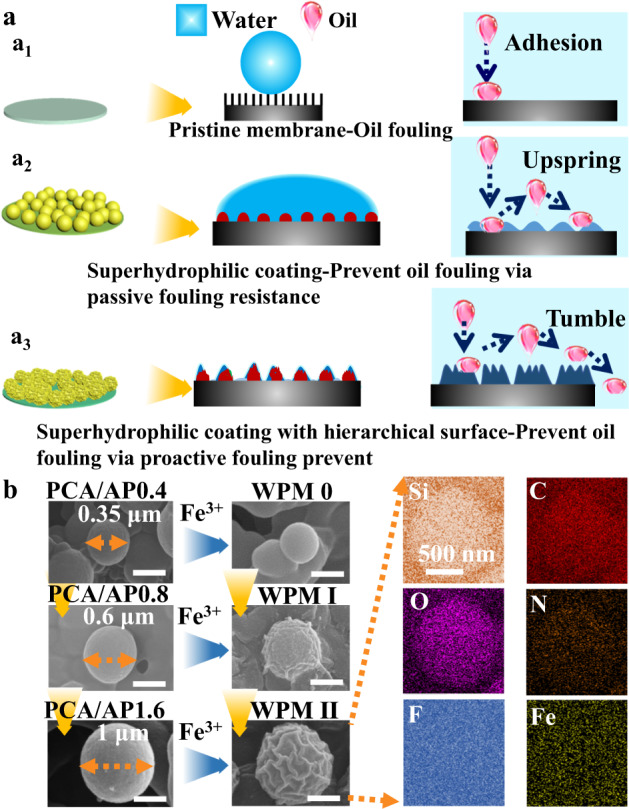
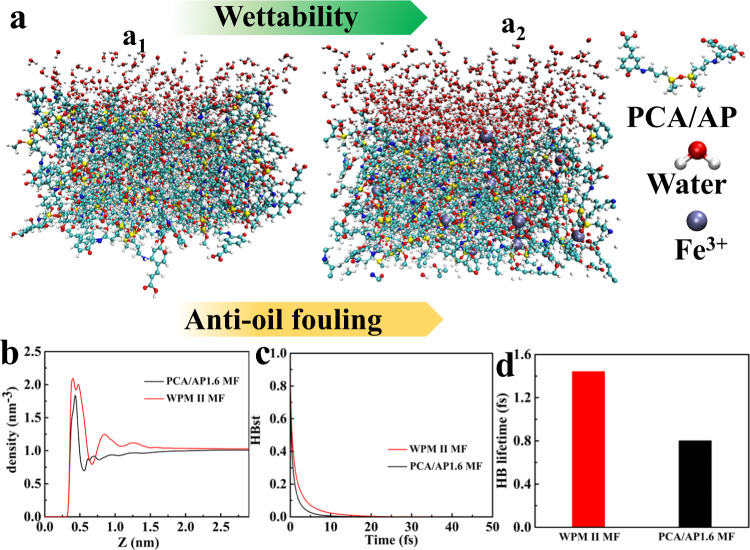
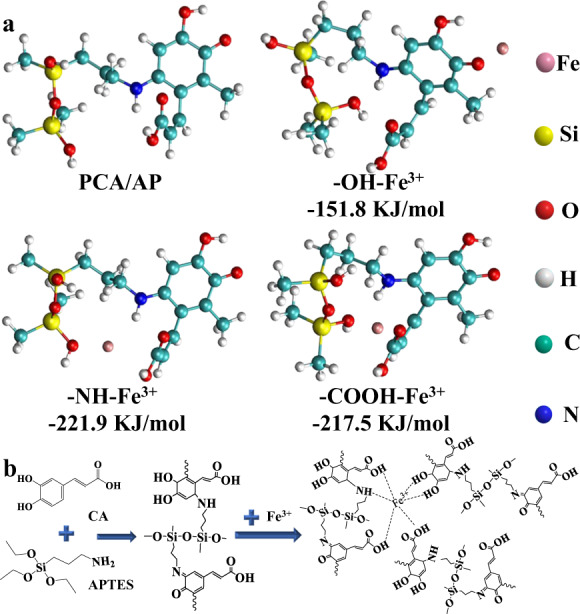
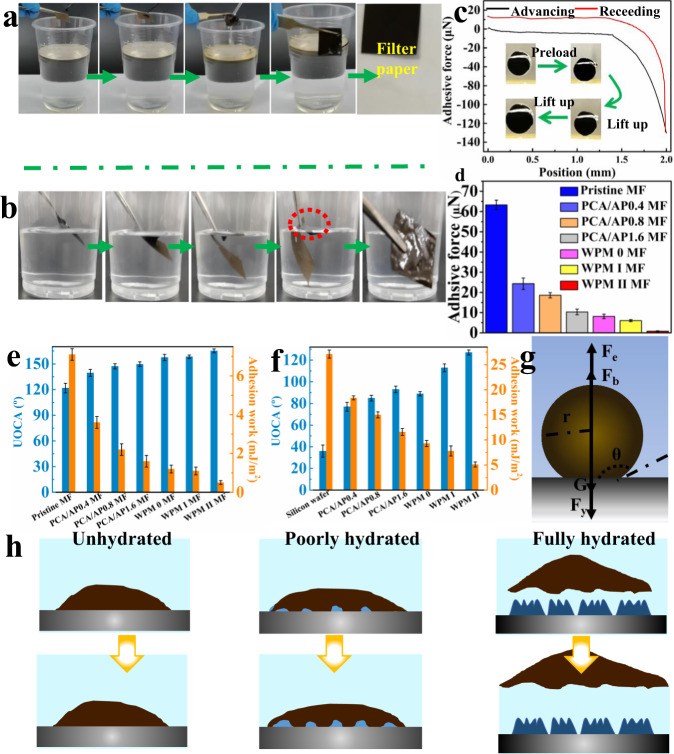
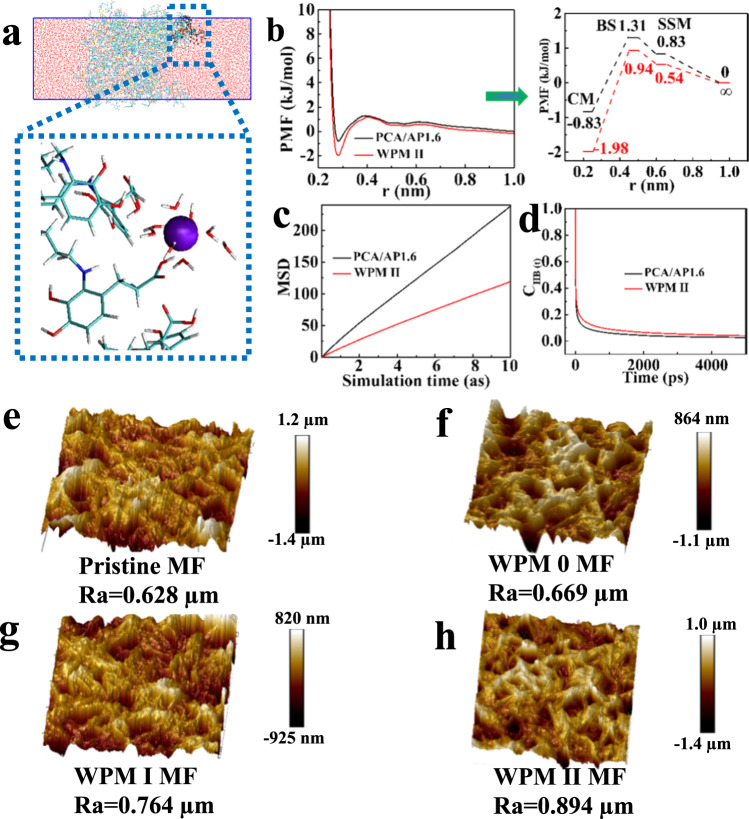
Here, we present a proactive fouling prevention mechanism that endows superhydrophilic membranes with antifouling capability against migratory viscous crude oil fouling. By simulating the hierarchical architecture/chemical composition of a dahlia leaf, a membrane surface is decorated with wrinkled-pattern microparticles, exhibiting a unique proactive fouling prevention mechanism based on a synergistic hydration layer/steric hindrance. The density functional theory and physicochemical characterizations demonstrate that the main chains of the microparticles are bent towards Fe through coordination interactions to create nanoscale wrinkled patterns on smooth microparticle surfaces. Nanoscale wrinkled patterns reduce the surface roughness and increase the contact area between the membrane surface and water molecules, expanding the steric hindrance between the oil molecules and membrane surface. Molecular dynamic simulations reveal that the water-molecule densities and strengths of the hydrogen bonds are higher near the resultant membrane surface. With this concept, we can successfully inhibit the initial adhesion, migration, and deposition of oil, regardless of the viscosity, on the membrane surface and achieve migratory viscous crude oil antifouling. This research on the PFP mechanism opens pathways to realize superwettable materials for diverse applications in fields related to the environment, energy, health, and beyond.
在这里,我们提出了一种主动防污机制,赋予超亲水膜抗迁移粘性原油污染的防污能力。通过模拟大丽花叶子的分层结构/化学成分,在膜表面上装饰有波纹图案的微粒子,基于协同水合层/空间位阻作用,展现出独特的主动防污机制。密度泛函理论和物理化学特性表明,微粒子的主链通过配位相互作用向 Fe 弯曲,在光滑的微粒子表面上形成纳米级的褶皱图案。纳米级褶皱图案降低了表面粗糙度并增加了膜表面与水分子之间的接触面积,增加了油分子与膜表面之间的空间位阻。分子动力学模拟表明,在所得膜表面附近,水分子的密度和氢键的强度更高。基于这一概念,我们可以成功地抑制油在膜表面上的初始粘附、迁移和沉积,无论其粘度如何,从而实现迁移粘性原油的防污。这项关于 PFP 机制的研究为实现用于环境、能源、健康等领域相关应用的超润湿材料开辟了道路。