Rashid Selena, Ardeljan Amalia, Frankel Lexi R, Cardeiro Matthew, Kim Enoch, Nagel Brittany M, Takabe Kazuaki, Rashid Omar
Department of Surgery, Michael and Dianne Bienes Comprehensive Cancer Center, Holy Cross Health, Fort Lauderdale, USA.
Department of Allopathic Medicine, Nova Southeastern University, Dr. Kiran C. Patel College of Allopathic Medicine, Fort Lauderdale, USA.
Cureus. 2023 Apr 7;15(4):e37265. doi: 10.7759/cureus.37265. eCollection 2023 Apr.
Cytomegalovirus (CMV) causes a long-lasting, asymptomatic infection that reportedly has both advantageous and deleterious effects on tumor progression. The purpose of this study was to evaluate the correlation between CMV infection and the incidence of bronchogenic carcinoma.
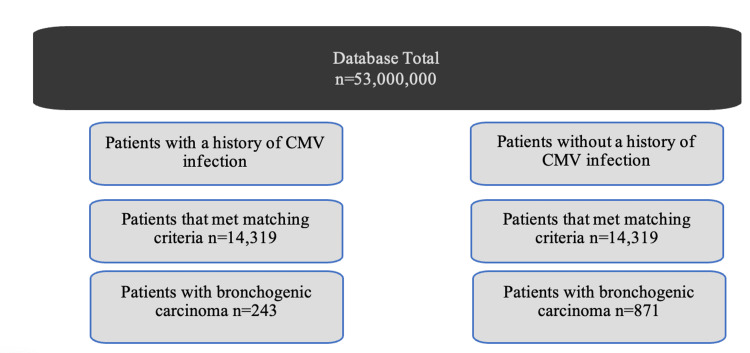
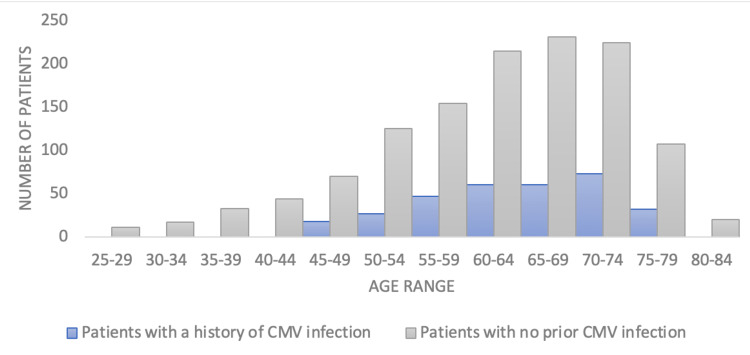
The study was conducted using a Health Insurance Portability and Accountability Act (HIPAA) compliant national database to identify patients both with and without histories of CMV infection using International Classification of Diseases (ICD-10 and ICD-9) codes. Access to the database was granted by Holy Cross Health, Fort Lauderdale for the purpose of academic research with standard statistical methods used to analyze the data. 14,319 patients were included in both the control and CMV-exposed groups and matched by age range and Charlson Comorbidity Index (CCI) scores.
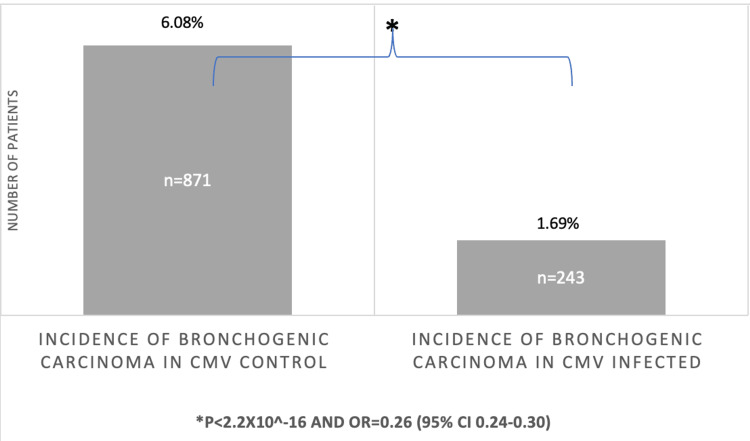
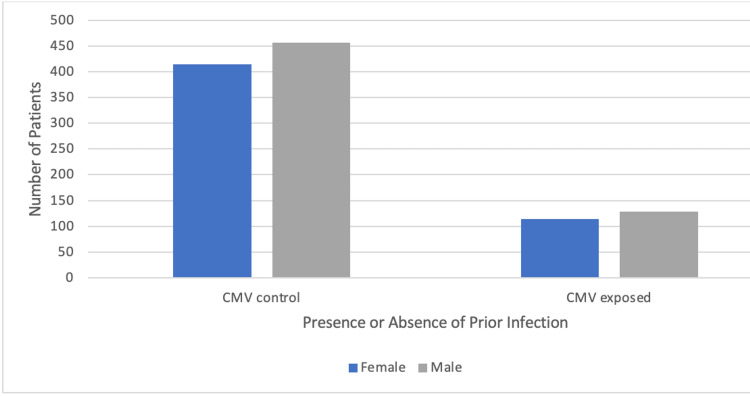
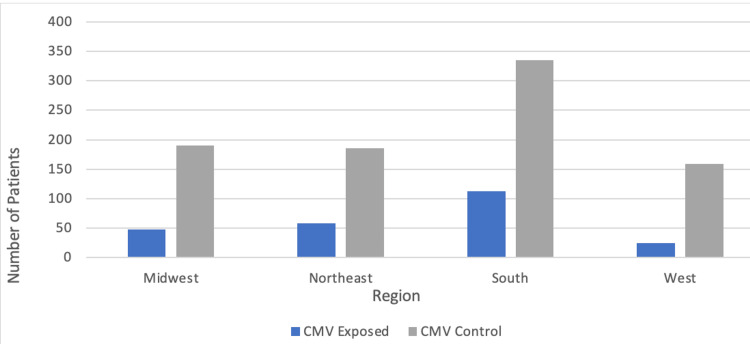
The incidence of bronchogenic carcinoma was 1.69% (243/14,319 patients) in the CMV group and 6.08% (871/14,319 patients) in the control group. The difference was statistically significant by a p-value of less than 2.6x10 with an odds ratio of 0.26 (95% CI: 0.24-0.30). The two groups were also matched for treatment. Further evaluation of the CMV-specific treatment effects on outcomes was limited due to the insufficient number of treated patients in the control group.
This study found a statistically significant correlation between a prior CMV infection and a reduced incidence of bronchogenic carcinoma. This study demonstrates the need for further investigation into how the tumor microenvironment and host immune system are altered by the presence of a latent CMV infection.
巨细胞病毒(CMV)会引发一种持续时间长且无症状的感染,据报道这种感染对肿瘤进展既有有利影响也有有害影响。本研究的目的是评估CMV感染与支气管癌发病率之间的相关性。
本研究使用了一个符合《健康保险流通与责任法案》(HIPAA)的全国性数据库,通过国际疾病分类(ICD - 10和ICD - 9)编码来确定有和没有CMV感染病史的患者。劳德代尔堡的圣十字健康机构为学术研究目的提供了数据库访问权限,并使用标准统计方法对数据进行分析。对照组和CMV暴露组均纳入14319名患者,并根据年龄范围和查尔森合并症指数(CCI)评分进行匹配。
CMV组支气管癌的发病率为1.69%(243/14319例患者),对照组为6.08%(871/14319例患者)。差异具有统计学意义,p值小于2.6×10,优势比为0.26(95%CI:0.24 - 0.30)。两组在治疗方面也进行了匹配。由于对照组中接受治疗的患者数量不足,对CMV特异性治疗效果对结局的进一步评估受到限制。
本研究发现既往CMV感染与支气管癌发病率降低之间存在统计学上的显著相关性。本研究表明需要进一步调查潜伏性CMV感染的存在如何改变肿瘤微环境和宿主免疫系统。