Department of Virology, Institute of Microbiology and Immunology, 1 Dr Subotica Street, 11000 Belgrade, Serbia.
Faculty of Medicine, University of Belgrade, 8 Dr Subotica Street, 11000 Belgrade, Serbia.
Int J Mol Sci. 2024 Mar 27;25(7):3741. doi: 10.3390/ijms25073741.
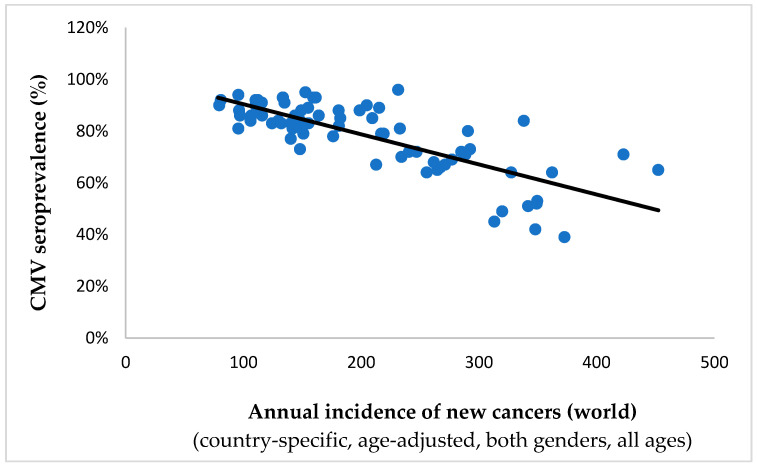
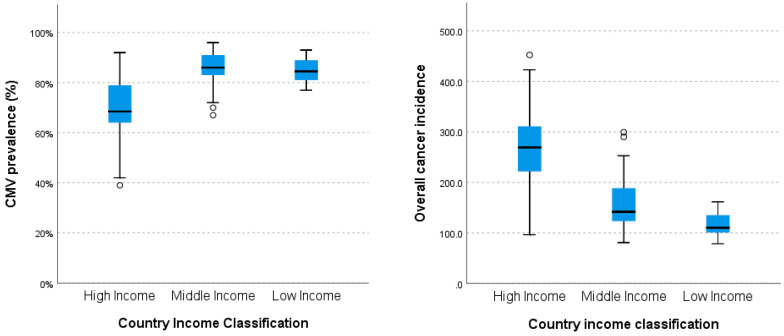
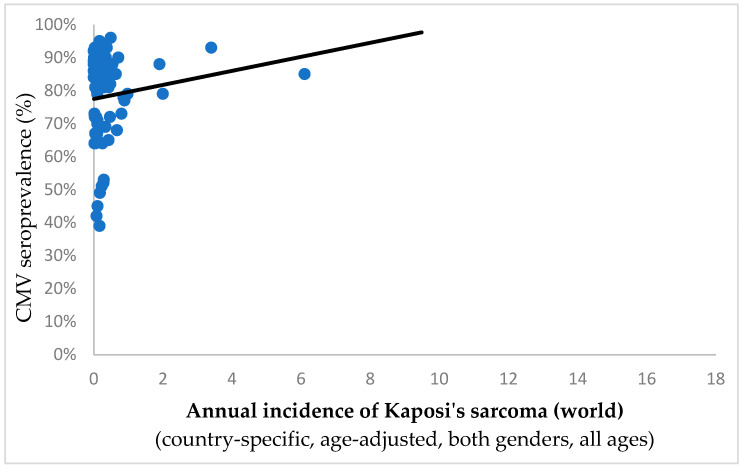
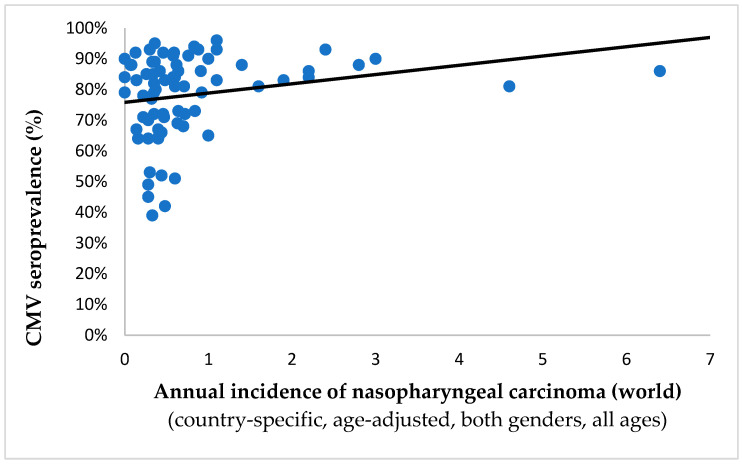
The oncogenicity of the human cytomegalovirus (CMV) is currently being widely debated. Most recently, mounting clinical evidence suggests an anti-cancer effect via CMV-induced T cell-mediated tumor destruction. However, the data were mostly obtained from single-center studies and in vitro experiments. Broad geographic coverage is required to offer a global perspective. Our study examined the correlation between country-specific CMV seroprevalence (across 73 countries) and the age-standardized incidence rate (of 34 invasive tumors). The populations studied were stratified according to decadal age periods as the immunologic effects of CMV seropositivity may depend upon age at initial infection. The International Agency for Research on Cancer of the World Health Organization (IARC WHO) database was used. The multivariate linear regression analysis revealed a worldwide inverse correlation between CMV seroprevalence and the incidences of 62.8% tumors. Notably, this inverse link persists for all cancers combined (Spearman's ρ = -0.732, < 0.001; β = -0.482, < 0.001, adjusted R = 0.737). An antithetical and significant correlation was also observed in particular age groups for the vast majority of tumors. Our results corroborate the conclusions of previous studies and indicate that this oncopreventive phenomenon holds true on a global scale. It applies to a wide spectrum of cancer histologies, additionally supporting the idea of a common underlying mechanism-CMV-stimulated T cell tumor targeting. Although these results further advance the notion of CMV-based therapies, in-depth investigation of host-virus interactions is still warranted.
人巨细胞病毒(CMV)的致癌性目前正在广泛讨论。最近,越来越多的临床证据表明,CMV 通过诱导 T 细胞介导的肿瘤破坏具有抗癌作用。然而,这些数据主要来自单中心研究和体外实验。需要广泛的地理覆盖范围来提供全球视角。我们的研究检查了特定国家的 CMV 血清流行率(涉及 73 个国家)与 34 种侵袭性肿瘤的年龄标准化发病率之间的相关性。根据 10 年年龄期对研究人群进行分层,因为 CMV 血清阳性的免疫效应可能取决于初次感染时的年龄。使用了世界卫生组织国际癌症研究机构(IARC-WHO)数据库。多元线性回归分析显示,CMV 血清流行率与 62.8%肿瘤的发病率呈全球负相关。值得注意的是,这种负相关关系对于所有癌症的总和仍然存在(Spearman's ρ = -0.732,<0.001;β = -0.482,<0.001,调整 R = 0.737)。在绝大多数肿瘤中,大多数特定年龄组也观察到相反且显著的相关性。我们的结果证实了之前研究的结论,并表明这种肿瘤预防现象在全球范围内是真实存在的。它适用于广泛的癌症组织学,进一步支持了存在共同潜在机制——CMV 刺激的 T 细胞肿瘤靶向的观点。尽管这些结果进一步推动了基于 CMV 的治疗方法的发展,但仍需要深入研究宿主-病毒相互作用。