Department of Nephrology-Dialysis-Transplantation, University Hospital Centre of Nice, Nice, France.
Department of Pharmacology and Pharmacovigilance, University Hospital Centre of Nice, Nice, France.
BioDrugs. 2023 Jul;37(4):521-530. doi: 10.1007/s40259-023-00599-1. Epub 2023 May 11.
Chimeric antigen receptor T (CAR-T) cells have proven to be a game changer for treating several hematologic malignancies. Randomized controlled trials have highlighted potential life-threatening adverse drug reactions (ADRs), including cytokine release syndrome (CRS). Acute renal failure (ARF) has also been reported in 20% of the patients treated. However, an analysis of renal safety supported by large-scale real-life data seems warranted.
We queried VigiBase® for all reports of the Standardised MedDRA Query "acute renal failure" (ARF) involving a CAR-T cell, registered until 24 July 2022. Disproportionality for this ADR was analyzed through calculation of the Information Component [IC (95% confidence interval)]. A positive lower end of the 95% confidence interval of the IC is the threshold used in statistical signal detection in VigiBase®. The same analysis was carried out for various hydroelectrolytic disorders.
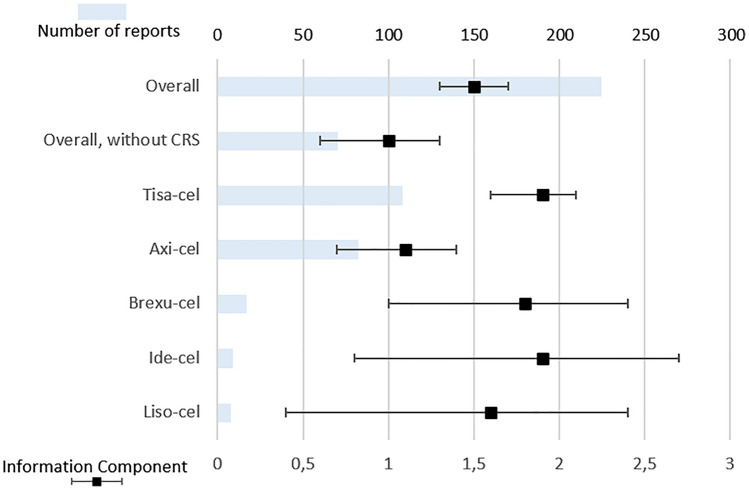
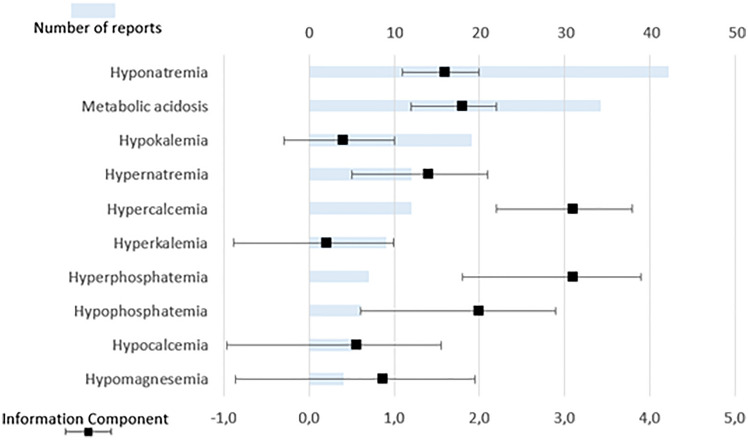
We gathered 224 reports of ARF, and 125 reports of hydroelectrolytic disorders involving CAR-T cells. CAR-T cells were disproportionately reported with ARF [IC 1.5 (1.3-1.7)], even after excluding reports mentioning CRS. A significant disproportionate reporting was also found for hypernatremia [IC 3.1 (2.2-3.8)], hyperphosphatemia [IC 3.1 (1.8-3.9)], hypophosphatemia [IC 2.0 (0.6-2.9)], metabolic acidosis [IC 1.8 (1.2-2.2)], hyponatremia [IC 1.6 (1.1-2.0)], and hypercalcemia [IC 1.4 (0.5-2.1)]. There was no disproportionate reporting of dyskalemia.
This study is limited by the inherent flaws of pharmacovigilance approaches. Nonetheless, our findings suggest that ARF and an array of hydroelectrolytic disorders are potential ADRs of CAR-T cell therapy, in real-life settings and in a nonselected population.
嵌合抗原受体 T(CAR-T)细胞已被证明在治疗多种血液系统恶性肿瘤方面具有变革性。随机对照试验强调了潜在的危及生命的药物不良反应(ADR),包括细胞因子释放综合征(CRS)。接受治疗的患者中有 20%也报告了急性肾衰竭(ARF)。然而,似乎需要通过大规模真实数据的安全性分析来支持对肾脏安全性的评估。
我们在 VigiBase®中查询了截至 2022 年 7 月 24 日登记的所有与 CAR-T 细胞相关的标准化 MedDRA 查询“急性肾衰竭”(ARF)报告。通过计算信息成分[IC(95%置信区间)]分析该 ADR 的比例失调情况。IC 的 95%置信区间下限的正值是 VigiBase®中统计信号检测使用的阈值。对各种水电解质紊乱也进行了同样的分析。
我们共收集了 224 例 ARF 报告和 125 例涉及 CAR-T 细胞的水电解质紊乱报告。CAR-T 细胞与 ARF 的报告不成比例[IC 1.5(1.3-1.7)],即使排除了报告中提到 CRS 的情况。还发现高钠血症[IC 3.1(2.2-3.8)]、高磷血症[IC 3.1(1.8-3.9)]、低磷血症[IC 2.0(0.6-2.9)]、代谢性酸中毒[IC 1.8(1.2-2.2)]、低钠血症[IC 1.6(1.1-2.0)]和高钙血症[IC 1.4(0.5-2.1)]的报告也不成比例。低钾血症的报告没有不成比例。
本研究受到药物警戒方法固有缺陷的限制。尽管如此,我们的研究结果表明,ARF 和一系列水电解质紊乱是 CAR-T 细胞治疗的潜在不良反应,无论是在真实环境中还是在非选择性人群中。