Parmentier T, Gaju-Ricart M, Wenseleers T, Molero-Baltanás R
Research Unit of Environmental and Evolutionary Biology, Namur Institute of Complex Systems, and Institute of Life, Earth, and the Environment, University of Namur, Rue de Bruxelles 61, B-5000, Namur, Belgium.
Terrestrial Ecology Unit (TEREC), Department of Biology, Ghent University, K.L. Ledeganckstraat 35, B-9000, Ghent, Belgium.
BMC Zool. 2022 May 11;7(1):23. doi: 10.1186/s40850-022-00118-9.
Host range is a fundamental trait to understand the ecological and evolutionary dynamics of symbionts. Increasing host specificity is expected to be accompanied with specialization in different symbiont traits. We tested this specificity-specialization association in a large group of 16 ant-associated silverfish species by linking their level of host specificity to their degree of behavioural integration into the colony and to their accuracy of chemically imitating the host's recognition system, i.e. the cuticular hydrocarbon (CHC) profile.
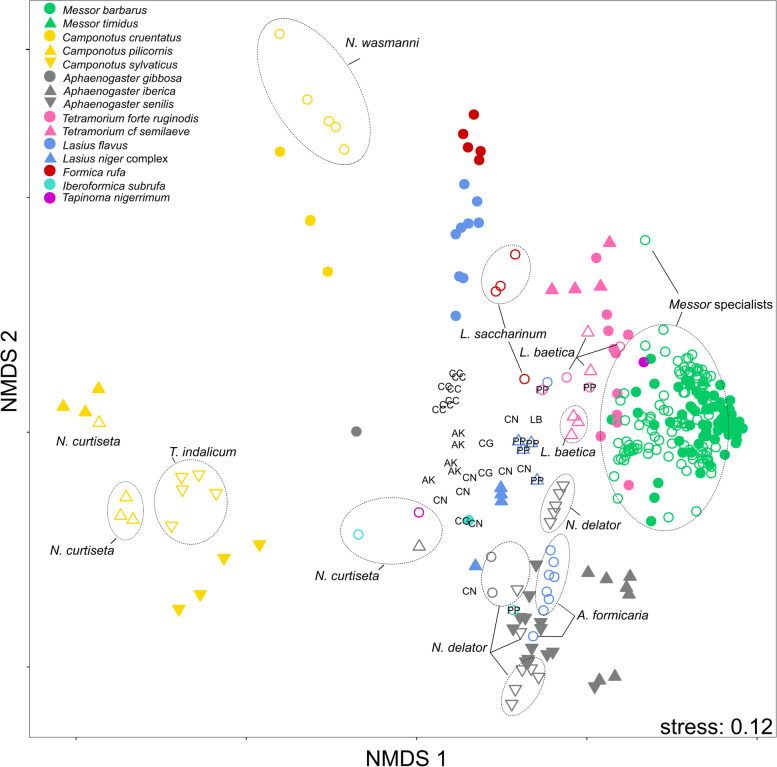
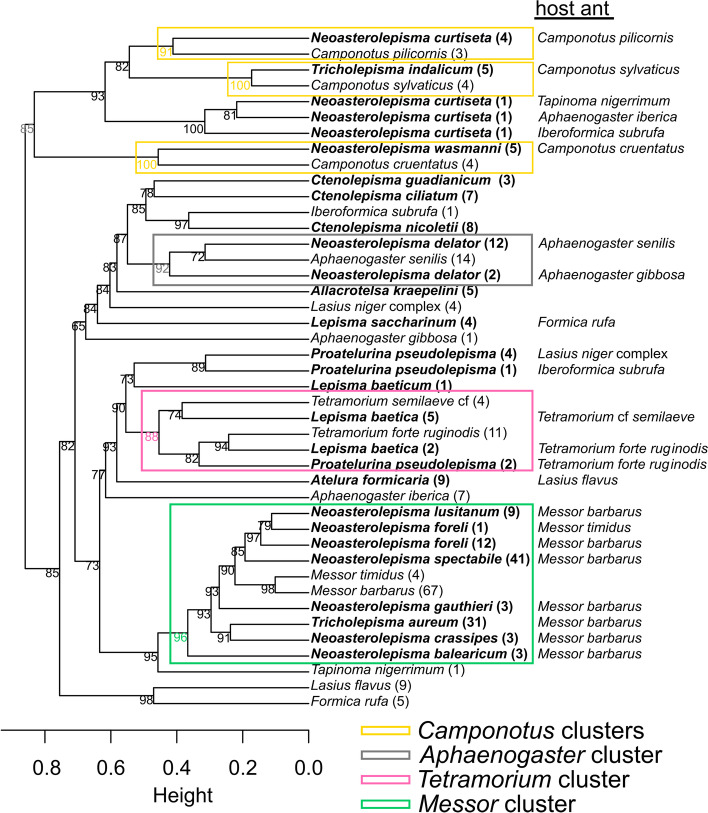
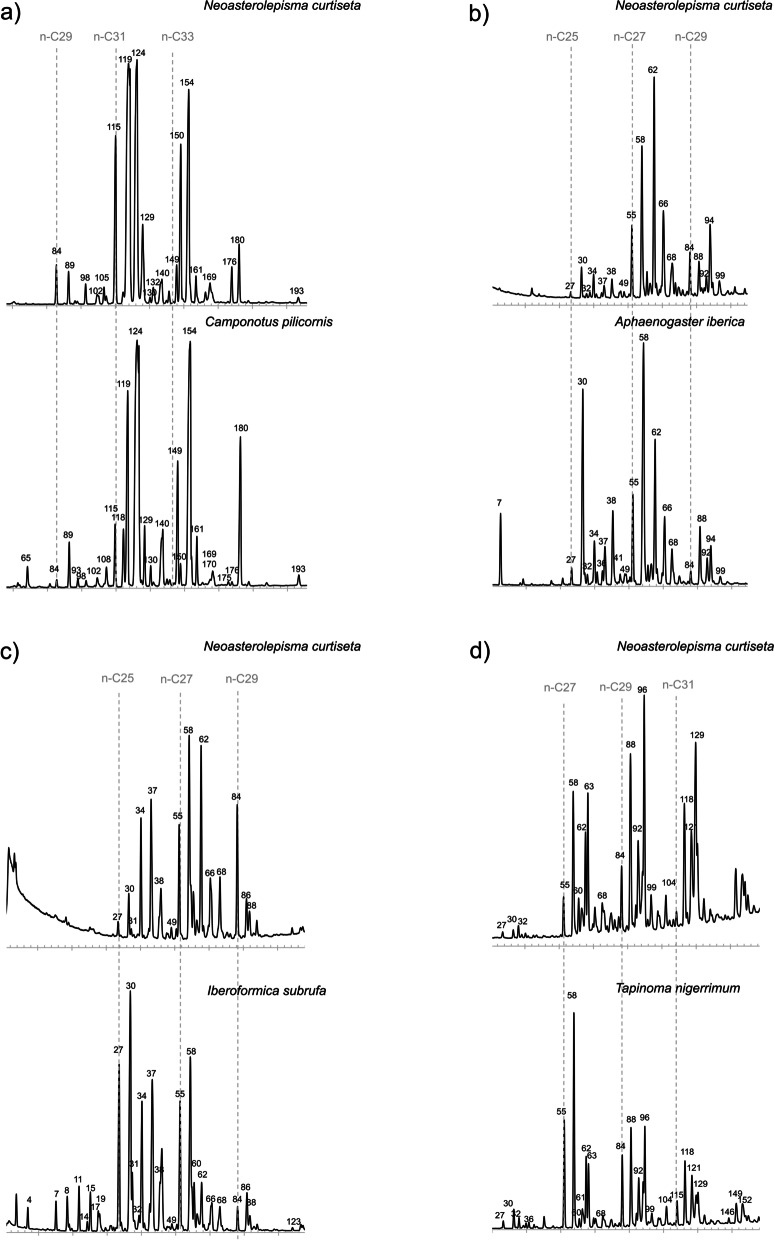
As expected, facultative associates and host generalists (targeting multiple unrelated ants) tend to avoid the host, whereas host-specialists (typically restricted to Messor ants) were bolder, approached the host and allowed inspection. Generalists and host specialists regularly followed a host worker, unlike the other silverfish. Host aggression was extremely high toward non-ant-associated silverfish and modest to low in ant-associated groups. Surprisingly, the degree of chemical deception was not linked to host specificity as most silverfish, including facultative ant associates, imitated the host's CHC profile. Messor specialists retained the same CHC profile as the host after moulting, in contrast to a host generalist, suggesting an active production of the cues (chemical mimicry). Host generalist and facultative associates flexibly copied the highly different CHC profiles of alternative host species, pointing at passive acquisition (chemical camouflage) of the host's odour.
Overall, we found that behaviour that seems to facilitate the integration in the host colony was more pronounced in host specialist silverfish. Chemical deception, however, was employed by all ant-associated species, irrespective of their degree of host specificity.
宿主范围是理解共生生物生态和进化动态的一个基本特征。宿主特异性的增加预计会伴随着共生生物不同特征的特化。我们通过将16种与蚂蚁相关的衣鱼的宿主特异性水平与其融入蚁群的行为程度以及化学模拟宿主识别系统(即表皮碳氢化合物(CHC)谱)的准确性联系起来,在一大组衣鱼物种中测试了这种特异性 - 特化关联。
正如预期的那样,兼性共生者和宿主通才(针对多种不相关的蚂蚁)往往会避开宿主,而宿主专性者(通常局限于收获蚁属蚂蚁)则更大胆,接近宿主并允许检查。与其他衣鱼不同,通才和宿主专性者经常跟随宿主工蚁。宿主对非蚂蚁相关的衣鱼攻击性极高,而对蚂蚁相关群体的攻击性则为中等至低。令人惊讶的是,化学欺骗程度与宿主特异性无关,因为大多数衣鱼,包括兼性蚂蚁共生者,都模仿了宿主的CHC谱。与宿主通才相比,收获蚁专性者在蜕皮后保留了与宿主相同的CHC谱,这表明存在对线索的主动产生(化学模拟)。宿主通才和兼性共生者灵活地复制了替代宿主物种高度不同的CHC谱,表明是对宿主气味的被动获取(化学伪装)。
总体而言,我们发现,在宿主专性衣鱼中,似乎有助于融入宿主蚁群的行为更为明显。然而,所有与蚂蚁相关的物种都采用了化学欺骗,无论其宿主特异性程度如何。