SAMRC/ Wits Centre for Health Economics and Decision Science, PRICELESS SA, Faculty of Health Sciences, School of Public Health, University of Witwatersrand, Johannesburg, South Africa.
SAMRC/ Wits Developmental Pathways for Health Research Unit, Faculty of Health Sciences, School of Clinical Medicine, University of the Witwatersrand, Johannesburg, South Africa.
BMC Public Health. 2023 May 12;23(1):873. doi: 10.1186/s12889-023-15761-1.
Voices of under-resourced communities are recognised as important yet are often unheard in decisions about healthcare resource allocation. Deliberative public engagement can serve as an effective mechanism for involving communities in establishing nutrition priorities. This study sought to identify the priorities of community members of a South African township, Soweto, and describe the underlying values driving their prioritisation process, to improve nutrition in the first 1000 days of life.
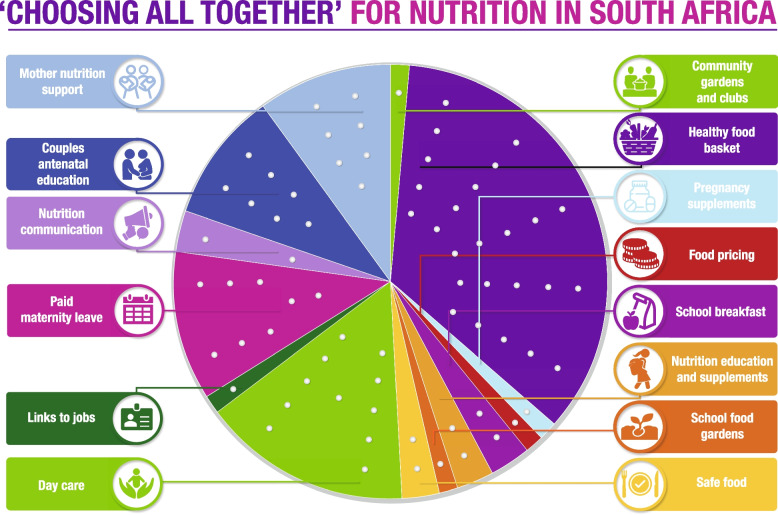
We engaged 54 community members (28 men and 26 women aged > 18 years) from Soweto. We conducted seven group discussions to determine how to allocate limited resources for prioritising nutrition interventions. We used a modified public engagement tool: CHAT (Choosing All Together) which presented 14 nutrition intervention options and their respective costs. Participants deliberated and collectively determined their nutritional priorities. Choices were captured quantitatively, while group discussions were audio-recorded. A thematic analysis was undertaken to identify the reasons and values associated with the selected priorities.
All groups demonstrated a preference to allocate scarce resources towards three priority interventions-school breakfast provisioning, six-months paid maternity leave, and improved food safety. All but one group selected community gardens and clubs, and five groups prioritised decreasing the price of healthy food and receiving job search assistance. Participants' allocative decisions were guided by several values implicit in their choices, such as fairness and equity, efficiency, social justice, financial resilience, relational solidarity, and human development, with a strong focus on children. Priority interventions were deemed critical to supporting children's optimal development and well-being, interrupting the intergenerational cycle of poverty and poor human development in the community.
Our study demonstrates how public engagement can facilitate the incorporation of community values and programmatic preferences into nutrition priority setting, enabling a responsive approach to local community needs, especially in resource constrained contexts. Findings could guide policy makers to facilitate more appropriate decisions and to improve nutrition in the first 1000 days of life.
资源匮乏社区的声音被认为很重要,但在医疗资源分配决策中往往听不到这些声音。审议性公众参与可以作为一种有效的机制,让社区参与确定营养优先事项。本研究旨在确定南非索韦托镇社区成员的优先事项,并描述驱动其优先排序过程的基本价值观,以改善生命最初 1000 天的营养状况。
我们邀请了 54 名来自索韦托的社区成员(28 名男性和 26 名女性,年龄均>18 岁)参与。我们进行了 7 次小组讨论,以确定如何分配有限的资源来确定营养干预措施的优先次序。我们使用了一种经过修改的公众参与工具:CHAT(一起选择),该工具提出了 14 种营养干预措施及其各自的成本。参与者进行了审议,并共同确定了他们的营养优先事项。选择结果进行了定量记录,同时对小组讨论进行了录音。我们进行了主题分析,以确定所选优先事项的原因和价值观。
所有小组都倾向于将稀缺资源分配给三个优先干预措施:提供学校早餐、六个月带薪产假和提高食品安全。除一个小组外,所有小组都选择了社区花园和俱乐部,五个小组优先考虑降低健康食品价格和获得求职援助。参与者的分配决策受到其选择中隐含的几个价值观的指导,例如公平和公正、效率、社会正义、财务弹性、关系团结和人的发展,并且非常关注儿童。优先干预措施被认为对支持儿童的最佳发展和福祉至关重要,可以打破社区中代际贫困和人类发展不良的循环。
我们的研究表明,公众参与如何能够促进将社区价值观和计划偏好纳入营养优先事项设定,从而实现对当地社区需求的响应式方法,特别是在资源有限的情况下。研究结果可以为决策者提供指导,以促进更合适的决策,并改善生命最初 1000 天的营养状况。