Mora Jaume, Castañeda Alicia, Gorostegui Maite, Varo Amalia, Perez-Jaume Sara, Simao Margarida, Muñoz Juan Pablo, Garraus Moira, Larrosa Cristina, Salvador Noelia, Lavarino Cinzia, Krauel Lucas, Mañe Salvador
Pediatric Cancer Center Barcelona, Hospital Sant Joan de Déu, 08950 Barcelona, Spain.
Cancers (Basel). 2023 Apr 28;15(9):2535. doi: 10.3390/cancers15092535.
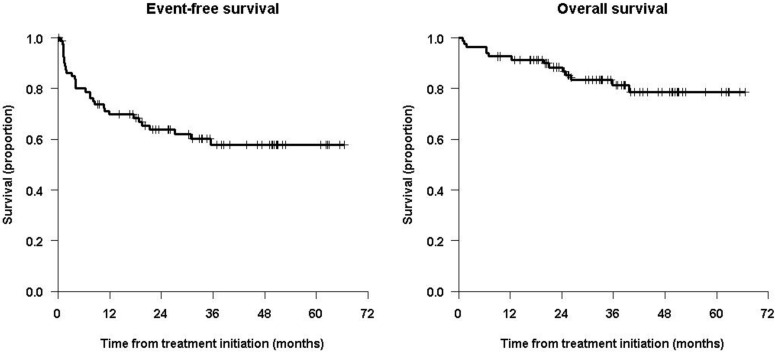
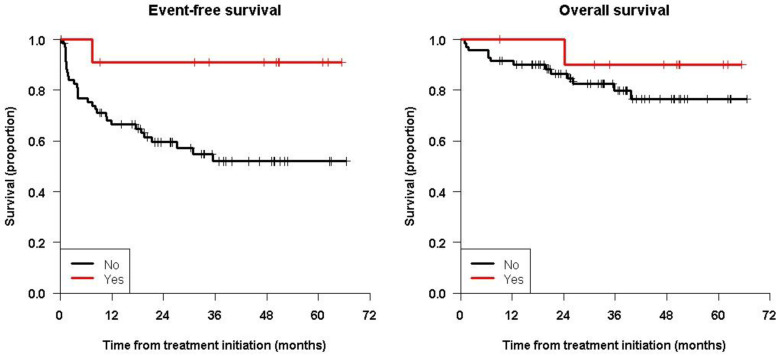
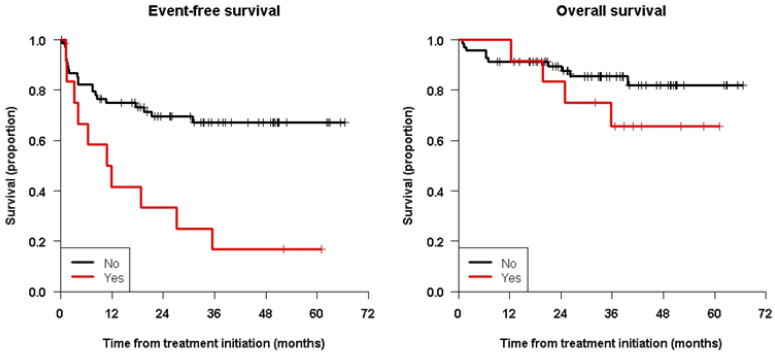
Naxitamab is an anti-GD2 antibody approved for the treatment of relapsed/refractory HR-NB. We report the survival, safety, and relapse pattern of a unique set of HR-NB patients consolidated with naxitamab after having achieved first CR. Eighty-two patients were treated with 5 cycles of GM-CSF for 5 days at 250 μg/m/day (-4 to 0), followed by GM-CSF for 5 days at 500 μg/m/day (1-5) and naxitamab at 3 mg/kg/day (1, 3, 5), on an outpatient basis. All patients but one were older than 18 months at diagnosis and had stage M; 21 (25.6%) pts had MYCN-amplified (A) NB; and 12 (14.6%) detectable MRD in the BM. Eleven (13.4%) pts had received high-dose chemotherapy and ASCT and 26 (31.7%) radiotherapy before immunotherapy. With a median follow-up of 37.4 months, 31 (37.8%) pts have relapsed. The pattern of relapse was predominantly (77.4%) an isolated organ. Five-year EFS and OS were 57.9% (71.4% for MYCN A) 95% CI = (47.2, 70.9%); and 78.6% (81% for MYCN A) 95% CI = (68.7%, 89.8%), respectively. EFS showed significant differences for patients having received ASCT ( = 0.037) and pre-immunotherapy MRD ( = 0.0011). Cox models showed only MRD as a predictor of EFS. In conclusion, consolidation with naxitamab resulted in reassuring survival rates for HR-NB patients after end-induction CR.
纳昔妥单抗是一种获批用于治疗复发/难治性高危神经母细胞瘤(HR-NB)的抗GD2抗体。我们报告了一组独特的HR-NB患者在首次完全缓解(CR)后接受纳昔妥单抗巩固治疗后的生存情况、安全性和复发模式。82例患者在门诊接受治疗,于第-4至0天接受5个周期的粒细胞-巨噬细胞集落刺激因子(GM-CSF)治疗,剂量为250μg/m²/天,共5天;随后于第1至5天接受GM-CSF治疗,剂量为500μg/m²/天,共5天,并于第1、3、5天接受纳昔妥单抗治疗,剂量为3mg/kg/天。除1例患者外,所有患者诊断时年龄均超过18个月,且为M期;21例(25.6%)患者为MYCN扩增(A)型神经母细胞瘤;12例(14.6%)患者骨髓中可检测到微小残留病(MRD)。11例(13.4%)患者在免疫治疗前接受过高剂量化疗和自体造血干细胞移植(ASCT),26例(31.7%)患者接受过放疗。中位随访37.4个月,31例(37.8%)患者复发。复发模式主要为(77.4%)孤立器官复发。5年无事件生存率(EFS)和总生存率(OS)分别为57.9%(MYCN A型为71.4%),95%置信区间=(47.2,70.9%);以及78.6%(MYCN A型为81%),95%置信区间=(68.7%,89.8%)。接受ASCT的患者(P = 0.037)和免疫治疗前存在MRD的患者(P = 0.0011)的EFS存在显著差异。Cox模型显示只有MRD是EFS的预测因素。总之,对于HR-NB患者,诱导缓解结束后使用纳昔妥单抗巩固治疗可带来令人安心的生存率。