Division of Cancer Treatment & Diagnosis, National Cancer Institute, Bethesda, MD 20892, USA.
Cells. 2023 May 5;12(9):1316. doi: 10.3390/cells12091316.
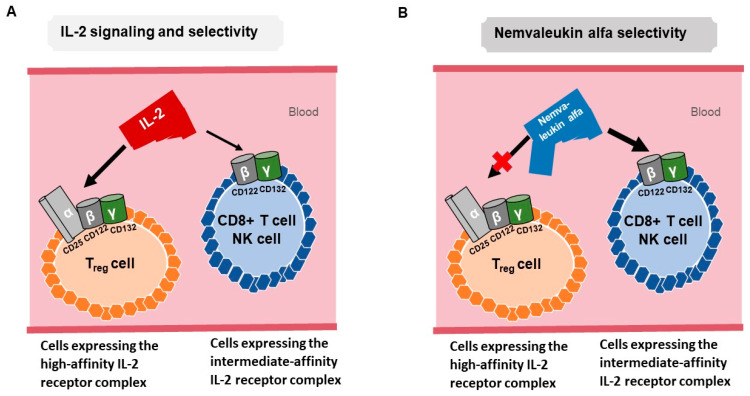
High-dose recombinant human IL-2 (rhIL-2, aldesleukin) emerged as an important treatment option for selected patients with metastatic melanoma and metastatic renal cell carcinoma, producing durable and long-lasting antitumor responses in a small fraction of patients and heralding the potential of cancer immunotherapy. However, the adoption of high-dose rhIL-2 has been restricted by its severe treatment-related adverse event (TRAE) profile, which necessitates highly experienced clinical providers familiar with rhIL-2 administration and readily accessible critical care medicine support. Given the comparatively wide-ranging successes of immune checkpoint inhibitors and chimeric antigen receptor T cell therapies, there have been concerted efforts to significantly improve the efficacy and toxicities of IL-2-based immunotherapeutic approaches. In this review, we highlight novel drug development strategies, including biochemical modifications and engineered IL-2 variants, to expand the narrow therapeutic window of IL-2 by leveraging downstream activation of the IL-2 receptor to selectively expand anti-tumor CD8-positive T cells and natural killer cells. These modified IL-2 cytokines improve single-agent activity in solid tumor malignancies beyond the established United States Food and Drug Administration (FDA) indications of metastatic melanoma and renal cell carcinoma, and may also be safer in rational combinations with established treatment modalities, including anti-PD-(L)1 and anti-CTLA-4 immunotherapy, chemotherapies, and targeted therapy approaches.
高剂量重组人白细胞介素 2(rhIL-2,阿地白介素)作为一种重要的治疗选择,已被应用于转移性黑色素瘤和转移性肾细胞癌的部分患者,为少数患者带来了持久和长期的抗肿瘤反应,并预示着癌症免疫治疗的潜力。然而,高剂量 rhIL-2 的应用受到其严重治疗相关不良事件(TRAE)特征的限制,这需要具有丰富 rhIL-2 给药经验的临床医生,以及随时可获得的重症监护医学支持。鉴于免疫检查点抑制剂和嵌合抗原受体 T 细胞疗法取得了相对广泛的成功,人们一直在努力显著提高基于 IL-2 的免疫治疗方法的疗效和毒性。在这篇综述中,我们强调了新的药物开发策略,包括生化修饰和工程化的 IL-2 变体,通过利用 IL-2 受体的下游激活来扩大 IL-2 的治疗窗,从而选择性地扩增抗肿瘤 CD8 阳性 T 细胞和自然杀伤细胞。这些改良的 IL-2 细胞因子提高了单药活性,超出了转移性黑色素瘤和肾细胞癌的既定美国食品和药物管理局(FDA)适应证范围,并且在与包括抗 PD-(L)1 和抗 CTLA-4 免疫疗法、化疗和靶向治疗方法在内的现有治疗方式进行合理联合时,也可能更安全。