
小麦 ABA 受体 TaPYL5 与其下游伙伴 TaPP2C53/TaSnRK2.1/TaABI1 构成信号模块,调节植物的抗旱反应。
Wheat ABA Receptor TaPYL5 Constitutes a Signaling Module with Its Downstream Partners TaPP2C53/TaSnRK2.1/TaABI1 to Modulate Plant Drought Response.
机构信息
State Key Laboratory of North China Crop Improvement and Regulation, Hebei Agricultural University, Baoding 071001, China.
College of Agronomy, Hebei Agricultural University, Baoding 071001, China.
出版信息
Int J Mol Sci. 2023 Apr 27;24(9):7969. doi: 10.3390/ijms24097969.
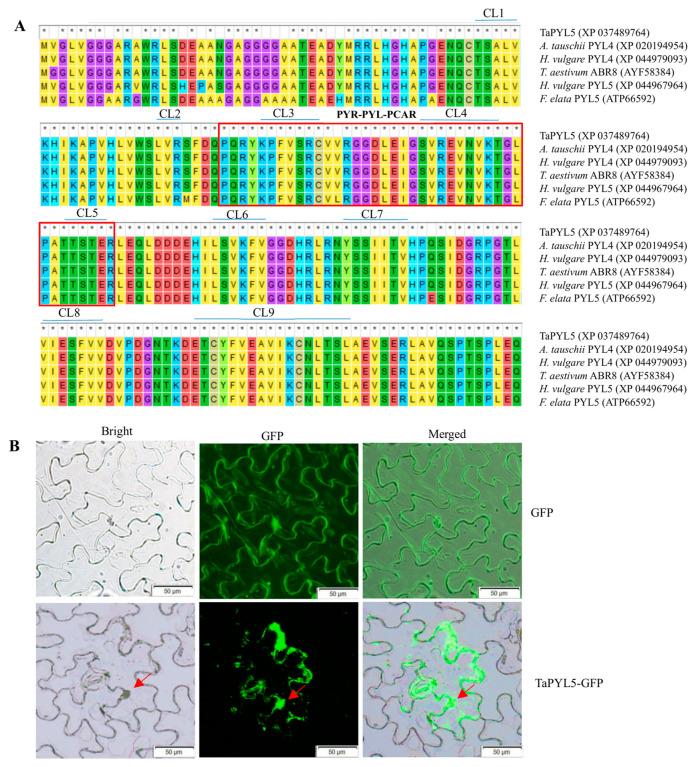
Abscisic acid receptors (ABR) play crucial roles in transducing the ABA signaling initiated by osmotic stresses, which has a significant impact on plant acclimation to drought by modulating stress-related defensive physiological processes. We characterized , a member of the ABR family in wheat (), as a mediator of drought stress adaptation in plants. The signals derived from the fusion of TaPYL5-GFP suggest that the TaPYL5 protein was directed to various subcellular locations, namely stomata, plasma membrane, and nucleus. Drought stress significantly upregulated the transcripts in roots and leaves. The biological roles of ABA and drought responsive -elements, specifically ABRE and recognition sites MYB, in mediating gene transcription under drought conditions were confirmed by histochemical GUS staining analysis for plants harbouring a truncated promoter. Yeast two-hybrid and BiFC assays indicated that TaPYL5 interacted with TaPP2C53, a clade A member of phosphatase (PP2C), and the latter with TaSnRK2.1, a kinase member of the SnRK2 family, implying the formation of an ABA core signaling module TaPYL5/TaPP2C53/TaSnRK2.1. TaABI1, an ABA responsive transcription factor, proved to be a component of the ABA signaling pathway, as evidenced by its interaction with TaSnRK2.1. Transgene analysis of and its module partners, as well as , revealed that they have an effect on plant drought responses. and positively regulated plant drought acclimation, whereas and negatively regulated it. This coincided with the osmotic stress-related physiology shown in their transgenic lines, such as stomata movement, osmolytes biosynthesis, and antioxidant enzyme function. significantly altered the transcription of numerous genes involved in biological processes related to drought defense. Our findings suggest that is one of the most important regulators in plant drought tolerance and a valuable target for engineering drought-tolerant cultivars in wheat.
脱落酸受体 (ABR) 在传递由渗透胁迫引发的 ABA 信号中发挥着关键作用,这对植物通过调节与应激相关的防御生理过程来适应干旱具有重要意义。我们鉴定了小麦中的 ABR 家族成员 ,作为植物适应干旱胁迫的中介。来自 TaPYL5-GFP 融合的信号表明 TaPYL5 蛋白被导向各种亚细胞位置,即气孔、质膜和核。干旱胁迫显著上调了根和叶中的 转录本。通过对含有截短的 启动子的植物进行组织化学 GUS 染色分析,证实了 ABA 和干旱响应元件(特别是 ABRE 和识别位点 MYB)在介导干旱条件下基因转录中的作用。酵母双杂交和 BiFC 分析表明 TaPYL5 与 TaPP2C53 相互作用,TaPP2C53 是磷酸酶 (PP2C) 的 clade A 成员,而后者与 TaSnRK2.1 相互作用,TaSnRK2.1 是 SnRK2 家族的激酶成员,暗示形成了一个 ABA 核心信号模块 TaPYL5/TaPP2C53/TaSnRK2.1。ABA 响应转录因子 TaABI1 被证明是 ABA 信号通路的一个组成部分,这是通过其与 TaSnRK2.1 的相互作用证明的。对 和其模块伙伴的转基因分析,以及 ,表明它们对植物的干旱反应有影响。 和 正向调节植物的干旱适应,而 和 则负向调节。这与它们的转基因系中表现出的与渗透胁迫相关的生理学一致,例如气孔运动、渗透调节剂生物合成和抗氧化酶功能。 显著改变了许多与干旱防御相关的生物学过程的基因的转录。我们的研究结果表明, 是植物耐旱性的最重要调节因子之一,是培育小麦耐旱品种的有价值的目标。



 Zotero 插件