Chiu Yi Han, Tsai Shiow-Chwen, Lin Chen-Si, Wang Li-Yu, Huang Kuo-Chin
Department of Microbiology, Soochow University, Taipei, 111, Taiwan.
Institute of Sports Science, University of Taipei, Taipei, 111, Taiwan.
J Exerc Sci Fit. 2023 Jul;21(3):253-259. doi: 10.1016/j.jesf.2023.04.001. Epub 2023 Apr 19.
BACKGROUND/OBJECTIVES: Regular exercise such as aerobic exercise has been shown to reduce the risk of some diseases such as cardiovascular disease (CVD). However, only few studies have investigated the impact of regular aerobic exercise on non-obese and overweight/obese persons. Therefore, this study was designed to compare the effect of a 12-week 10,000 steps a day walking intervention on the body composition, serum lipids, adipose tissue function, and obesity-associated cardiometabolic risk between normal weight and overweight/obese female college students.
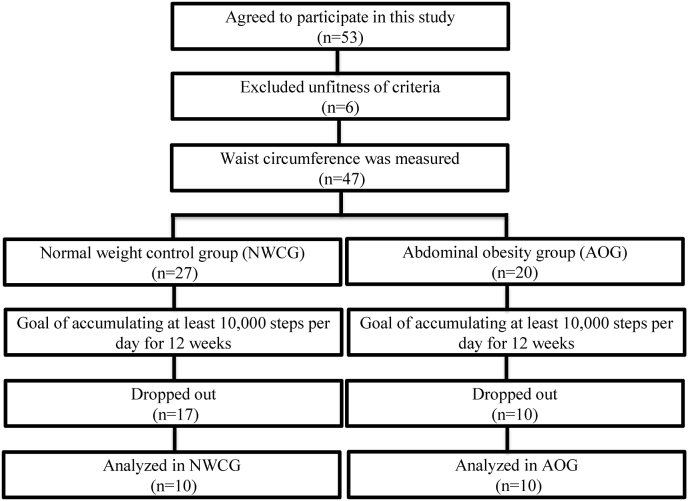
Ten normal weight (NWCG) and 10 overweight/obese (AOG) individuals were recruited in this study. Both groups performed a regular 10,000 steps a day walk for 12 weeks. Their blood pressure, body mass index, waist-to-hip ratio, and blood lipid profiles were evaluated. Moreover, serum leptin and adiponectin levels were measured using an enzyme-linked immunosorbent assay.
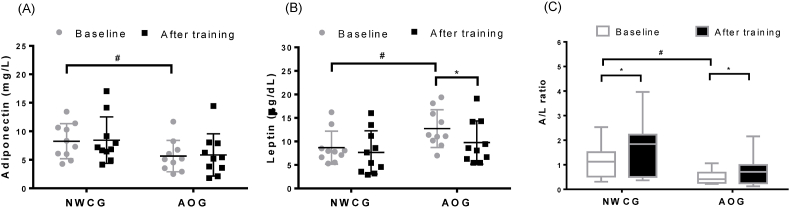
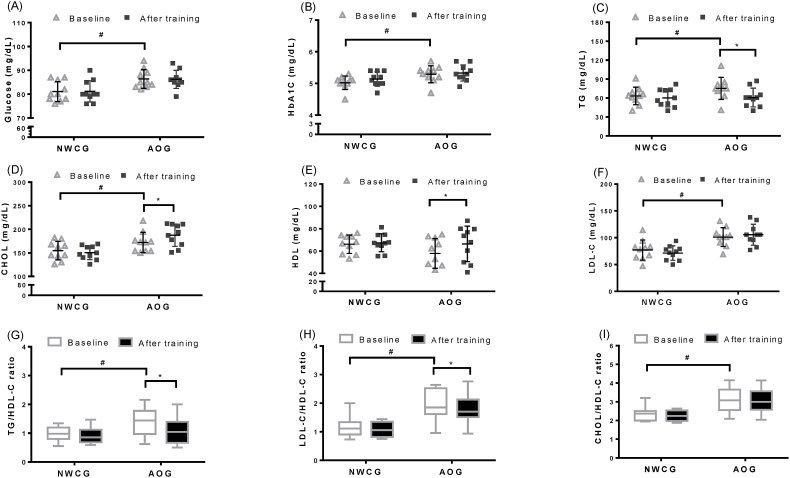
Our results revealed that triglyceride (TG), TG/high-density lipoprotein cholesterol (HDL-C) ratio and leptin were significantly reduced in the AOG group after the 12-week walking intervention. However, total cholesterol, HDL-C, and adiponectin/leptin ratio were significantly increased in the AOG group. There was little or no change in these variables in the NWCG group after the 12-week walking intervention.
Our study demonstrated that a 12-week walking intervention may help improve cardiorespiratory fitness and obesity-associated cardiometabolic risk by decrease resting heart rate, modulating blood lipid profiles, and inducing adipokine alterations in obese individuals. Therefore, our research encourages obese young adults to improve their physical health by participating in a 12-week walking program of 10,000 steps a day.
背景/目的:诸如有氧运动之类的规律运动已被证明可降低某些疾病的风险,如心血管疾病(CVD)。然而,仅有少数研究调查了规律有氧运动对非肥胖和超重/肥胖人群的影响。因此,本研究旨在比较为期12周、每天步行10000步的干预措施对正常体重和超重/肥胖女大学生的身体成分、血脂、脂肪组织功能以及肥胖相关的心脏代谢风险的影响。
本研究招募了10名正常体重(NWCG)和10名超重/肥胖(AOG)个体。两组均进行为期12周、每天规律步行10000步的活动。评估了她们的血压、体重指数、腰臀比和血脂谱。此外,采用酶联免疫吸附测定法测量血清瘦素和脂联素水平。
我们的结果显示,在为期12周的步行干预后,AOG组的甘油三酯(TG)、TG/高密度脂蛋白胆固醇(HDL-C)比值和瘦素显著降低。然而,AOG组的总胆固醇、HDL-C和脂联素/瘦素比值显著升高。在为期12周的步行干预后,NWCG组的这些变量几乎没有变化。
我们的研究表明,为期12周的步行干预可能有助于通过降低静息心率、调节血脂谱以及诱导肥胖个体脂肪因子改变来改善心肺功能和肥胖相关的心脏代谢风险。因此,我们的研究鼓励肥胖的年轻人通过参与为期12周、每天步行10000步的计划来改善他们的身体健康。