
中风后跌倒者:一项回顾性研究,旨在探讨姿势摇摆测量与临床信息相结合在跌倒者识别中的作用。
Fallers after stroke: a retrospective study to investigate the combination of postural sway measures and clinical information in faller's identification.
作者信息
Jonsdottir Johanna, Mestanza Mattos Fabiola Giovanna, Torchio Alessandro, Corrini Chiara, Cattaneo Davide
机构信息
IRCCS Fondazione Don Carlo Gnocchi, Milan, Italy.
Department of Pathophysiology and Transplantation, University of Milan, Milan, Italy.
出版信息
Front Neurol. 2023 Apr 27;14:1157453. doi: 10.3389/fneur.2023.1157453. eCollection 2023.
BACKGROUND
Falls can have devastating effects on quality of life. No clear relationships have been identified between clinical and stabilometric postural measures and falling in persons after stroke.
OBJECTIVE
This cross-sectional study investigates the value of including stabilometric measures of sway with clinical measures of balance in models for identification of faller chronic stroke survivors, and the relations between variables.
METHODS
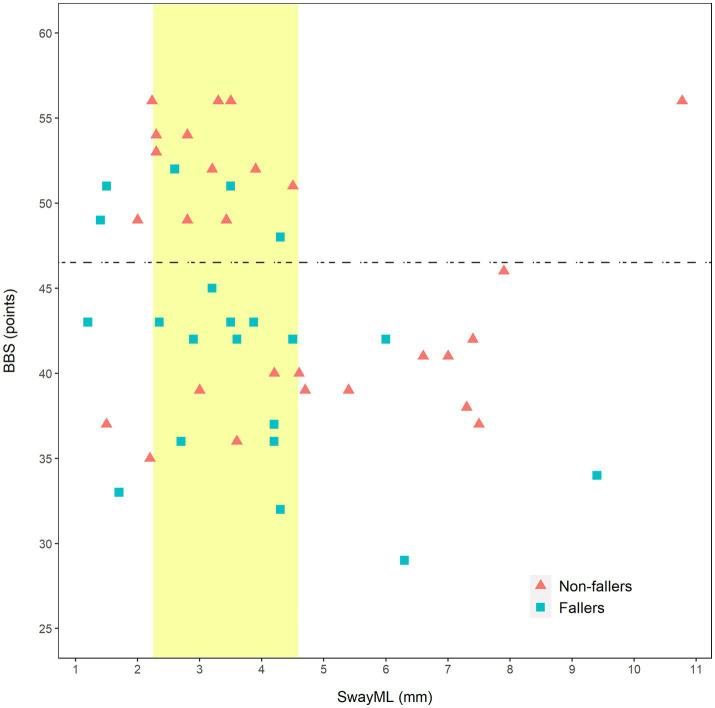
Clinical and stabilometric data were collected from a convenience sample of 49 persons with stroke in hospital care. They were categorized as fallers ( = 21) or non-fallers ( = 28) based on the occurrence of falls in the previous 6 months. Logistic regression (model 1) was performed with clinical measures, including the Berg Balance scale (BBS), Barthel Index (BI), and Dynamic Gait Index (DGI). A second model (model 2) was run with stabilometric measures, including mediolateral (SwayML) and anterior-posterior sway (SwayAP), velocity of antero-posterior (VelAP) and medio-lateral sway (VelML), and absolute position of center of pressure (CopX abs). A third stepwise regression model was run including all variables, resulting in a model with SwayML, BBS, and BI (model 3). Finally, correlations between independent variables were analyzed.
RESULTS
The area under the curve (AUC) for model 1 was 0.68 (95%CI: 0.53-0.83, sensitivity = 95%, specificity = 39%) with prediction accuracy of 63.3%. Model 2 resulted in an AUC of 0.68 (95%CI: 0.53-0.84, sensitivity = 76%, specificity = 57%) with prediction accuracy of 65.3%. The AUC of stepwise model 3 was 0.74 (95%CI: 0.60-0.88, sensitivity = 57%, specificity = 81%) with prediction accuracy of 67.4%. Finally, statistically significant correlations were found between clinical variables ( < 0.05), only velocity parameters were correlated with balance performance ( < 0.05).
CONCLUSION
A model combining BBS, BI, and SwayML was best at identifying faller status in persons in the chronic phase post stroke. When balance performance is poor, a high SwayML may be part of a strategy protecting from falls.
背景
跌倒会对生活质量产生毁灭性影响。目前尚未明确临床和静态姿势测量指标与中风后患者跌倒之间的关系。
目的
本横断面研究探讨在慢性中风幸存者跌倒识别模型中,将姿势摆动的静态测量指标与平衡的临床测量指标相结合的价值,以及各变量之间的关系。
方法
从49名住院治疗的中风患者便利样本中收集临床和静态测量数据。根据前6个月内是否发生跌倒,将他们分为跌倒者(n = 21)或非跌倒者(n = 28)。采用逻辑回归(模型1),纳入临床测量指标,包括伯格平衡量表(BBS)、巴氏指数(BI)和动态步态指数(DGI)。第二个模型(模型2)纳入静态测量指标,包括左右摆动(SwayML)和前后摆动(SwayAP)、前后摆动速度(VelAP)和左右摆动速度(VelML)以及压力中心绝对位置(CopX abs)。第三步进行逐步回归模型,纳入所有变量,得到一个包含SwayML、BBS和BI的模型(模型3)。最后,分析自变量之间的相关性。
结果
模型1的曲线下面积(AUC)为0.68(95%CI:0.53 - 0.83,灵敏度 = 95%,特异度 = 39%),预测准确率为63.3%。模型2的AUC为0.68(95%CI:0.53 - 0.84,灵敏度 = 76%,特异度 = 57%),预测准确率为65.3%。逐步模型3的AUC为0.74(95%CI:0.60 - 0.88,灵敏度 = 57%,特异度 = 81%),预测准确率为67.4%。最后,发现临床变量之间存在统计学显著相关性(P < 0.05),只有速度参数与平衡表现相关(P < 0.05)。
结论
结合BBS、BI和SwayML的模型在识别中风后慢性期患者的跌倒状态方面表现最佳。当平衡表现较差时,较高的SwayML可能是预防跌倒策略的一部分。

 Zotero 插件