Alghadir Ahmad H, Al-Eisa Einas S, Anwer Shahnawaz, Sarkar Bibhuti
Rehabilitation Research Chair, College of Applied Medical Sciences, King Saud University, P.O.Box-10219, Riyadh, 11433, Saudi Arabia.
National Institute for Locomotor Disabilities (Divyangjan), Kolkata, India.
BMC Neurol. 2018 Sep 13;18(1):141. doi: 10.1186/s12883-018-1146-9.
Various outcome measures are used for the assessment of balance and mobility in patients with stroke. The purpose of the present study was to examine test-retest reliability, construct validity, and responsiveness of the Timed Up and Go Test (TUG), Berg Balance Scale (BBS), and Dynamic Gait Index (DGI) for measuring balance in patients with chronic stroke.
Fifty-six patients (39 male and 17 female) with chronic stroke participated in this study. A senior physical therapist assessed the test-retest reliability and validity of three scales, including the DGI, TUG, and BBS over two testing sessions. In addition, the third assessment of each scale was taken at the time of discharge to determine the responsiveness of the three outcome measures.
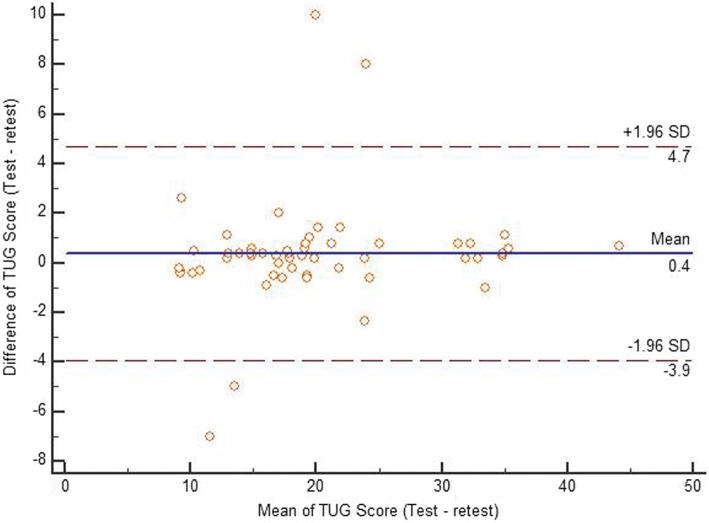
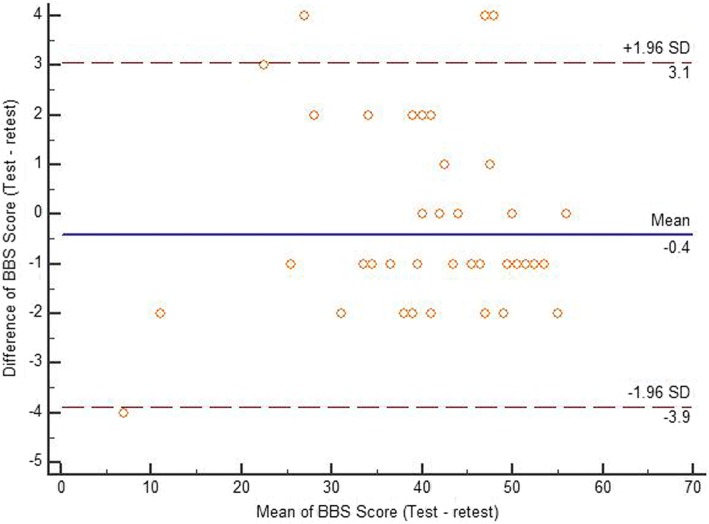
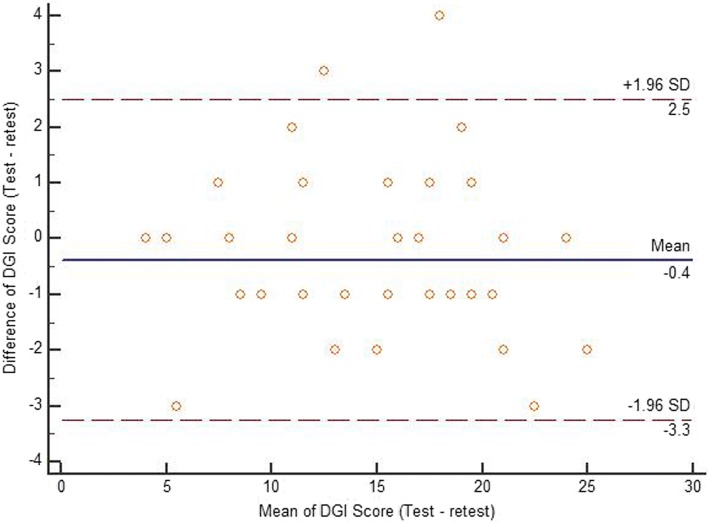
The reliability of the TUG (intraclass correlation coefficient [ICC] = 0.98), DGI (ICC = 0.98) and BBS (ICC = 0.99) were excellent. The standard error of measurement (SEM) of the TUG, DGI, and BBS were 1.16, 0.71, and 0.98, respectively. The minimal detectable change (MDC) of the TUG, DGI, and BBS were 3.2, 1.9, and 2.7, respectively. There was a significant correlation found between the DGI and BBS (first reading [r] = 0.75; second reading [r] = 0.77), TUG and BBS (first reading [r] = -.52; second reading [r] = -.53), and the TUG and DGI (first reading [r] = 0.45; second reading [r] = 0.48), respectively.
The test-retest reliability of the TUG, BBS, and DGI was excellent. The DGI demonstrated slightly better responsiveness than TUG and BBS. However, the small sample size of this study limits the validity of the results.
多种结局指标用于评估中风患者的平衡能力和活动能力。本研究的目的是检验计时起立行走测试(TUG)、伯格平衡量表(BBS)和动态步态指数(DGI)在测量慢性中风患者平衡能力方面的重测信度、结构效度和反应度。
56例慢性中风患者(39例男性,17例女性)参与本研究。一名资深物理治疗师在两个测试阶段评估了三种量表(包括DGI、TUG和BBS)的重测信度和效度。此外,在出院时对每个量表进行第三次评估,以确定这三种结局指标的反应度。
TUG(组内相关系数[ICC]=0.98)、DGI(ICC=0.98)和BBS(ICC=0.99)的信度极佳。TUG、DGI和BBS的测量标准误(SEM)分别为1.16、0.71和0.98。TUG、DGI和BBS的最小可检测变化(MDC)分别为3.2、1.9和2.7。DGI与BBS之间(第一次读数[r]=0.75;第二次读数[r]=0.77)、TUG与BBS之间(第一次读数[r]= -0.52;第二次读数[r]= -0.53)以及TUG与DGI之间(第一次读数[r]=0.45;第二次读数[r]=0.48)均存在显著相关性。
TUG、BBS和DGI的重测信度极佳。DGI的反应度略优于TUG和BBS。然而,本研究的小样本量限制了结果的有效性。