Goitia Jesse J, Onwuzurike James, Chen Aiyu, Wu Yi-Lin, Shen Albert Yuh-Jer, Lee Ming-Sum
Division of Cardiology, University of California, Irvine.
Department of Cardiology, Kaiser Permanente Los Angeles Medical Center, Los Angeles, CA, USA.
Am J Prev Cardiol. 2023 Apr 25;14:100500. doi: 10.1016/j.ajpc.2023.100500. eCollection 2023 Jun.
Access to reliable transportation is fundamental in the management of chronic disease. The purpose of this study was to investigate the association between vehicle ownership at the neighborhood-level and long-term mortality after myocardial infarction (MI).
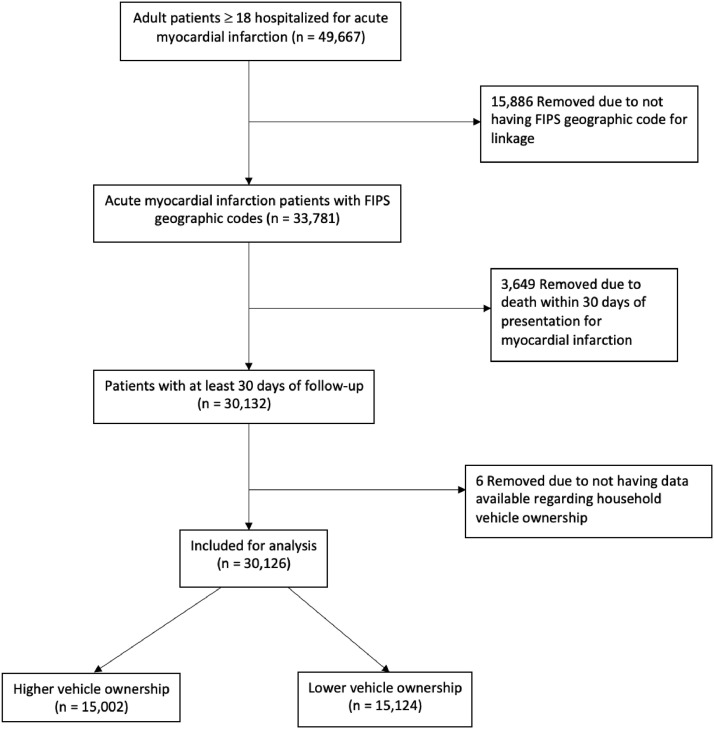
This is a retrospective observational study evaluating adult patients admitted for MI between January 1st, 2006, and December 31st, 2016. Neighborhoods were defined by census tract and household vehicle ownership data was obtained from the American Community Survey courtesy of the University of California, Los Angeles Center for Neighborhood Knowledge. Patients were divided into 2 groups: those living in neighborhoods with higher vehicle ownership, and those living in neighborhoods with lower vehicle ownership. The cutoff of 4.34% of households reporting not owning a vehicle was used to define a neighborhood as one with "higher" vs "lower" vehicle ownership as this was the median value for the cohort. The association between vehicle ownership and all-cause mortality after MI was assessed using Cox proportional hazards regression models.
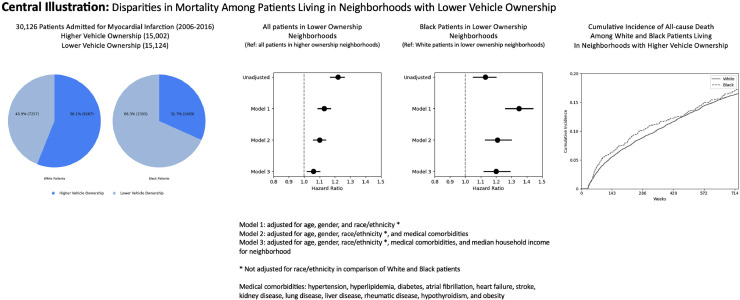
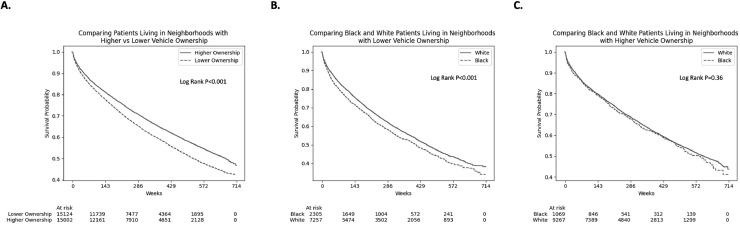
A total of 30,126 patients were included (age 68.1 +/- 13.5 years, 63.2% male). After adjusting for age, sex, race/ethnicity, and medical comorbidities, lower vehicle ownership was associated with increased all-cause mortality after MI (hazard ratio [HR] 1.10; 95% confidence interval [CI] 1.06-1.14; <0.001). This finding remained significant after adjusting for median household income (HR 1.06; 95% CI 1.02-1.10; = 0.007). Upon comparison of White and Black patients living in neighborhoods with lower vehicle ownership; Black patients were found to have an increased all-cause mortality after MI (HR 1.21, 95% CI 1.13-1.30, <0.001), a difference which remained significant after adjusting for income (HR 1.20; 95% CI 1.12-1.29; <0.001). There was no significant difference in mortality between White and Black patients living in neighborhoods with higher vehicle ownership.
Lower vehicle ownership was associated with increased mortality after MI. Black patients living in neighborhoods with lower vehicle ownership had a higher mortality after MI than White patients living in similar neighborhoods but Black patients living in neighborhoods with higher vehicle ownership had no worse mortality than their White counterparts. This study highlights the importance of transportation in determining health status after MI.
获得可靠的交通方式是慢性病管理的基础。本研究的目的是调查社区层面的车辆拥有情况与心肌梗死(MI)后长期死亡率之间的关联。
这是一项回顾性观察研究,评估了2006年1月1日至2016年12月31日期间因MI入院的成年患者。社区由普查区定义,家庭车辆拥有数据由加利福尼亚大学洛杉矶分校邻里知识中心提供的美国社区调查获得。患者分为两组:居住在车辆拥有率较高社区的患者和居住在车辆拥有率较低社区的患者。以报告无车辆的家庭比例4.34%作为 cutoff,将社区定义为“较高”与“较低”车辆拥有率的社区,因为这是该队列的中位数。使用Cox比例风险回归模型评估MI后车辆拥有情况与全因死亡率之间的关联。
共纳入30126例患者(年龄68.1±13.5岁,63.2%为男性)。在调整年龄、性别、种族/民族和合并症后,较低的车辆拥有率与MI后全因死亡率增加相关(风险比[HR]1.10;95%置信区间[CI]1.06 - 1.14;P<0.001)。在调整家庭收入中位数后,这一发现仍然显著(HR 1.06;95% CI 1.02 - 1.10;P = 0.007)。在比较居住在车辆拥有率较低社区的白人和黑人患者时;发现黑人患者MI后的全因死亡率增加(HR 1.21,95% CI 1.13 - 1.30,P<0.001),在调整收入后这一差异仍然显著(HR 1.20;95% CI 1.12 - 1.29;P<0.001)。居住在车辆拥有率较高社区的白人和黑人患者的死亡率没有显著差异。
较低的车辆拥有率与MI后死亡率增加相关。居住在车辆拥有率较低社区的黑人患者MI后的死亡率高于居住在类似社区的白人患者,但居住在车辆拥有率较高社区的黑人患者的死亡率并不比白人患者差。本研究强调了交通在确定MI后健康状况方面的重要性。