Muller Alexander J, Mondal Arpita, Dey Souvik, Prendergast George C
Lankenau Institute for Medical Research, Wynnewood, PA, United States.
Sidney Kimmel Cancer Center, Thomas Jefferson University, Philadelphia, PA, United States.
Front Oncol. 2023 Apr 27;13:1165298. doi: 10.3389/fonc.2023.1165298. eCollection 2023.
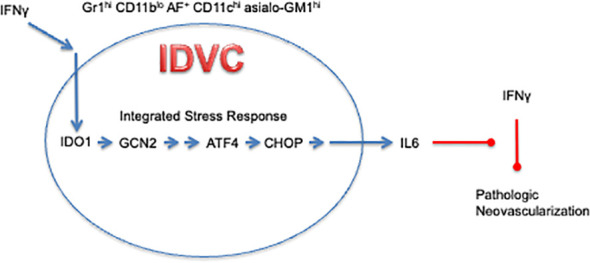
In parallel with the genetic and epigenetic changes that accumulate in tumor cells, chronic tumor-promoting inflammation establishes a local microenvironment that fosters the development of malignancy. While knowledge of the specific factors that distinguish tumor-promoting from non-tumor-promoting inflammation remains inchoate, nevertheless, as highlighted in this series on the 'Hallmarks of Cancer', it is clear that tumor-promoting inflammation is essential to neoplasia and metastatic progression making identification of specific factors critical. Studies of immunometabolism and inflamometabolism have revealed a role for the tryptophan catabolizing enzyme IDO1 as a core element in tumor-promoting inflammation. At one level, IDO1 expression promotes immune tolerance to tumor antigens, thereby helping tumors evade adaptive immune control. Additionally, recent findings indicate that IDO1 also promotes tumor neovascularization by subverting local innate immunity. This newly recognized function for IDO1 is mediated by a unique myeloid cell population termed IDVCs (IDO1-dependent vascularizing cells). Initially identified in metastatic lesions, IDVCs may exert broader effects on pathologic neovascularization in various disease settings. Mechanistically, induction of IDO1 expression in IDVCs by the inflammatory cytokine IFNγ blocks the antagonistic effect of IFNγ on neovascularization by stimulating the expression of IL6, a powerful pro-angiogenic cytokine. By contributing to vascular access, this newly ascribed function for IDO1 aligns with its involvement in other cancer hallmark functionalities, (tumor-promoting inflammation, immune escape, altered cellular metabolism, metastasis), which may stem from an underlying role in normal physiological functions such as wound healing and pregnancy. Understanding the nuances of how IDO1 involvement in these cancer hallmark functionalities varies between different tumor settings will be crucial to the future development of successful IDO1-directed therapies.
与肿瘤细胞中积累的基因和表观遗传变化同时发生的是,慢性肿瘤促进性炎症建立了一个促进恶性肿瘤发展的局部微环境。虽然区分肿瘤促进性炎症和非肿瘤促进性炎症的具体因素的认识仍不完整,但正如本系列关于“癌症特征”所强调的,很明显肿瘤促进性炎症对于肿瘤形成和转移进展至关重要,因此确定具体因素至关重要。免疫代谢和炎症代谢的研究揭示了色氨酸分解代谢酶IDO1在肿瘤促进性炎症中作为核心要素的作用。一方面,IDO1的表达促进对肿瘤抗原的免疫耐受,从而帮助肿瘤逃避适应性免疫控制。此外,最近的研究结果表明,IDO1还通过颠覆局部先天免疫来促进肿瘤新生血管形成。IDO1的这一新发现的功能是由一种独特的髓样细胞群介导的,称为IDVCs(IDO1依赖性血管生成细胞)。IDVCs最初在转移灶中被发现,可能在各种疾病环境中对病理性新生血管形成产生更广泛的影响。从机制上讲,炎症细胞因子IFNγ诱导IDVCs中IDO1的表达,通过刺激强大的促血管生成细胞因子IL6的表达,阻断IFNγ对新生血管形成的拮抗作用。通过促进血管通路,IDO1的这一新赋予的功能与其参与其他癌症特征功能(肿瘤促进性炎症、免疫逃逸、细胞代谢改变、转移)相一致,这些功能可能源于其在伤口愈合和妊娠等正常生理功能中的潜在作用。了解IDO1在不同肿瘤环境中参与这些癌症特征功能的细微差别,对于未来成功开发针对IDO1的疗法至关重要。