Department of Urology, Yokohama City University Graduate School of Medicine, 3-9 Fuku-ura, Kanazawa-ku, Yokohama, Kanagawa, 236-0004, Japan; Laboratory for Cancer Genomics, RIKEN Center for Integrative Medical Sciences, Yokohama, Kanagawa, 230-0045, Japan.
Laboratory for Cancer Genomics, RIKEN Center for Integrative Medical Sciences, Yokohama, Kanagawa, 230-0045, Japan.
EBioMedicine. 2023 Jun;92:104596. doi: 10.1016/j.ebiom.2023.104596. Epub 2023 May 12.
Birt-Hogg-Dubé (BHD) syndrome, caused by germline alteration of folliculin (FLCN) gene, develops hybrid oncocytic/chromophobe tumour (HOCT) and chromophobe renal cell carcinoma (ChRCC), whereas sporadic ChRCC does not harbor FLCN alteration. To date, molecular characteristics of these similar histological types of tumours have been incompletely elucidated.
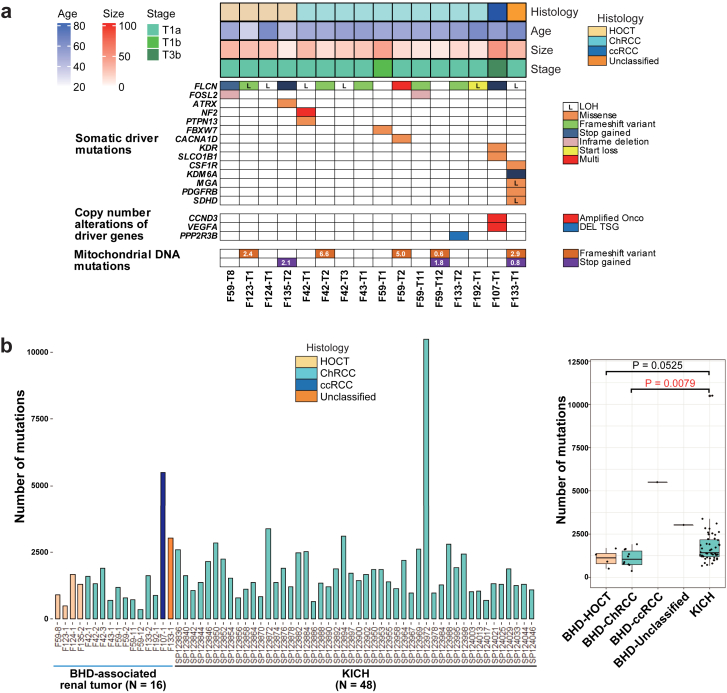
To elucidate renal tumourigenesis of BHD-associated renal tumours and sporadic renal tumours, we conducted whole genome sequencing (WGS) and RNA-sequencing (RNA-seq) of sixteen BHD-associated renal tumours from nine unrelated BHD patients, twenty-one sporadic ChRCCs and seven sporadic oncocytomas. We then compared somatic mutation profiles with FLCN variants and RNA expression profiles between BHD-associated renal tumours and sporadic renal tumours.
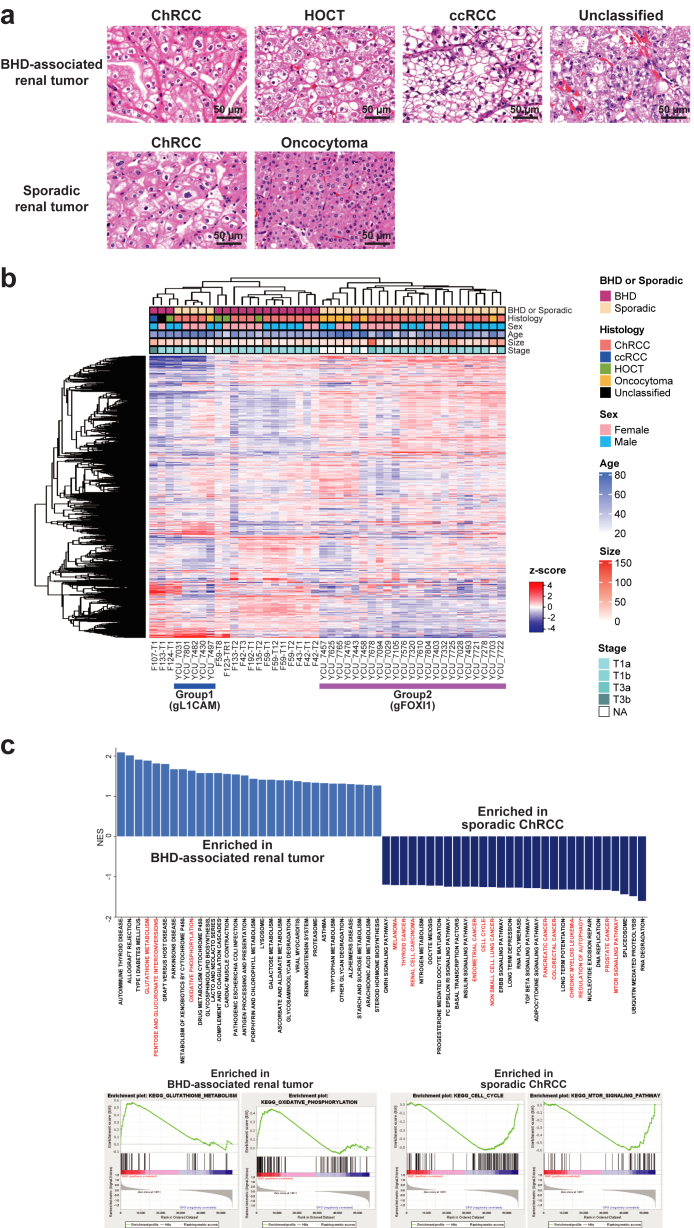
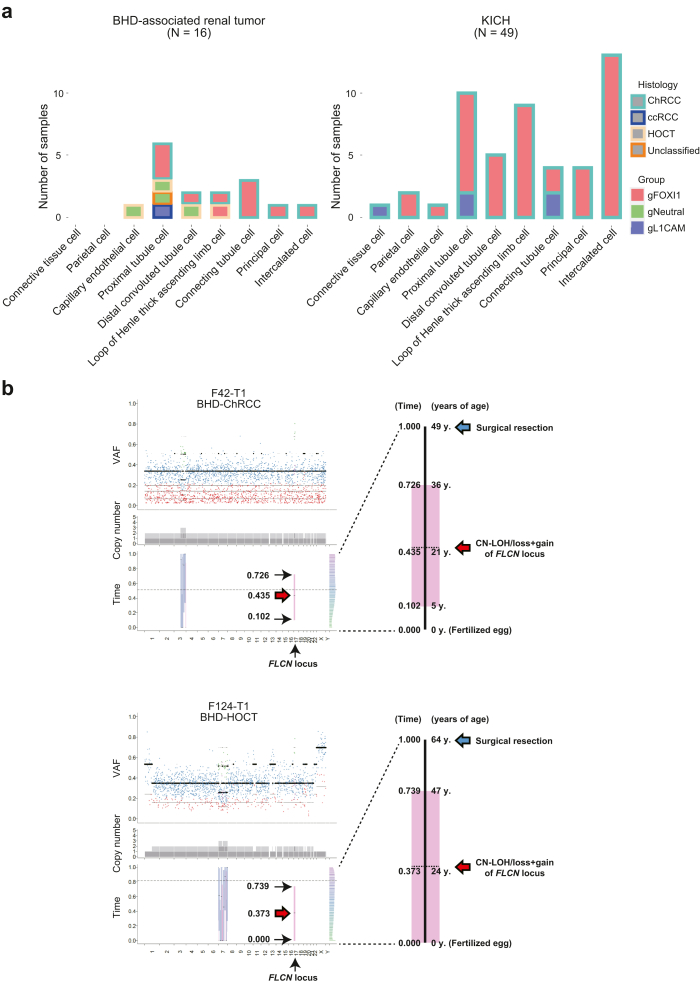
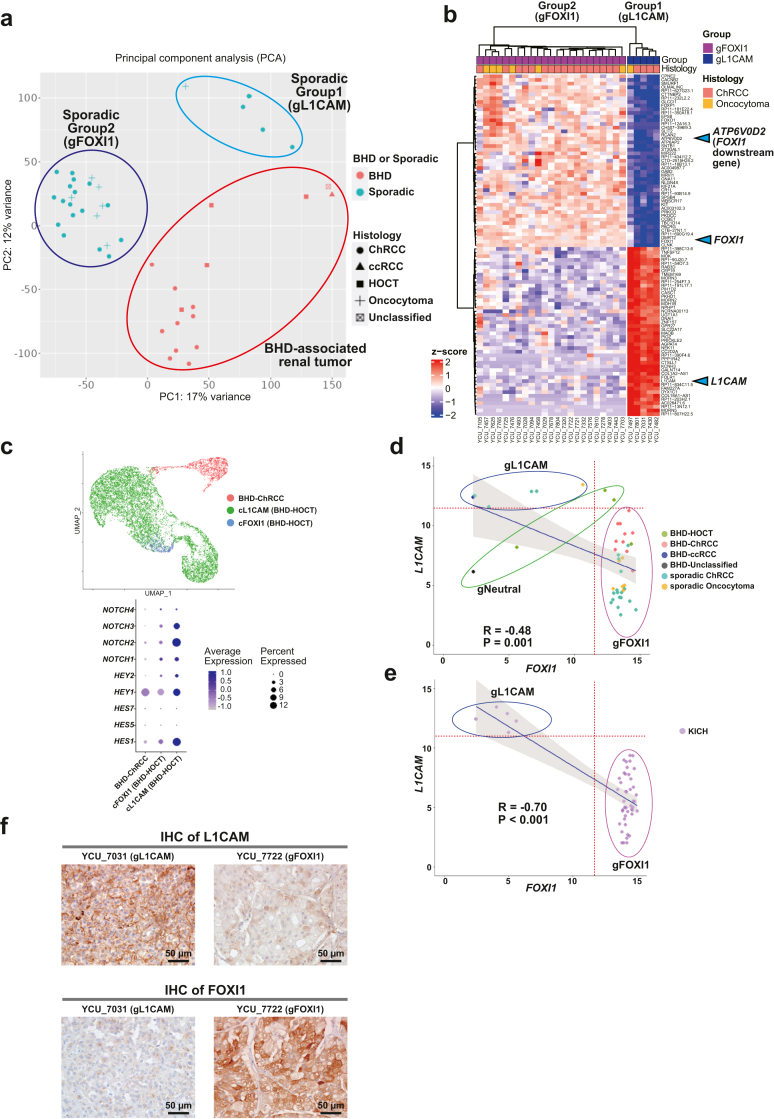
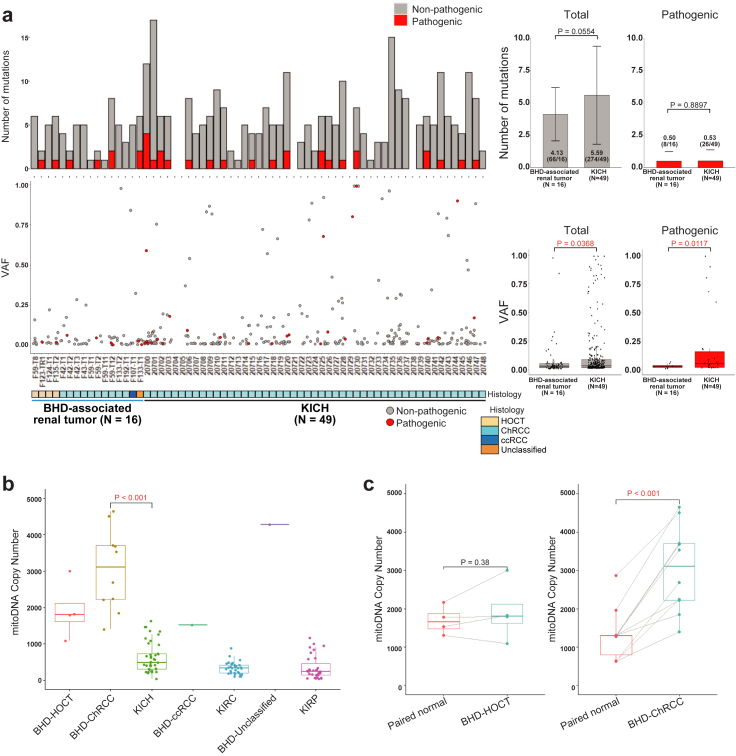
RNA-seq analysis revealed that BHD-associated renal tumours and sporadic renal tumours have totally different expression profiles. Sporadic ChRCCs were clustered into two distinct clusters characterized by L1CAM and FOXI1 expressions, molecular markers for renal tubule subclasses. Increased mitochondrial DNA (mtDNA) copy number with fewer variants was observed in BHD-associated renal tumours compared to sporadic ChRCCs. Cell-of-origin analysis using WGS data demonstrated that BHD-associated renal tumours and sporadic ChRCCs may arise from different cells of origin and second hit FLCN alterations may occur in early third decade of life in BHD patients.
These data further our understanding of renal tumourigenesis of these two different types of renal tumours with similar histology.
This study was supported by JSPS KAKENHI Grants, RIKEN internal grant, and the Intramural Research Program of the National Institutes of Health (NIH), National Cancer Institute (NCI), Center for Cancer Research.
Birt-Hogg-Dubé(BHD)综合征是由滤泡素(FLCN)基因突变引起的,可导致混合性嗜酸细胞/嫌色细胞肿瘤(HOCT)和嫌色细胞肾细胞癌(ChRCC),而散发性 ChRCC 则不携带 FLCN 改变。迄今为止,这些具有相似组织学类型的肿瘤的分子特征尚未完全阐明。
为了阐明 BHD 相关肾肿瘤和散发性肾肿瘤的肾肿瘤发生机制,我们对 9 名 BHD 患者的 16 个 BHD 相关肾肿瘤、21 个散发性 ChRCC 和 7 个散发性嗜酸细胞瘤进行了全基因组测序(WGS)和 RNA 测序(RNA-seq)。然后,我们比较了 BHD 相关肾肿瘤和散发性肾肿瘤之间的体细胞突变谱与 FLCN 变异和 RNA 表达谱。
RNA-seq 分析显示,BHD 相关肾肿瘤和散发性肾肿瘤具有完全不同的表达谱。散发性 ChRCC 可分为两个不同的簇,其特征是 L1CAM 和 FOXI1 的表达,这是肾小管亚类的分子标志物。与散发性 ChRCC 相比,BHD 相关肾肿瘤中观察到线粒体 DNA(mtDNA)拷贝数增加,而变异较少。使用 WGS 数据进行的细胞起源分析表明,BHD 相关肾肿瘤和散发性 ChRCC 可能起源于不同的细胞起源,并且 BHD 患者在 30 岁出头时可能发生第二个 FLCN 改变。
这些数据进一步加深了我们对这两种具有相似组织学的不同类型肾肿瘤的肾肿瘤发生机制的理解。
本研究得到了日本学术振兴会(JSPS KAKENHI)资助、日本理化学研究所内部拨款以及美国国立卫生研究院(NIH)、美国国立癌症研究所(NCI)癌症研究中心的资助。