Department of Infection Control, Fukushima Medical University, Fukushima, Japan.
Infection Control Unit, Fukushima Rosai Hospital, Iwaki, Japan.
J Infect Chemother. 2023 Aug;29(8):820-824. doi: 10.1016/j.jiac.2023.05.003. Epub 2023 May 12.
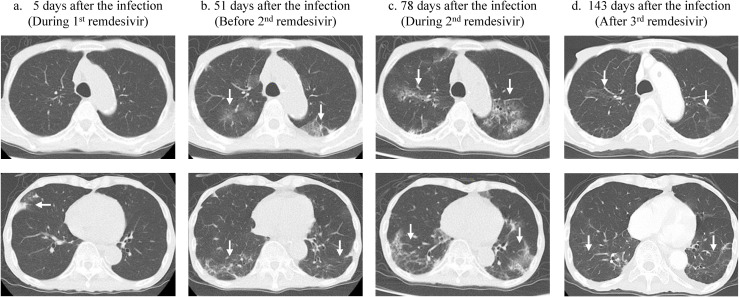
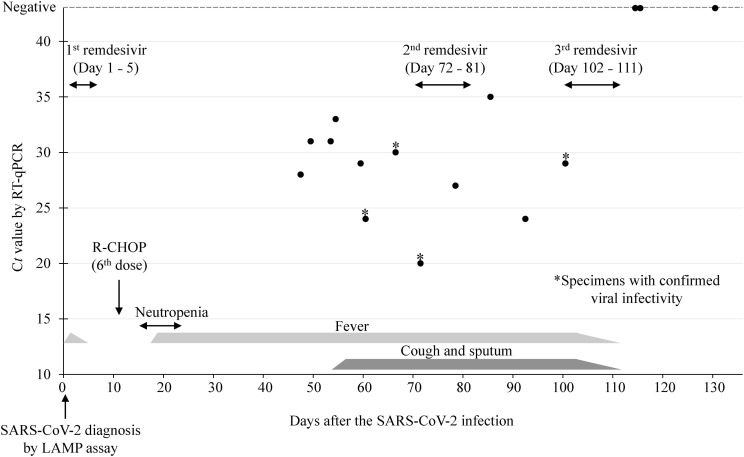
We report a case of prolonged shedding of the infective SARS-CoV-2 omicron variant BA.1.1.2 in a 79-year-old male patient with diffuse large B-cell lymphoma, after receiving chemotherapy with rituximab, cyclophosphamide, doxorubicin, vincristine, and prednisolone (R-CHOP). The patient was admitted to our hospital in late March 2022 for the sixth course of R-CHOP chemotherapy. Initially, the patient tested negative for severe acute respiratory syndrome coronavirus 2 (SARS-CoV-2) using an in-hospital loop-mediated amplification assay with a nasopharyngeal swab, both on the day of admission and three days later. However, the patient developed fever and was diagnosed with coronavirus disease (COVID-19) six days after admission and was suspected to have contracted the infection in the ward. Viral shedding continued for more than three months, with confirmed viral infectivity. As compared to the original Wuhan-Hu-1/2019 strain, amino acid substitutions including S36 N in non-structural protein (NSP)2, S148P, S1265del and L1266I in NSP3, G105D in NSP4, G496S, A831V, or V987F in spike protein, and I45T in open-reading frame (ORF)9b were randomly detected in isolated viruses. Although the patient had received two doses of the BNT162b2 vaccine approximately six months earlier and the third dose on day 127 after the infection, both serum anti-spike and anti-nuclear protein IgG and IgM tests were negative at day 92, 114, and 149 after the infection. The patient finally cleared the virus after the third course of remdesivir and did not have further recurrence.
我们报告了一例 79 岁弥漫性大 B 细胞淋巴瘤患者在接受利妥昔单抗、环磷酰胺、多柔比星、长春新碱和泼尼松(R-CHOP)化疗后,持续排出感染性 SARS-CoV-2 奥密克戎变异株 BA.1.1.2 的病例。该患者于 2022 年 3 月下旬因第六个疗程的 R-CHOP 化疗入院。最初,患者在入院当天和三天后均使用鼻咽拭子进行院内环介导扩增检测,结果均为 SARS-CoV-2 阴性。然而,患者在入院后六天出现发热,被诊断为冠状病毒病(COVID-19),并怀疑在病房感染。病毒脱落持续了三个多月,且病毒具有传染性。与原始的武汉-Hu-1/2019 株相比,在分离出的病毒中随机检测到非结构蛋白(NSP)2 中的 S36N、NSP3 中的 S148P、S1265del 和 L1266I、NSP4 中的 G105D、刺突蛋白中的 G496S、A831V 或 V987F 以及 ORF9b 中的 I45T 氨基酸取代。尽管该患者大约六个月前已接种两剂 BNT162b2 疫苗,并在感染后第 127 天接种了第三剂,但在感染后第 92、114 和 149 天,血清抗刺突蛋白和抗核蛋白 IgG 和 IgM 检测均为阴性。患者在接受第三疗程瑞德西韦治疗后最终清除了病毒,且未再复发。