From the Department of Surgery, West Virginia University School of Medicine, Morgantown, West Virginia.
J Trauma Acute Care Surg. 2023 Aug 1;95(2S Suppl 1):S26-S30. doi: 10.1097/TA.0000000000004010. Epub 2023 May 15.
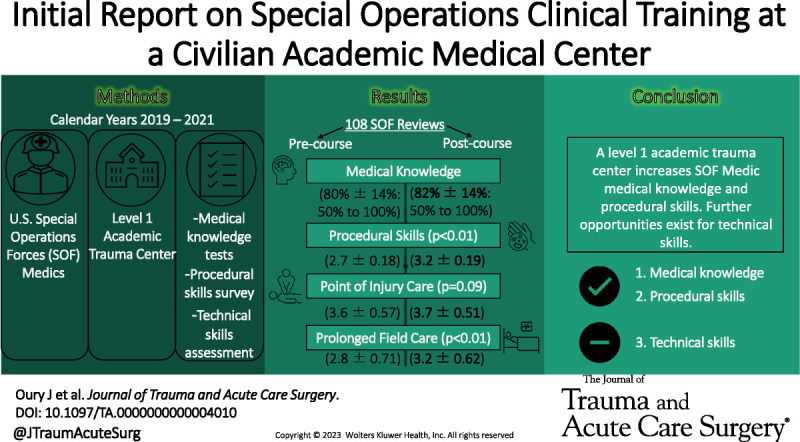
Military-civilian partnerships for combat casualty care skills training have mostly focused on traditional, combat surgical team training. We sought to better understand US Special Forces (SF) Medics' training at West Virginia University in Morgantown, West Virginia, a Level 1 trauma center, via assessments of medical knowledge, clinical skills confidence, and technical performance.
Special Forces Medics were evaluated using posttraining medical knowledge tests, procedural skills confidence surveys (using a 5-point Likert scale), and technical skills assessments using fresh perfused cadavers in a simulated combat casualty care environment. Data from these tests, surveys, and assessments were analyzed for 18 consecutive SF medic rotations from the calendar years 2019 through 2021.
A total of 108 SF Medics' tests, surveys, and assessments were reviewed. These SF Medics had an average of 5.3 years of active military service; however, deployed experience was minimal (73% never deployed). Review of knowledge testing demonstrated a slight increase in mean test score between the precourse (80% ± 14%; range, 50-100%) when compared with the postcourse (82% ± 14%; range, 50-100%). Skills confidence scores increased between courses, specifically within the point of injury care ( p = 0.09) and prolonged field care ( p < 0.001). Technical skills assessments included cricothyroidotomy, chest tube insertion, and tourniquet placement.
This study provides preliminary evidence supporting military-civilian partnerships at an academic Level 1 trauma center to provide specialty training to SF Medics as demonstrated by increase in medical knowledge and confidence in procedural skills. Additional opportunities exist for the development technical skills assessments.
Therapeutic/Care Management; Level IV.
军民合作进行战伤救治技能培训主要集中在传统的、针对战斗外科团队的培训上。我们试图通过评估医疗知识、临床技能信心和技术表现,更好地了解位于西弗吉尼亚州摩根敦的西弗吉尼亚大学(一级创伤中心)的美国特种部队(SF)医务人员的培训情况。
使用培训后的医疗知识测试、程序技能信心调查(使用 5 分李克特量表)以及在模拟战斗伤员救治环境中使用新鲜灌注尸体的技术技能评估来评估特种部队医务人员。对 2019 年至 2021 年连续 18 个 SF 医疗兵轮训的数据进行了这些测试、调查和评估。
共审查了 108 名 SF 医务人员的测试、调查和评估。这些 SF 医务人员的平均现役时间为 5.3 年;然而,他们的部署经验很少(73%的人从未部署过)。知识测试回顾显示,与课程前(80%±14%;范围,50-100%)相比,课程后(82%±14%;范围,50-100%)的平均测试分数略有增加。技能信心评分在课程之间有所提高,特别是在受伤点护理(p=0.09)和延长现场护理(p<0.001)方面。技术技能评估包括环甲膜切开术、胸腔管插入术和止血带放置术。
这项研究提供了初步证据,支持军民合作在学术一级创伤中心为 SF 医务人员提供专业培训,这体现在医疗知识的增加和程序技能信心的提高上。还有机会进一步发展技术技能评估。
治疗/护理管理;四级。