Discipline of General Practice, Adelaide Medical School, The University of Adelaide, Adelaide, South Australia, Australia.
School of Health and Rehabilitation, Chengdu University of Traditional Chinese Medicine, Chengdu, China.
BMJ Open. 2023 Apr 25;13(4):e069875. doi: 10.1136/bmjopen-2022-069875.
This study investigated whether the monitoring and control of clinical parameters are better among patients with newly compared with past recorded diabetes diagnosis.
Retrospective cohort study.
MedicineInsight, a national general practice database in Australia.
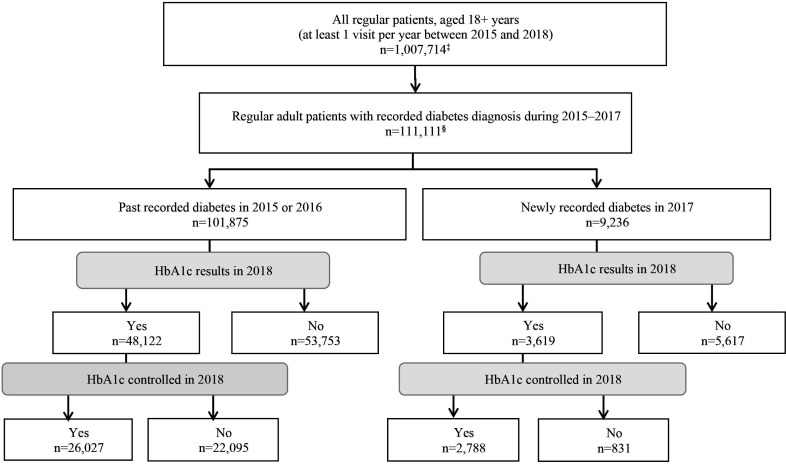
101 875 'regular' adults aged 18+ years with past recorded (2015-2016) and 9236 with newly recorded (2017) diabetes diagnosis.
Two different groups of outcomes were assessed in 2018. The first group of outcomes was the proportion of patients with clinical parameters (ie, glycated haemoglobin A1c (HbA1c), blood pressure (BP), total cholesterol, low-density lipoprotein cholesterol (LDL-C), high-density lipoprotein cholesterol, triglycerides, estimated glomerular filtration rate and albumin-to-creatinine ratio) monitored at least once in 2018. The second group of outcomes were those related to diabetes control in 2018 (HbA1c ≤7.0%, (BP) ≤140/90 mm Hg, total cholesterol <4.0 mmol/L and LDL-C <2.0 mmol/L). Adjusted ORs (OR) and adjusted probabilities (%) were obtained based on logistic regression models adjusted for practice variables and patients' socio-demographic and clinical characteristics.
The study included 111 111 patients (51.7% men; mean age 65.3±15.0 years) with recorded diabetes diagnosis (11.0% of all 1 007 714 adults in the database). HbA1c was monitored in 39.2% (95% CI 36.9% to 41.6%) of patients with newly recorded and 45.2% (95% CI 42.6% to 47.8%) with past recorded diabetes (OR 0.78, 95% CI 0.73 to 0.82). HbA1c control was achieved by 78.4% (95% CI 76.7% to 80.0%) and 54.4% (95% CI 53.4% to 55.4%) of monitored patients with newly or past recorded diabetes, respectively (OR 3.11, 95% CI 2.82 to 3.39). Less than 20% of patients with newly or past recorded diabetes had their HbA1c, BP and total cholesterol levels controlled (OR 1.08, 95% CI 0.97 to 1.21).
The monitoring of clinical parameters was lower among patients with newly than past recorded diabetes. However, diabetes control was similarly low in both groups, with only one in five monitored patients achieving control of all clinical parameters.
本研究旨在调查新发糖尿病患者与既往记录的糖尿病患者相比,其临床参数的监测和控制情况是否更好。
回顾性队列研究。
澳大利亚国家综合实践数据库 MedicineInsight。
101875 名年龄在 18 岁及以上的“常规”成年人,他们的既往记录(2015-2016 年)和 9236 名新发记录(2017 年)患有糖尿病。
2018 年评估了两组不同的结局。第一组结局是至少在 2018 年监测一次临床参数(即糖化血红蛋白 A1c(HbA1c)、血压(BP)、总胆固醇、低密度脂蛋白胆固醇(LDL-C)、高密度脂蛋白胆固醇、甘油三酯、估算肾小球滤过率和白蛋白/肌酐比值)的患者比例。第二组结局是 2018 年与糖尿病控制相关的结局(HbA1c≤7.0%、BP≤140/90mmHg、总胆固醇<4.0mmol/L 和 LDL-C<2.0mmol/L)。基于调整后的逻辑回归模型,根据实践变量和患者的社会人口统计学和临床特征,获得了调整后的比值比(OR)和调整后的概率(%)。
研究纳入了 111111 名患有记录的糖尿病诊断(数据库中所有 1007714 名成年人的 11.0%)的患者(51.7%为男性;平均年龄 65.3±15.0 岁)。HbA1c 监测率在新发记录的患者中为 39.2%(95%CI 36.9%至 41.6%),在既往记录的患者中为 45.2%(95%CI 42.6%至 47.8%)(OR 0.78,95%CI 0.73 至 0.82)。HbA1c 控制率分别为 78.4%(95%CI 76.7%至 80.0%)和 54.4%(95%CI 53.4%至 55.4%),接受监测的新发和既往记录糖尿病患者分别为(OR 3.11,95%CI 2.82 至 3.39)。只有不到 20%的新发或既往记录的糖尿病患者的 HbA1c、BP 和总胆固醇水平得到控制(OR 1.08,95%CI 0.97 至 1.21)。
与既往记录的糖尿病患者相比,新发糖尿病患者的临床参数监测率较低。然而,两组的糖尿病控制情况同样较低,只有五分之一接受监测的患者能够控制所有临床参数。