Pandey Manoj Kumar
Cincinnati Children's Hospital Medical Center, Division of Human Genetics, Cincinnati, OH 45229-3026, USA.
Department of Pediatrics, University of Cincinnati College of Medicine, Cincinnati, OH 45267-0515, USA.
Biomedicines. 2023 Apr 1;11(4):1067. doi: 10.3390/biomedicines11041067.
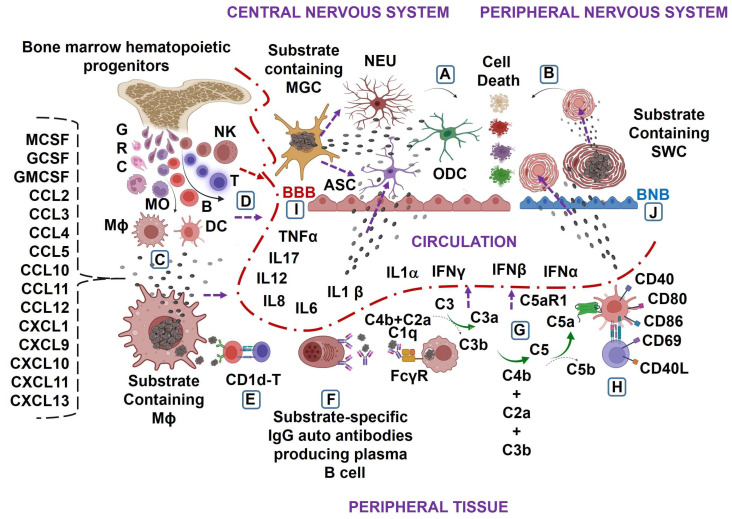
Lysosomal storage diseases are a group of rare and ultra-rare genetic disorders caused by defects in specific genes that result in the accumulation of toxic substances in the lysosome. This excess accumulation of such cellular materials stimulates the activation of immune and neurological cells, leading to neuroinflammation and neurodegeneration in the central and peripheral nervous systems. Examples of lysosomal storage diseases include Gaucher, Fabry, Tay-Sachs, Sandhoff, and Wolman diseases. These diseases are characterized by the accumulation of various substrates, such as glucosylceramide, globotriaosylceramide, ganglioside GM2, sphingomyelin, ceramide, and triglycerides, in the affected cells. The resulting pro-inflammatory environment leads to the generation of pro-inflammatory cytokines, chemokines, growth factors, and several components of complement cascades, which contribute to the progressive neurodegeneration seen in these diseases. In this study, we provide an overview of the genetic defects associated with lysosomal storage diseases and their impact on the induction of neuro-immune inflammation. By understanding the underlying mechanisms behind these diseases, we aim to provide new insights into potential biomarkers and therapeutic targets for monitoring and managing the severity of these diseases. In conclusion, lysosomal storage diseases present a complex challenge for patients and clinicians, but this study offers a comprehensive overview of the impact of these diseases on the central and peripheral nervous systems and provides a foundation for further research into potential treatments.
溶酶体贮积病是一组罕见和极其罕见的遗传性疾病,由特定基因缺陷引起,导致有毒物质在溶酶体中蓄积。这种细胞物质的过度蓄积刺激免疫细胞和神经细胞的激活,导致中枢和外周神经系统的神经炎症和神经退行性变。溶酶体贮积病的例子包括戈谢病、法布里病、泰-萨克斯病、桑德霍夫病和沃尔曼病。这些疾病的特征是在受影响的细胞中蓄积各种底物,如葡糖脑苷脂、球三糖神经酰胺、神经节苷脂GM2、鞘磷脂、神经酰胺和甘油三酯。由此产生的促炎环境导致促炎细胞因子、趋化因子、生长因子和补体级联反应的几个成分的产生,这些成分促成了这些疾病中所见的进行性神经退行性变。在本研究中,我们概述了与溶酶体贮积病相关的基因缺陷及其对神经免疫炎症诱导的影响。通过了解这些疾病背后的潜在机制,我们旨在为监测和管理这些疾病的严重程度提供潜在生物标志物和治疗靶点的新见解。总之,溶酶体贮积病给患者和临床医生带来了复杂的挑战,但本研究全面概述了这些疾病对中枢和外周神经系统的影响,并为进一步研究潜在治疗方法奠定了基础。