
出血性脑损伤后时空细胞骨架蛋白信号转导、小胶质细胞激活、神经炎症和认知障碍。
Spatiotemporal Cofilin Signaling, Microglial Activation, Neuroinflammation, and Cognitive Impairment Following Hemorrhagic Brain Injury.
机构信息
Department of Pharmacology and Experimental Therapeutics, College of Pharmacy and Pharmaceutical Sciences, University of Toledo, Toledo, OH 43614, USA.
Department of Pathology, College of Medicine, The University of Toledo, Toledo, OH 43614, USA.
出版信息
Cells. 2023 Apr 13;12(8):1153. doi: 10.3390/cells12081153.
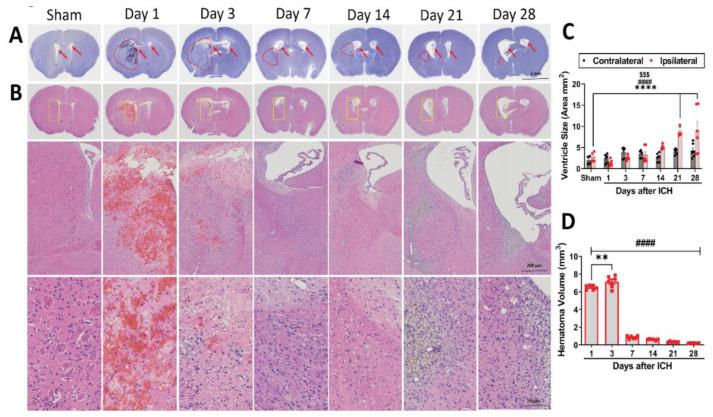
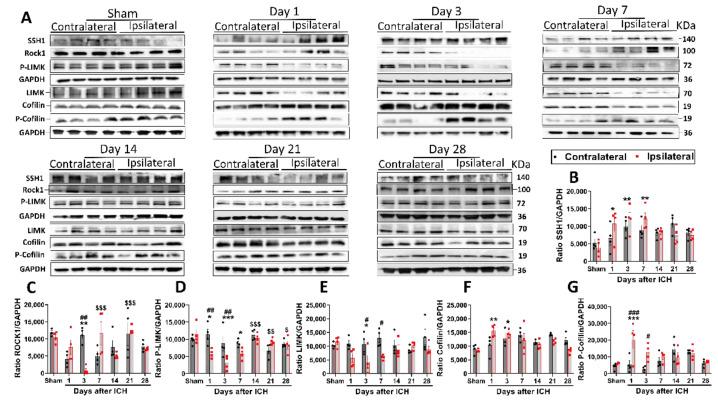
Intracerebral hemorrhage (ICH) is a significant health concern associated with high mortality. Cofilin plays a crucial role in stress conditions, but its signaling following ICH in a longitudinal study is yet to be ascertained. In the present study, we examined the cofilin expression in human ICH autopsy brains. Then, the spatiotemporal cofilin signaling, microglia activation, and neurobehavioral outcomes were investigated in a mouse model of ICH. Human autopsy brain sections from ICH patients showed increased intracellular cofilin localization within microglia in the perihematomal area, possibly associated with microglial activation and morphological changes. Various cohorts of mice were subjected to intrastriatal collagenase injection and sacrificed at time points of 1, 3, 7, 14, 21, and 28 days. Mice suffered from severe neurobehavioral deficits after ICH, lasting for 7 days, followed by a gradual improvement. Mice suffered post-stroke cognitive impairment (PSCI) both acutely and in the chronic phase. Hematoma volume increased from day 1 to 3, whereas ventricle size increased from day 21 to 28. Cofilin protein expression increased in the ipsilateral striatum on days 1 and 3 and then decreased from days 7 to 28. An increase in activated microglia was observed around the hematoma on days 1 to 7, followed by a gradual reduction up to day 28. Around the hematoma, activated microglia showed morphological changes from ramified to amoeboid. mRNA levels of inflammatory [tumor necrosis factor-α (TNF-α), interleukin 1β (IL-1β), and interleukin-6 (IL-6) and anti-inflammatory markers [interleukin-10 (IL-10), transforming growth factor-β TGF-β, and arginase I (Arg1)] increased during the acute phase and decreased in the chronic phase. Blood cofilin levels increased on day 3 and matched the increase in chemokine levels. slingshot protein phosphatase 1 (SSH1) protein, which activates cofilin, was increased from day 1 to 7. These results suggest that microglial activation might be the sequel of cofilin overactivation following ICH, leading to widespread neuroinflammation and consequent PSCI.
脑出血(ICH)是一种与高死亡率相关的重大健康问题。丝切蛋白在应激条件下发挥着关键作用,但在纵向研究中,其在 ICH 后的信号传递尚未确定。在本研究中,我们检测了人类 ICH 尸检大脑中的丝切蛋白表达。然后,我们在 ICH 小鼠模型中研究了丝切蛋白信号转导、小胶质细胞激活和神经行为学结果。ICH 患者尸检脑切片显示,在血肿周围区域,小胶质细胞内的细胞内丝切蛋白定位增加,可能与小胶质细胞激活和形态变化有关。将不同队列的小鼠进行纹状体胶原酶注射,然后在 1、3、7、14、21 和 28 天处死。ICH 后,小鼠出现严重的神经行为缺陷,持续 7 天,然后逐渐改善。小鼠发生急性和慢性中风后认知障碍(PSCI)。血肿体积从第 1 天增加到第 3 天,而脑室大小从第 21 天增加到第 28 天。丝切蛋白蛋白表达在第 1 天和第 3 天在对侧纹状体增加,然后从第 7 天到第 28 天减少。在第 1 天到第 7 天,在血肿周围观察到活化的小胶质细胞增加,然后逐渐减少到第 28 天。在血肿周围,活化的小胶质细胞从有分支的形态转变为阿米巴样形态。在急性期,促炎[肿瘤坏死因子-α(TNF-α)、白细胞介素 1β(IL-1β)和白细胞介素 6(IL-6)]和抗炎标志物[白细胞介素 10(IL-10)、转化生长因子-β(TGF-β)和精氨酸酶 1(Arg1)]的 mRNA 水平增加,在慢性期下降。血液丝切蛋白水平在第 3 天增加,与趋化因子水平增加相匹配。激活丝切蛋白的弹弓蛋白磷酸酶 1(SSH1)蛋白从第 1 天到第 7 天增加。这些结果表明,ICH 后丝切蛋白过度激活可能导致小胶质细胞激活,从而导致广泛的神经炎症和随后的 PSCI。




 Zotero 插件